
Keeping pool water clean is a science. For many pool owners, the chemistry side feels confusing, especially when balancing chlorine and stabilizer levels. One common question is whether calcium hypochlorite (also called cal hypo) increases cyanuric acid (CYA) in your pool. Some believe every chlorine product impacts CYA, while others are not sure. This article will explore what calcium hypochlorite is, how it works, and whether it raises CYA. We’ll look at the science, practical pool care, and what matters for real-world pool maintenance.
What Is Calcium Hypochlorite?
Calcium hypochlorite is a chlorine-based chemical often used for disinfecting swimming pools. It comes as a white, powdery substance or in solid tablets. People use cal hypo to kill bacteria, destroy algae, and keep pool water safe.
Most cal hypo products contain 65% to 75% available chlorine. The rest is made up of calcium and other ingredients. Unlike some other chlorine types, cal hypo does not come pre-mixed with CYA or stabilizer. This makes it different from popular products like trichlor or dichlor.
How Calcium Hypochlorite Works
When you add cal hypo to water, it dissolves and releases free chlorine. This chlorine attacks germs and contaminants. After it works, the chlorine turns into other harmless compounds and eventually breaks down.
A key point is that cal hypo adds calcium to your pool but not stabilizer. This is important for understanding whether it affects CYA levels.
Common Uses For Cal Hypo
- Shock treatments: Cal hypo is often used to “shock” a pool, meaning to raise the chlorine level high for a short time to kill algae or bacteria.
- Daily chlorination: Some use cal hypo for regular chlorination, especially in outdoor pools.
- Algae control: Because of its strength, cal hypo is effective against algae blooms.
What Is Cyanuric Acid (cya) And Why Does It Matter?
Cyanuric acid (also called CYA or pool stabilizer) is a chemical that helps protect chlorine from being destroyed by sunlight. In outdoor pools, sunlight can break down chlorine quickly. CYA acts like a sunscreen for chlorine, allowing it to last longer.
How Cya Works
CYA forms a weak bond with free chlorine. This slows down how fast sunlight removes chlorine from pool water. But this bond is not too strong, so chlorine can still disinfect the water.
Why Pool Owners Need To Watch Cya
While CYA protects chlorine, too much can cause problems. High CYA levels make chlorine less effective at killing germs and algae. This means you need more free chlorine to keep the pool safe as CYA increases.
Recommended CYA levels are:
- 30–50 ppm (parts per million) for most outdoor pools
- Below 20 ppm for indoor pools (since there’s no sun)
If CYA is too high, you may have to drain some water and refill to lower it. If it’s too low, chlorine disappears too quickly. Balancing CYA is a key part of pool care.
Does Calcium Hypochlorite Raise Cya?
This is the core question for many pool owners. The short answer is no—calcium hypochlorite does not raise cyanuric acid levels in your pool. Let’s look at why.
The Chemistry Explained
Calcium hypochlorite is a compound of calcium, chlorine, and oxygen. When you add it to water, it creates:
- Free chlorine (for disinfection)
- Calcium ions (raise water hardness)
- Other byproducts (like hypochlorous acid)
But it does not contain or produce cyanuric acid. There is no chemical reaction where cal hypo turns into CYA.
Comparing Chlorine Types And Cya Impact
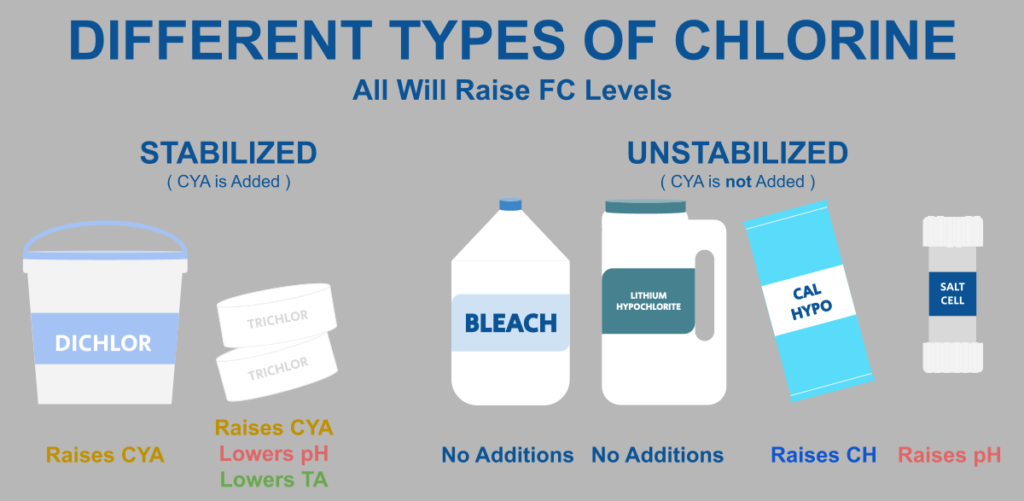
Many people confuse cal hypo with other types of chlorine that do add CYA. The most common are trichlor and dichlor. These are “stabilized” chlorines, meaning they are pre-mixed with CYA.
Here’s a simple table to compare chlorine types and their effects on CYA:
| Chlorine Type | Adds CYA? | Other Effects |
|---|---|---|
| Calcium Hypochlorite | No | Adds calcium |
| Trichlor (Trichloroisocyanuric acid) | Yes | Lowers pH, adds CYA |
| Dichlor (Sodium dichloroisocyanurate) | Yes | Neutral pH, adds CYA |
| Liquid Chlorine (Sodium hypochlorite) | No | No CYA, no calcium |
Why The Confusion Happens
Some pool products are labeled “shock” or “chlorinating granules” but don’t say which chemical they use. People may use trichlor or dichlor thinking it’s the same as cal hypo. Always check the label: only cal hypo and liquid bleach do not contain CYA.
Key Takeaway
If you use calcium hypochlorite as your main chlorine, your CYA levels will not rise due to the chlorine itself. Any increase in CYA comes from adding separate stabilizer or using stabilized chlorine.
Effects Of Using Cal Hypo Regularly
Many pool owners choose cal hypo for its strong disinfecting power. But using it often can affect other aspects of your pool water.
How Cal Hypo Affects Pool Water
- Raises calcium hardness: Regular use will increase the calcium level in your pool. High calcium can cause scaling (white deposits) on tiles and equipment.
- No impact on CYA: As explained, cal hypo does not change CYA.
- PH effects: Cal hypo is slightly basic, so it can raise pool pH over time.
Table: Cal Hypo’s Effects On Key Pool Parameters
| Parameter | Effect of Cal Hypo | Ideal Range |
|---|---|---|
| Cyanuric Acid (CYA) | No effect | 30–50 ppm |
| Calcium Hardness | Increases | 200–400 ppm |
| pH | Slight increase | 7.2–7.8 |
| Total Alkalinity | Minimal effect | 80–120 ppm |
Practical Example
Suppose you have a 20,000-gallon pool and use cal hypo to shock it weekly. Over a summer, calcium levels could rise by 50–100 ppm, but your CYA will stay the same unless you add stabilizer or use stabilized chlorine at the same time.
Common Pool Owner Mistakes With Cal Hypo And Cya
Even with clear information, mistakes happen. Here are errors beginners often make:
- Mixing up chlorine types: Using trichlor or dichlor instead of cal hypo, then wondering why CYA rises.
- Ignoring product labels: Not checking if a product adds CYA or calcium.
- Assuming all chlorine is the same: Different types have very different side effects.
- Adding more CYA “just in case”: This can lead to high CYA and chlorine problems.
- Not testing water often enough: You can’t see CYA or calcium levels without a test kit.
How To Manage Cya Levels When Using Cal Hypo
If you use cal hypo as your main chlorine, you’ll need to add CYA separately. Here’s how to do it safely:
- Test CYA levels regularly (every 2-4 weeks in summer).
- Add CYA only as needed to reach 30–50 ppm. Use a pool stabilizer product.
- Avoid over-stabilizing: High CYA makes chlorine less effective.
- If CYA is too high: The only fix is to drain part of the water and refill.
- If you switch from stabilized chlorine to cal hypo: Monitor CYA, as it may slowly drop (CYA is removed only by splash-out, backwashing, or dilution).
Pro Tip
When first filling a pool, add stabilizer to bring CYA to around 30 ppm. After that, use cal hypo for chlorine. This keeps chlorine protected from sun without risking too much CYA buildup.

Credit: www.reddit.com
Real-world Advice: When To Use Cal Hypo Vs. Stabilized Chlorine
Choosing the right chlorine type depends on your situation. Here’s some advice based on real pool owner experiences:
- Outdoor pools with high sun: Use cal hypo for regular chlorination, but add CYA as a separate product. This gives you control.
- Pools with already high CYA: Avoid trichlor and dichlor. Only use cal hypo or liquid chlorine.
- Pools with hard water: If your fill water is high in calcium, using cal hypo can push calcium hardness too high. Use liquid chlorine instead.
- Indoor pools: No need for CYA, so use cal hypo or liquid chlorine.
Table: Choosing The Right Chlorine For Your Pool
| Pool Situation | Best Chlorine Choice | Why |
|---|---|---|
| Outdoor, low CYA | Cal Hypo + add CYA as needed | Control over both chlorine and stabilizer |
| Outdoor, high CYA | Cal Hypo or Liquid Chlorine | Prevents further CYA rise |
| Indoor pool | Cal Hypo or Liquid Chlorine | No stabilizer required |
| Hard fill water | Liquid Chlorine | Keeps calcium hardness in check |
Non-obvious Insights Most Beginners Miss
Some facts about cal hypo and CYA are not obvious, but make a big difference in pool care:
- High calcium hardness can be a hidden problem. If you use cal hypo for years, calcium can build up to the point where you start seeing cloudy water or white scale. It’s important to test calcium hardness every month.
- Draining water is the only way to lower CYA. Many think adding chemicals can “fix” high CYA, but only removing water helps. This is why using cal hypo (which does not add CYA) is safer for long-term pool care.
- CYA degrades slowly over time. Sunlight and water loss (splashing, backwashing) can lower CYA, but it’s a slow process. Plan for this if you want to manage your stabilizer carefully.
Step-by-step: Testing And Adjusting Cya When Using Cal Hypo
To keep your pool safe and comfortable, follow these steps:
- Buy a good test kit that checks CYA, free chlorine, pH, alkalinity, and calcium hardness.
- Test CYA at the start of swim season. Record your results.
- If CYA is below 30 ppm, add stabilizer according to label instructions. Dissolve granules in a bucket before adding, or pour slowly into the skimmer.
- Use cal hypo for daily chlorination or shocking. This won’t change your CYA.
- Check CYA monthly during summer. Add more stabilizer only if it drops below 30 ppm.
- If CYA goes over 50–60 ppm, plan to drain and refill some water.
- Always test calcium hardness every 1–2 months if you’re using cal hypo. If it goes above 400 ppm, consider switching to liquid chlorine for a while.
Safety And Handling Tips For Cal Hypo
Calcium hypochlorite is a strong oxidizer. It can be dangerous if not handled carefully. Here are key safety tips:
- Store in a cool, dry place away from other chemicals, especially acids.
- Never mix cal hypo with trichlor or dichlor—a dangerous chemical reaction can occur.
- Always add cal hypo to water, not water to cal hypo. This prevents splashing and chemical burns.
- Wear gloves and eye protection when handling.
- Clean up spills immediately. Cal hypo can cause fires if it contacts organic material.

Credit: www.testyourownpool.com
What Pool Professionals Say
Most pool experts recommend using cal hypo or liquid chlorine for long-term pool care. This gives you more control over CYA and calcium levels. They suggest testing water at least once a week, and adjusting only when needed. Relying on stabilized chlorine can make CYA levels rise slowly, leading to “chlorine lock,” where chlorine becomes less effective.
A real-world tip: Don’t chase numbers every day. Pool chemistry is about balance, not perfection. Small changes are normal. Focus on keeping chlorine, pH, and CYA in the right range for safe, clear water.
When Should You Add Or Remove Cya?
Knowing when to increase or decrease CYA is important for pool health.
- Add CYA: When your pool is new, after draining and refilling, or if CYA has dropped below 30 ppm.
- Remove CYA: If CYA is over 60–70 ppm, drain part of the pool and refill with fresh water. There is no chemical that removes CYA.
Remember, cal hypo will never add CYA on its own. Only add stabilizer as needed for your situation.
Credit: www.testyourownpool.com
Environmental And Health Considerations
Calcium hypochlorite is safe for pool use when handled correctly, but there are some environmental impacts to know:
- High calcium runoff: If you drain pool water with high calcium, it can affect soil and plants.
- Chlorine smell: Over-shocking with cal hypo can produce a strong chlorine odor.
- Sensitive skin: Some swimmers may notice dryness or skin irritation if calcium is high.
Using the correct amount and testing water regularly minimizes these risks. Always follow local rules when draining or refilling your pool.
Summary: Cal Hypo And Cya—what You Need To Remember
To answer the original question: Calcium hypochlorite does not raise cyanuric acid (CYA) levels. Cal hypo adds chlorine and calcium, but no stabilizer. If you want to control your CYA, cal hypo is a safe choice for most pools. Regular testing and careful handling keep your pool clear, safe, and balanced.
The most common mistake is confusing cal hypo with stabilized chlorines like trichlor and dichlor, which do add CYA. Always read product labels and understand what you’re adding to your water. With the right approach, you can enjoy a sparkling, healthy pool all season.
For more in-depth pool chemistry, you can check the CDC’s guide on pool disinfection.
Frequently Asked Questions
Does Calcium Hypochlorite Add Cyanuric Acid To Pool Water?
No, calcium hypochlorite does not add cyanuric acid to your pool. It only increases free chlorine and calcium hardness. If you need to raise CYA, you must add a stabilizer product separately.
What Chlorine Types Increase Cya?
Trichlor and dichlor are the main chlorine products that increase CYA. Both are called “stabilized chlorine” because they contain CYA. Cal hypo and liquid chlorine do not affect CYA levels.
How Often Should I Test Cya When Using Cal Hypo?
Test your CYA level every 2–4 weeks during the swimming season. Since cal hypo does not change CYA, you only need to add stabilizer if levels drop from splash-out, dilution, or backwashing.
Can I Use Cal Hypo If My Calcium Hardness Is Already High?
You can use cal hypo, but be careful. It will keep raising calcium hardness. If your pool’s calcium is above 400 ppm, switch to liquid chlorine for a while to avoid scale and cloudiness.
What Should I Do If My Cya Is Too High?
The only reliable way to lower high CYA is to drain some pool water and refill with fresh water. There is no chemical that removes CYA. After lowering, switch to cal hypo or liquid chlorine to prevent CYA from rising again.
With this knowledge, you can take control of your pool chemistry and avoid hidden problems. Safe swimming!