
Keeping a pool crystal clear and safe is more than just adding water. It takes the right balance of chemicals—and the right measurement. If you use too little, your pool can turn green or unsafe. If you use too much, swimmers might get red eyes or irritated skin. Many pool owners struggle with measuring dry pool chemicals accurately. This is not surprising; powders and granules can be tricky, and packaging instructions are often confusing. But with the right knowledge and method, you can measure dry pool chemicals confidently and keep your pool healthy all season.
This guide will walk you through every step of measuring dry pool chemicals. You’ll learn why accuracy matters, the best tools to use, how to read chemical labels, and even how to avoid mistakes most beginners make. Along the way, you’ll find practical examples, tables for quick comparison, and clear, simple advice.
Whether you’re new to pool care or want to fine-tune your routine, this article will help you master measuring dry pool chemicals the right way.
Why Accurate Measurement Of Dry Pool Chemicals Matters
Many pool owners think, “More chemicals mean cleaner water.” This is a mistake. Using the right amount of dry pool chemicals is critical for safety and comfort. Too little, and bacteria or algae can grow. Too much, and you risk damaging pool equipment or causing health problems for swimmers.
Chemical balance affects:
- Water clarity: Overdosing can make water cloudy or foamy.
- Swimmer comfort: Incorrect levels can cause skin and eye irritation.
- Equipment longevity: High chemical concentrations can corrode metal parts and damage liners.
- Safety: Some chemicals, like chlorine, become hazardous if handled or dosed incorrectly.
A pool with the correct chemical balance feels smooth, looks inviting, and is safe for everyone.
The Most Common Dry Pool Chemicals
Let’s look at the most common dry chemicals you’ll need to measure:
- Calcium Hypochlorite: Used as a chlorine sanitizer.
- Sodium Dichloroisocyanurate (Dichlor): Another form of chlorine; dissolves quickly.
- Trichloroisocyanuric Acid (Trichlor) Tablets or Granules: Slow-dissolving chlorine.
- Sodium Bicarbonate (Baking Soda): Raises total alkalinity.
- Sodium Carbonate (Soda Ash): Raises pH.
- Cyanuric Acid (Stabilizer/Conditioner): Protects chlorine from sunlight.
- Calcium Chloride: Raises calcium hardness.
- Dry Acid (Sodium Bisulfate): Lowers pH.
- Algaecide (Dry Form): Prevents or treats algae.
- Shock (Non-chlorine, Potassium Monopersulfate): Oxidizes contaminants.
Each chemical has its own purpose, and measuring them correctly ensures your pool stays balanced and safe.
Understanding Pool Chemistry Basics
Before you start measuring, it helps to know what you’re adjusting:
- Chlorine: Kills germs and keeps water safe.
- PH: Measures how acidic or basic the water is (ideal range: 7.2–7.6).
- Alkalinity: Buffers pH changes (80–120 ppm is typical).
- Calcium Hardness: Prevents corrosion and scaling (200–400 ppm for most pools).
- Cyanuric Acid: Stabilizes chlorine in outdoor pools (30–50 ppm ideal).
When you measure dry chemicals, you’re aiming for these target ranges. Too much or too little can create problems.
Tools For Measuring Dry Pool Chemicals
Accuracy starts with the right tools. Here’s what you’ll need:
Measuring Cups And Spoons
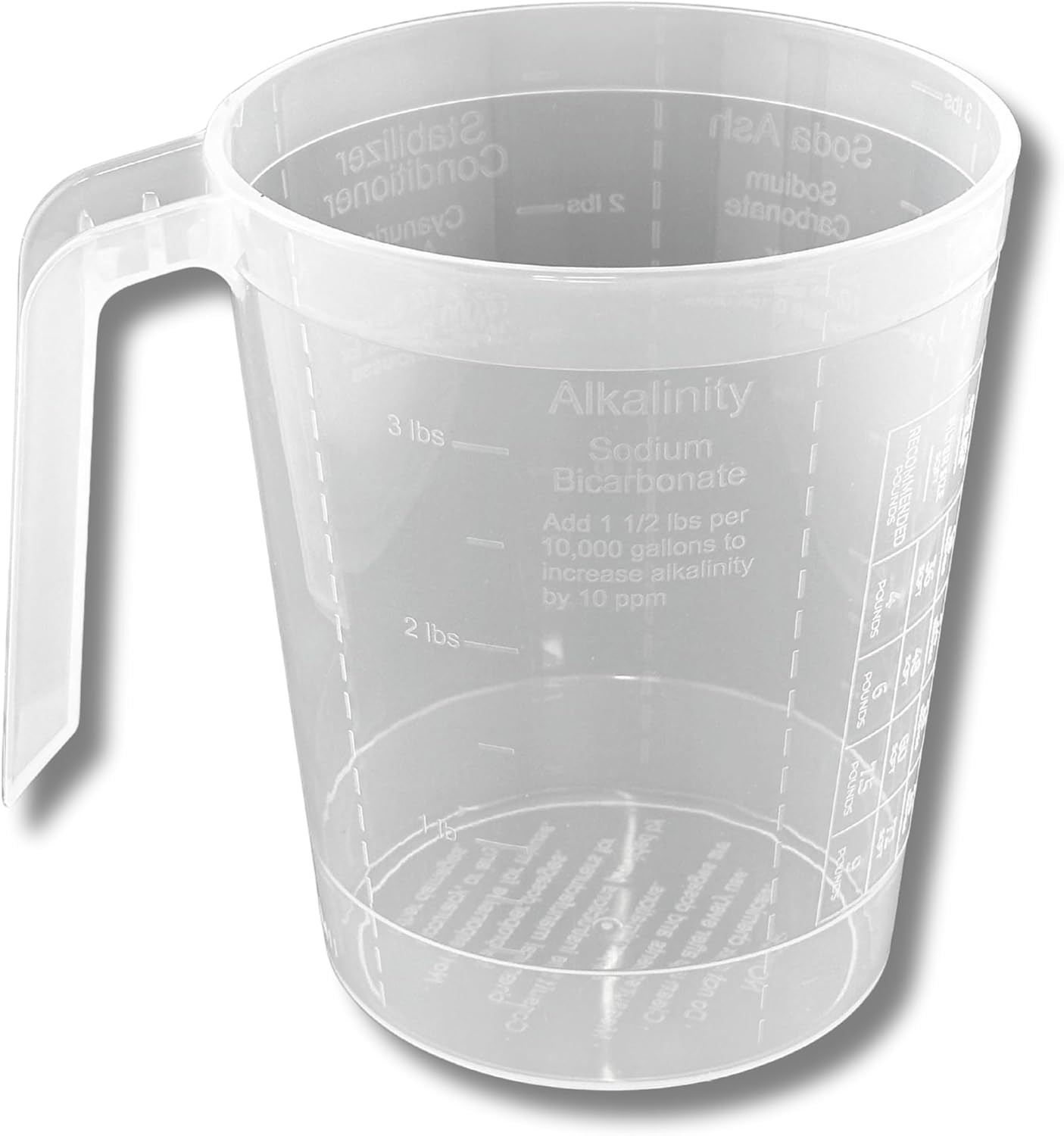
Plastic or stainless-steel measuring cups and spoons are best. Never use kitchen tools for pool chemicals. Keep these dedicated for pool use only.
Chemical Scoops
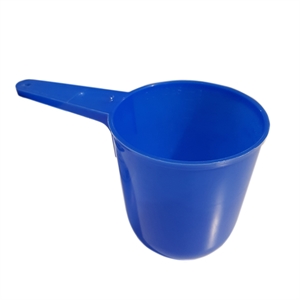
Many pool supply stores sell chemical scoops marked in ounces and grams. These help with larger quantities.
Digital Scales
For the highest accuracy, use a digital kitchen scale. It’s ideal for measuring small amounts, like 10–50 grams.
Buckets And Mixing Containers
You’ll often need a clean, dry bucket for mixing chemicals with water before adding them to your pool.
Comparison Table: Measuring Tools
Here’s a quick look at which tools fit which situation:
| Tool | Best For | Accuracy | Cost |
|---|---|---|---|
| Plastic Measuring Cups/Spoons | Everyday dosing | Good | Low |
| Chemical Scoops | Larger volumes | Moderate | Low |
| Digital Scale | Precise small amounts | Excellent | Medium |
| Bucket | Mixing/diluting | N/A | Low |
Pro tip: Never guess or use your hands. Even a small mistake can cause big changes in your pool.
Reading Dry Chemical Labels Correctly
Every pool chemical has a label with key information. But these labels can be confusing. Here’s how to read them correctly:
- Active Ingredient: Tells you what the chemical is (for example, “Calcium Hypochlorite 65%”).
- Dosing Instructions: Explains how much to add for a certain volume of water (often per 10,000 gallons or 40,000 liters).
- Safety Warnings: Always read these to avoid mixing dangerous chemicals.
- Storage Tips: Most dry chemicals should be kept cool, dry, and away from other chemicals.
Pay attention to units: Some labels use ounces, some use grams, some use cups. Convert as needed using online calculators or the conversion chart below.
Common Unit Conversions
| Unit | Equals |
|---|---|
| 1 ounce (oz) | 28.35 grams (g) |
| 1 cup | about 8 oz (227 g, for most pool chemicals) |
| 1 pound (lb) | 16 oz (454 g) |
| 1 tablespoon (tbsp) | 0.5 oz (14 g) |
Non-obvious insight: Not all dry chemicals have the same density. For example, 1 cup of sodium bicarbonate weighs less than 1 cup of calcium chloride. Always check the label or packaging for “weight per cup.”
Step-by-step: How To Measure Dry Pool Chemicals
Let’s break down the process into clear steps:
1. Test Your Pool Water
Before adding anything, test your pool with a test kit or test strips. Record the current values for:
- Chlorine
- PH
- Alkalinity
- Calcium Hardness
- Cyanuric Acid
Knowing your starting point helps you calculate exactly what you need.
2. Calculate The Required Chemical Amount
Using your test results, decide how much you need to adjust. Most chemical packages offer dosing tables. For example, to raise alkalinity by 10 ppm in a 10,000-gallon pool, you might need 1. 5 lbs (680 g) of sodium bicarbonate.
If your pool is a different size, adjust the amount proportionally.
3. Choose Your Measuring Tool
For small amounts (under 100 grams), use a digital scale. For larger amounts, use a measuring cup or chemical scoop.
Practical example: If you need 56 grams of cyanuric acid, use your digital scale for accuracy.
4. Measure Out The Chemical
Scoop or pour the chemical into your measuring tool. Level off the top with a straight edge (like the back of a knife) for accuracy. If you’re using a scale, reset (tare) the scale to zero with the container on it, then add the chemical until you hit the target weight.
5. Double-check Your Measurement
Mistakes happen. Double-check your measurement before adding the chemical. If you’re unsure, measure again.
6. Add The Chemical Safely
Never add dry chemicals directly to the pool unless the instructions say so. Most need to be dissolved in a bucket of water first, then poured slowly around the pool edge.
- Always add chemical to water, not water to chemical.
- Rinse measuring tools well after each use and store safely.
Example: Raising Ph With Soda Ash
Suppose your test shows pH is 7. 0 (too low). You have a 15,000-gallon pool. The label says, “Add 6 oz per 10,000 gallons to raise pH by 0. 2. ”
Calculation:
- Your pool is 1.5 times larger, so use 6 oz x 1.5 = 9 oz.
- Measure 9 oz (255 g) using a digital scale or 1 cup plus 1 tablespoon (since 1 cup ≈ 8 oz).
- Dissolve in a bucket, stir, and pour around the pool edge.
Common Mistakes When Measuring Dry Pool Chemicals
Even experienced owners make errors. Here are a few to avoid:
- Guessing without measuring: “Eyeballing” is risky. Always measure.
- Using kitchen tools: Cross-contamination is dangerous.
- Not leveling off: Rounded spoonfuls can add 20% more than needed.
- Ignoring chemical density: 1 cup does not always equal 8 oz for all chemicals.
- Skipping safety gear: Some powders can cause burns or breathing irritation.
- Adding chemicals too quickly: Dumping all at once can stain pool surfaces or cause clumping.
Non-obvious insight: Humidity changes the weight of some dry chemicals. If your storage area is humid, your chemicals may absorb water and become heavier, leading to overdosing if you measure by volume.
How To Store And Handle Dry Pool Chemicals
Proper storage keeps chemicals effective and safe:
- Store in a cool, dry place, out of direct sunlight.
- Keep chemicals in their original containers with labels intact.
- Never mix different chemicals or transfer them between containers.
- Keep out of reach of children and pets.
- Wear gloves and eye protection when handling powders.
Tip: Always wash your hands and tools after handling pool chemicals.
Credit: www.amazon.com
Adjusting For Pool Size
Most pool instructions use 10,000 gallons (about 38,000 liters) as the standard. If your pool is larger or smaller, adjust the dose:
- Pool is 20,000 gallons? Double the amount.
- Pool is 5,000 gallons? Use half the amount.
You can use this formula:
Required Chemical = (Your Pool Volume / 10,000) x Amount on Label
Example: If you need 4 oz for 10,000 gallons, and your pool is 18,000 gallons:
(18,000 / 10,000) x 4 oz = 1. 8 x 4 = 7. 2 oz
When To Measure By Weight Vs. Volume
Some labels give doses in weight (grams or ounces), others in volume (cups, tablespoons). Weight is always more accurate, especially for fine powders.
- Use a digital scale for weight.
- Use measuring cups or spoons for volume (when density is known).
Pro insight: If you’re using a new chemical, check the packaging for a conversion (e.g., “1 cup = 8 oz for this product”). If not, weigh 1 cup yourself and note it for future use.
Dealing With Different Brands And Concentrations
Not all brands have the same strength. For example, calcium hypochlorite can be 65% or 73% active ingredient. Always check the label and adjust the dose if needed.
Example: If your pool math is for 65% cal hypo but your product is 73%, you’ll need less to get the same effect.
- Divide the desired dose by the higher concentration, then multiply by the lower.
- Example: If you need 100 g at 65%, but you have 73%, use (65/73) x 100 = 89 g.
How To Mix And Apply Dry Chemicals
Some dry chemicals can go straight into the pool. Others need to be pre-dissolved. Here are the general rules:
- Chlorine granules: Usually dissolve in a bucket, then pour around the pool.
- Soda ash and baking soda: Pre-dissolve in water to avoid cloudy spots.
- Cyanuric acid: Fill a sock or skimmer basket and let it dissolve slowly.
- Calcium chloride: Pre-dissolve in a bucket and add slowly. Never mix with other chemicals.
Always add chemicals with the pump running for even distribution.
Tracking And Logging Chemical Use
Keep a pool log or journal. Record:
- Date and time
- Chemical added
- Amount
- Pool readings before and after
This helps you spot trends, avoid overuse, and troubleshoot problems.
Data example: If you notice you always need to add baking soda after a rainstorm, you can be proactive next time.
Special Tips For Beginners
- Start small: It’s safer to add less, test, and add more if needed.
- One chemical at a time: Never mix chemicals in the same bucket.
- Wait between additions: Give chemicals time to circulate before retesting.
- Learn your pool’s needs: Every pool is different. With experience, you’ll know what works best for yours.
Credit: www.allswimltd.com
Safety First: Personal Protection And Emergency Tips
Pool chemicals can be hazardous if misused. Always:
- Wear gloves and goggles.
- Work in a ventilated area.
- Clean up spills immediately.
- Store chemicals away from flammable items.
If you spill chemicals on your skin, rinse immediately with plenty of water. If you inhale powder, move to fresh air.
For more detailed safety guidance, visit the CDC’s pool chemical safety page.
Table: Typical Dosing For Common Dry Pool Chemicals
Here’s a quick reference for typical doses in a 10,000-gallon (38,000-liter) pool:
| Chemical | Purpose | Typical Dose | Notes |
|---|---|---|---|
| Calcium Hypochlorite | Sanitizer | 1-2 oz per day | Dissolve first |
| Sodium Bicarbonate | Raise alkalinity | 1.5 lbs to raise 10 ppm | Pre-dissolve |
| Soda Ash | Raise pH | 6 oz to raise 0.2 pH | Mix in bucket |
| Cyanuric Acid | Stabilizer | 13 oz to raise 10 ppm | Sock or skimmer |
| Calcium Chloride | Raise hardness | 1.25 lbs to raise 10 ppm | Pre-dissolve |
| Dry Acid | Lower pH | 12 oz to lower 0.2 pH | Mix in water |
| Non-Chlorine Shock | Oxidizer | 1 lb per week | Dissolve first |
Troubleshooting: What If The Chemical Level Is Still Off?
If you measure and add the right amount but your readings stay off:
- Check for hidden issues: Clogged filters, poor circulation, or heavy debris can use up chemicals fast.
- Test strips can expire or give false readings. Use a liquid test kit for accuracy.
- Weather: Rain, sun, and temperature affect chemical levels.
- Bather load: More swimmers = faster chemical use.
If in doubt, consult a pool professional for help.
Eco-friendly And Cost-saving Tips
- Buy chemicals in bulk to save money—but store them safely.
- Test water before and after heavy pool use or storms.
- Cover the pool when not in use to slow chemical loss.
- Reuse rinse water from cleaning measuring tools for the garden (if safe).

Credit: www.amazon.com
Frequently Asked Questions
How Often Should I Measure And Add Dry Pool Chemicals?
Test your pool water at least twice a week during swimming season. Add chemicals as needed based on test results. More frequent testing is needed after heavy use, rain, or hot weather.
Can I Use A Regular Kitchen Scale For Pool Chemicals?
Yes, but keep a dedicated scale for pool use only. Never use the same scale for food and chemicals to avoid contamination.
Is It Safe To Mix Dry Chemicals Together Before Adding To The Pool?
No, never mix dry chemicals together. Some combinations can create dangerous reactions, including fire or toxic fumes. Always dissolve one chemical at a time in water, and add separately to the pool.
What Should I Do If I Added Too Much Dry Chemical?
If you overdose, stop swimming and test the water. For minor overdoses, you can often dilute the pool by adding fresh water. For serious overdoses, consult a pool professional for advice.
Are Dry Pool Chemicals Better Than Liquid Ones?
Dry chemicals are often more concentrated, easier to store, and cheaper per dose. However, liquids can be easier to measure for small pools. Choose based on your pool size, budget, and comfort level with handling chemicals.
Keeping your pool safe and sparkling does not require advanced chemistry. With careful measurement, the right tools, and a little attention to detail, you can master dry pool chemicals and enjoy a clean, healthy swim every time.