
When you own a swimming pool, keeping the water safe and clear is a top priority. Many pool owners use different chemicals to sanitize the water and control algae. Among these chemicals, Calcium Hypochlorite—often called Cal Hypo—is a popular choice for pool shock treatments and routine chlorination. However, there is often confusion about how Cal Hypo affects other pool chemicals, especially Cyanuric Acid (CYA), which is used to protect chlorine from sunlight. If you’ve ever asked, “Does Cal Hypo raise CYA?” you’re not alone. This article dives deep into the relationship between Cal Hypo and CYA, giving you clear answers, practical insights, and tips for managing your pool chemistry effectively.
Understanding Cal Hypo
To answer the main question, you first need to understand what Cal Hypo is and how it works in a swimming pool. Calcium Hypochlorite is a strong chlorine compound that comes in granular or tablet form. Pool owners often use it for shocking the pool or as a primary sanitizer, especially in outdoor pools.
Cal Hypo is usually 65%–75% available chlorine by weight. When added to water, it quickly dissolves and releases free chlorine, which kills bacteria, viruses, and algae. Besides chlorine, Cal Hypo also adds calcium to your pool water—this can impact your pool’s total hardness over time.
One reason Cal Hypo is so popular is that it is stable, easy to store, and does not degrade as quickly as liquid chlorine. It’s also relatively affordable and widely available.
What Is Cya And Why Do Pools Need It?
Cyanuric Acid (CYA) is sometimes called chlorine stabilizer or pool conditioner. It plays a key role in protecting chlorine from being quickly destroyed by the sun’s ultraviolet (UV) rays. Without CYA, chlorine levels can drop fast on a sunny day, leaving your pool vulnerable to algae and bacteria.
CYA is typically added directly to the pool water as a powder or liquid. Some stabilized chlorine products, like trichlor and dichlor, contain CYA as part of their chemical makeup, so they add both chlorine and CYA every time they’re used.
Pool experts recommend keeping CYA levels between 30–50 ppm (parts per million) for outdoor pools. Too little, and you lose chlorine too quickly. Too much, and chlorine becomes less effective.
Does Cal Hypo Raise Cya?
The direct answer is no, Cal Hypo does not raise CYA. This is one of the main reasons many pool professionals choose Cal Hypo for regular shocking and sanitizing.
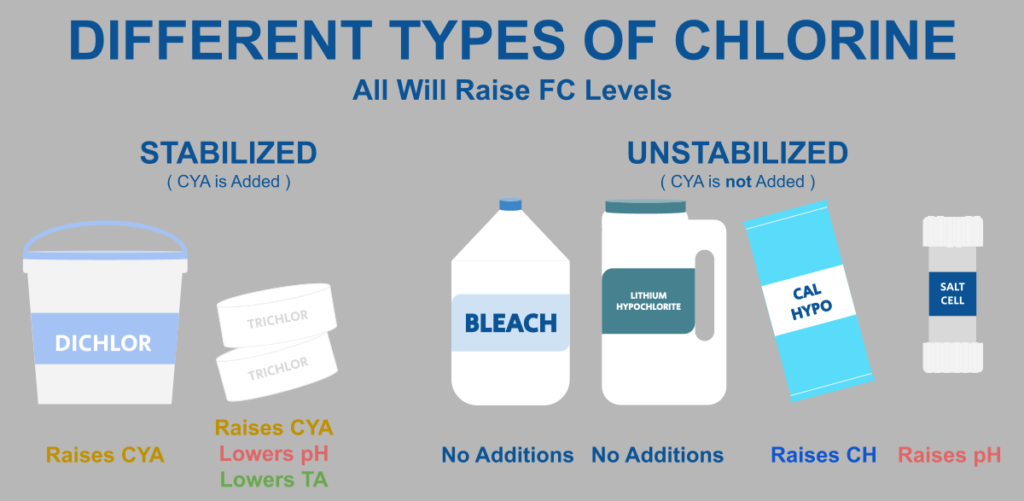
When you use Cal Hypo, you are adding chlorine and calcium to your pool water, but you are not adding any CYA. This is very different from stabilized chlorine products like trichlor and dichlor, which do add CYA every time they are used.
Some beginners make the mistake of thinking all chlorine products add CYA. This is not true. Cal Hypo is a non-stabilized chlorine—it does not contain CYA and does not affect CYA levels.
Common Confusion: Why Some Think Cal Hypo Raises Cya
Many pool owners confuse the types of chlorine. If you switch between different chlorine products, it can be easy to forget which ones add CYA. For example, if you sometimes use dichlor (which adds both chlorine and CYA) and other times Cal Hypo, you might mistakenly think Cal Hypo is raising your CYA.
It’s important to keep track of what chemicals you’re using, as this helps avoid misunderstandings.
How Cal Hypo Affects Pool Water Chemistry
While Cal Hypo does not raise CYA, it does have other effects on your pool water chemistry. Understanding these effects will help you manage your pool more effectively.
1. Raises Free Chlorine
The main purpose of Cal Hypo is to raise the free chlorine level in your pool. This is what keeps your water clean and safe.
2. Increases Calcium Hardness
Every time you add Cal Hypo, you are also adding calcium to your pool water. Over time, this can raise your pool’s calcium hardness level. High calcium hardness can lead to scaling on pool surfaces and equipment.
3. Impacts Ph And Alkalinity
Cal Hypo has a high pH (around 11–12), so adding it can cause your pool’s pH and total alkalinity to rise slightly. Regular testing helps keep these levels in check.
4. No Effect On Cya
Again, Cal Hypo does not add CYA. If your CYA level is low, you will need to add a stabilizer separately.

Credit: www.reddit.com
Comparing Cal Hypo And Stabilized Chlorines
It’s helpful to see how Cal Hypo compares to other chlorine types, especially those that do add CYA. Here’s a side-by-side look:
| Chlorine Type | Adds CYA? | Adds Calcium? | Form | Common Uses |
|---|---|---|---|---|
| Cal Hypo | No | Yes | Granular, Tablet | Shock, Routine Chlorination |
| Trichlor | Yes | No | Tablet, Stick | Routine Chlorination |
| Dichlor | Yes | No | Granular | Shock, Routine Chlorination |
| Liquid Chlorine | No | No | Liquid | Shock, Routine Chlorination |
This comparison makes it clear: Cal Hypo does not add CYA, making it a good choice if you want to control your stabilizer level separately.
When To Choose Cal Hypo
Cal Hypo is a smart choice for many pool owners, but it’s not always the best option for every pool. Here are times when Cal Hypo is especially useful:
- You want to avoid raising CYA: If your CYA is already in the ideal range, Cal Hypo lets you add chlorine without increasing CYA further.
- You need a strong shock treatment: Cal Hypo is powerful and works fast, making it ideal for killing algae and bacteria.
- You have soft water: If your water is low in calcium, Cal Hypo can help raise hardness to a safe level.
- You want to avoid stabilizer buildup: Overusing stabilized chlorine can lead to high CYA, which makes chlorine less effective. Cal Hypo avoids this problem.
However, if your calcium hardness is already high, you may want to avoid Cal Hypo to prevent scaling.

Credit: www.testyourownpool.com
Managing Cya Levels In Your Pool
Even though Cal Hypo doesn’t raise CYA, you still need to manage your pool’s CYA level for best results. Here are some tips:
1. Test Your Water Regularly
Use a reliable test kit to measure CYA, chlorine, pH, alkalinity, and calcium hardness at least once a week. Testing helps catch problems early.
2. Add Cya Only When Needed
If your CYA is below 30 ppm, add a stabilizer. Too much CYA can make chlorine less effective, so avoid overdoing it.
3. Avoid Mixing Chlorine Types Without A Plan
Switching between different chlorine products without understanding their effects can lead to chemical imbalances. For example, using both dichlor (adds CYA) and Cal Hypo (adds calcium) without a clear plan can make water chemistry hard to manage.
4. Dilute High Cya With Fresh Water
If CYA gets too high (over 80–100 ppm), the best solution is to partially drain and refill your pool with fresh water.
5. Balance Other Chemicals
Keeping pH, alkalinity, and calcium hardness in range helps chlorine work better, and prevents scaling or corrosion.
How To Add Cal Hypo Safely
Adding Cal Hypo to your pool is simple, but doing it correctly is important for safety and effectiveness. Here’s how:
- Wear gloves and safety goggles: Cal Hypo is a strong oxidizer and can irritate skin and eyes.
- Dissolve in water first (if recommended): Some brands recommend dissolving the granules in a bucket of water before pouring into the pool. Always read the label.
- Never mix with other chemicals: Mixing Cal Hypo with other pool chemicals, especially stabilized chlorines, can cause dangerous reactions.
- Add with pump running: Pour the solution around the edge of the pool with the circulation system on. This helps distribute the chlorine evenly.
- Brush the pool: After adding, brush the pool walls and floor to prevent undissolved granules from settling.
- Wait before swimming: Usually, wait until chlorine levels drop back to 3–5 ppm. This can take several hours or overnight.
Real-world Example: Cal Hypo And Cya Management
Let’s look at a practical scenario. Suppose you have a 20,000-gallon outdoor pool. You use trichlor tablets for daily chlorination, which add CYA each time. After a summer, your CYA level climbs from 40 ppm to 100 ppm. Now, your chlorine is less effective, and algae begins to appear.
To solve this, you switch to Cal Hypo for shocking and routine chlorination. You partially drain the pool to bring CYA back to 50 ppm. Over the next few months, your CYA stays stable because Cal Hypo does not add any more.
Your chlorine works better, and your water stays clear.
This example shows how using Cal Hypo can help control CYA buildup, especially if you’ve been using stabilized chlorine products for a long time.
The Chemistry: Why Cal Hypo Does Not Raise Cya
The reason Cal Hypo does not raise CYA comes down to basic chemistry. Cal Hypo’s chemical formula is Ca(OCl)₂. When dissolved in water, it releases calcium ions and hypochlorite ions, which form free chlorine. There is no cyanuric acid in the formula, and no chemical reaction between Cal Hypo and pool water will produce CYA.
Compare this to dichlor or trichlor, which have cyanuric acid built into their molecules. Each time you add them, you’re dosing both chlorine and CYA at the same time.
Cal Hypo Vs. Other Chlorine Types: Pros And Cons
Every chlorine type has strengths and weaknesses. Understanding these can help you make better choices for your pool.
| Feature | Cal Hypo | Trichlor | Dichlor | Liquid Chlorine |
|---|---|---|---|---|
| Adds CYA | No | Yes | Yes | No |
| Adds Calcium | Yes | No | No | No |
| pH Effect | Raises | Lowers | Neutral | Raises |
| Cost | Moderate | Moderate | High | Low |
| Storage Stability | High | High | Moderate | Low |
| Best Use | Shock, Non-CYA Pools | Daily Chlorine, CYA Build-Up | Quick Shock, Small Pools | Large Pools, Quick Chlorine Boost |
This table highlights that Cal Hypo is ideal when you want strong chlorine without raising CYA, but you must monitor calcium hardness.
Non-obvious Insights On Cal Hypo And Cya
Most beginners focus only on chlorine levels and forget the effects on other chemicals. Here are some insights you might not know:
- CYA does not break down easily. Once CYA is in your pool, it stays there unless you drain water. Using Cal Hypo helps prevent CYA buildup, but if your CYA is already high, only dilution removes it.
- Cal Hypo and high pH: Over time, repeated use of Cal Hypo can cause your pool’s pH to drift upward. If you’re not careful, this can reduce chlorine’s effectiveness and cause cloudy water. Always check pH after adding Cal Hypo and adjust with acid if needed.
- Stabilizer and chlorine “lock”: If your CYA is much too high (over 100 ppm), your chlorine can become “locked”—meaning it’s there, but not effective at killing germs and algae. Cal Hypo avoids adding more stabilizer, but you still need to manage your CYA levels.
- Mixing Cal Hypo with stabilized chlorines is dangerous: Never add Cal Hypo and trichlor or dichlor at the same time, especially in the same feeder or storage area. This can cause a violent chemical reaction. Always store and handle these products separately.
- Temperature and Cal Hypo: Cal Hypo dissolves more slowly in cold water. In early spring or late fall, pre-dissolving Cal Hypo is even more important to prevent granules from sitting on the pool floor.
Pool Owner Mistakes: Cya And Cal Hypo
Many pool owners make avoidable mistakes when using Cal Hypo and managing CYA. Here are some of the most common:
- Not testing CYA regularly: Some owners never check CYA, leading to over-stabilization and chlorine problems.
- Overusing stabilized chlorine: Using trichlor or dichlor for every treatment quickly raises CYA, making pool care harder.
- Ignoring calcium hardness: If you use Cal Hypo for years without checking hardness, scaling can damage your pool’s surface and equipment.
- Mixing chemicals: Attempting to save time by mixing different chlorine types together can be dangerous.
- Adding Cal Hypo without dissolving: Pouring dry granules directly into the pool can bleach liners or leave residue.
Avoiding these mistakes keeps your pool water clear, safe, and easy to manage.
Best Practices For Long-term Pool Health
Keeping your pool water in great shape means more than just adding chlorine. Here’s how to build a routine that works:
- Create a testing schedule: Check all chemical levels weekly, especially chlorine, pH, CYA, and calcium hardness.
- Record your readings: Write down results so you can spot trends, like rising CYA or calcium.
- Plan chemical use: Decide in advance which chlorine type to use and when, based on your pool’s needs.
- Shock with Cal Hypo when needed: Use Cal Hypo for regular shocking, but switch to non-calcium options if hardness gets too high.
- Add CYA only when necessary: Don’t top up CYA unless your test kit shows you’re below 30 ppm.
- Drain and refill as needed: If CYA or calcium gets too high, partial draining is the only solution.
Sticking to this routine prevents problems and helps you enjoy your pool with less hassle.
Expert Opinions On Cal Hypo And Cya
Pool professionals and chemists agree on the basics: Cal Hypo is a non-stabilized chlorine and does not raise CYA. Organizations such as the Pool & Hot Tub Alliance and the Centers for Disease Control and Prevention recommend Cal Hypo for shocking, especially when CYA levels are already high or when you want to avoid stabilizer buildup.
For more technical details and studies on pool chemistry, the CDC’s pool disinfection guide is a trusted resource.
Frequently Asked Questions
Does Cal Hypo Add Cya To Pool Water?
No, Cal Hypo does not add CYA to pool water. Cal Hypo is a non-stabilized chlorine, so it only adds chlorine and calcium. If you need to raise CYA, you must add a stabilizer separately.
What Happens If Cya Gets Too High In My Pool?
If CYA is too high (over 80–100 ppm), chlorine becomes less effective at killing germs and algae. The best solution is to partially drain and refill your pool to lower CYA to a safe range (30–50 ppm).
Can I Use Cal Hypo And Trichlor Together?
You should never mix Cal Hypo and trichlor directly, as this can cause a dangerous chemical reaction. If you switch between them, make sure your feeder and storage containers are completely clean and dry.
How Often Should I Test Cya In My Pool?
Test your CYA level at least once a month, and every time you open your pool for the season or after adding new water. Regular testing prevents over-stabilization and helps you balance other chemicals.
What Are The Risks Of Using Only Stabilized Chlorine For A Long Time?
Using only stabilized chlorine (like trichlor or dichlor) causes CYA to rise over time. High CYA can lead to chlorine lock, making your sanitizer less effective and increasing the risk of algae and bacteria. Switching to Cal Hypo or liquid chlorine helps control CYA buildup.
Keeping your pool healthy is all about balance. Cal Hypo offers strong sanitation without raising CYA, making it a valuable tool for any pool owner who wants clear, safe water all season long. By understanding how Cal Hypo interacts with other chemicals, you can avoid common mistakes and keep your swimming experience stress-free.
Credit: www.testyourownpool.com