
A backyard swimming pool can be the heart of your home during hot summer days. But to keep the water clean, clear, and safe, you need good circulation. That’s where pool returns come in. They might seem small, but they are essential for moving water and chemicals evenly around your pool. If you’ve ever wondered how many returns your pool should have, you’re not alone. Many pool owners and even some builders overlook this detail, leading to common problems like cloudy water, dead spots, and algae growth.
Let’s take a clear look at everything you need to know about pool returns: what they do, how many you need, what factors change the answer, and how to avoid costly mistakes. Whether you’re building a new pool or upgrading an old one, understanding this topic will make your pool easier to maintain and more enjoyable to swim in.
What Are Pool Returns?
Before deciding how many returns you need, it’s important to understand what they are. Pool returns are the small inlets, usually round and placed along the pool walls, where filtered and treated water flows back into the pool. Water is pulled out of the pool through skimmers and drains, cleaned by your filter, then sent back through these returns.
Key functions of pool returns:
- Circulating water across the pool to prevent stagnant spots
- Distributing chemicals evenly to avoid buildup in any area
- Helping to push debris toward skimmers and drains for better cleaning
- Ensuring temperature is uniform throughout the water
A pool with too few or poorly placed returns can have poor circulation, which means more work, more chemicals, and more risk of water problems.
Why The Number Of Returns Matters
Many pool owners think one or two returns are enough, especially for small pools. However, the right number of returns is critical for proper pool circulation. Good circulation means:
- Cleaner water
- Fewer chemical imbalances
- Less algae growth
- Lower maintenance costs
With not enough returns, you may see:
- “Dead zones” where water doesn’t move much
- Uneven chlorine or pH levels
- Trouble keeping the pool clear
On the other hand, too many returns can make the water turbulent, causing discomfort for swimmers and possibly stressing your filtration system.
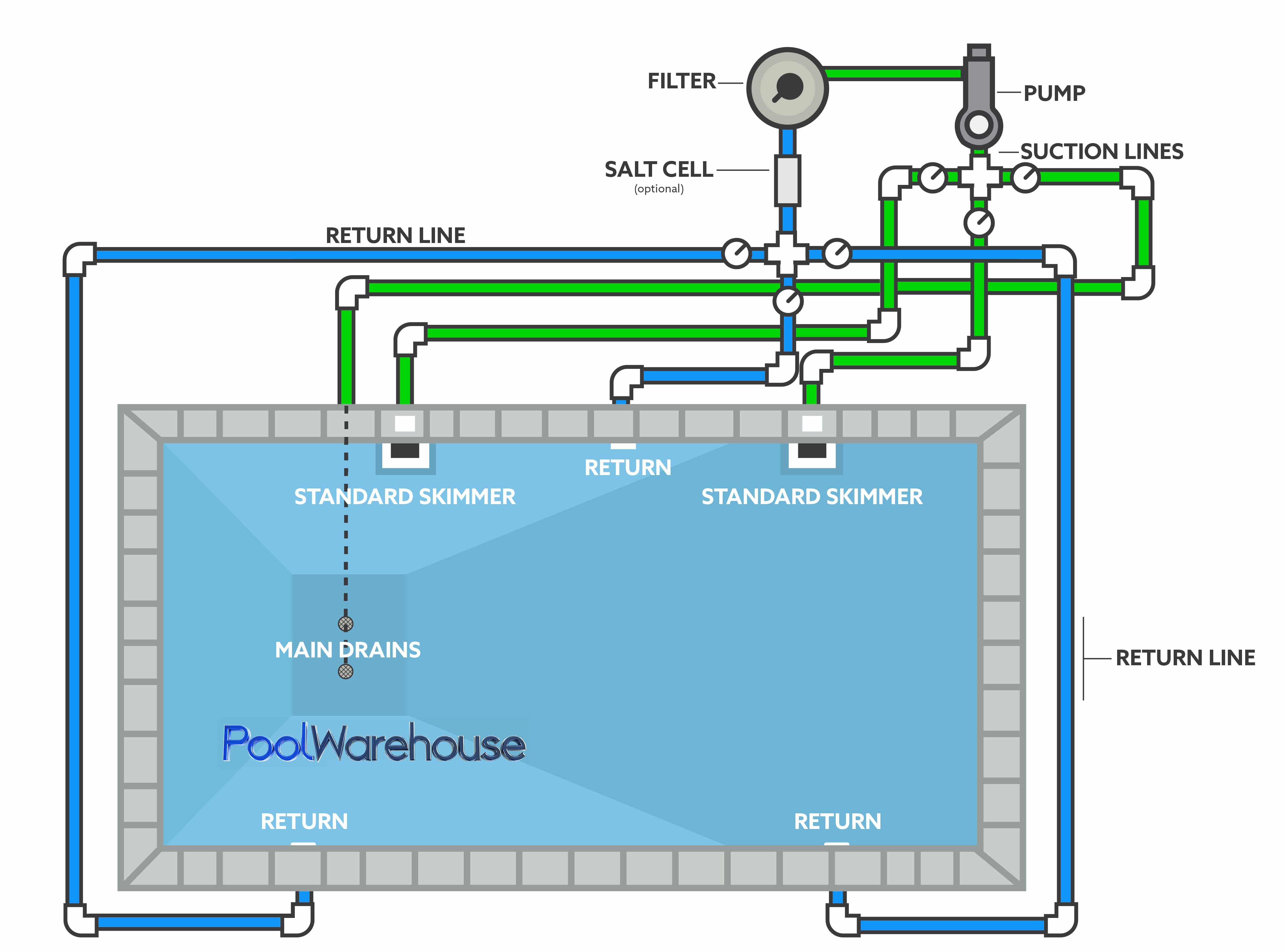
Credit: www.poolwarehouse.com
Basic Guidelines: Standard Number Of Pool Returns
For most residential pools, there is a general rule of thumb. Here’s a simple guideline:
| Pool Size (Gallons) | Typical Number of Returns |
|---|---|
| Up to 10,000 | 2 |
| 10,000 – 20,000 | 2 to 3 |
| 20,000 – 30,000 | 3 to 4 |
| Over 30,000 | 4 or more |
These numbers are not strict rules, but they are a good starting point. For example, a typical 15,000-gallon pool will work best with three returns.
Factors That Affect The Number Of Returns
Every pool is unique. The right number of returns depends on several factors, not just pool size.
1. Pool Shape
Rectangular pools are the easiest for returns because water moves in a predictable pattern. Freeform, kidney, L-shaped, or custom pools often need more returns for good coverage. Odd corners or curves can create dead spots where water does not move well.
For example:
- A 20,000-gallon rectangular pool may be fine with 3 returns.
- A 20,000-gallon freeform pool often needs 4 or 5 to cover all areas.
2. Pool Size And Volume
Larger pools need more returns to move water efficiently. Volume is important, but so is surface area. A long, narrow lap pool may need more returns along its length than a round pool of similar volume.
3. Features And Accessories
If your pool has:
- Spas or attached hot tubs
- Tanning ledges
- Shallow play areas
- Waterfalls or fountains
You may need extra returns to support these zones. For example, a tanning ledge might need its own dedicated return to keep water moving across it and prevent algae.
4. Plumbing Design
The way your pipes are laid out matters. If returns are placed on a single plumbing line, too many returns can reduce water pressure at each one. In this case, you may need larger pipe sizes or a more powerful pump.
5. Pump Size And Flow Rate
Your pool pump’s flow rate (measured in gallons per minute, or GPM) must match the number of returns. More returns mean more flow is needed to keep each one working well. If your pump is too small, water may trickle out weakly from each return.
6. Wind And Sun Exposure
If your pool is in a windy area or gets lots of direct sun, more returns can help mix chemicals and heat more evenly. Sunlight can break down chlorine, and wind can push debris into corners.
7. Pool Depth
Pools that are deep at one end may need returns at different heights to ensure water at the bottom moves as well as the surface.
8. Skimmer And Main Drain Placement
Returns should be placed to move water toward skimmers and main drains, creating a “circular” flow. The number and placement of skimmers can affect how many returns you need for best results.
How To Place Pool Returns For Best Circulation
It’s not just about how many returns you have—it’s also about where you put them. Poor placement can cause the same problems as having too few returns.
Best practices:
- Space returns evenly around the pool, usually on the walls opposite the skimmers.
- Angle returns slightly to push water in a circular pattern, so debris moves naturally toward skimmers.
- For rectangular pools, put returns along one long wall, aiming water across the pool.
- In freeform pools, focus returns on “dead spots”—corners or areas where water tends to stagnate.
- For deep pools, add at least one return lower on the wall to move water at the bottom.
Non-obvious insight: The height of your returns matters. Placing one or two returns a bit lower (12–18 inches below the surface) can help circulate colder water at the bottom, which is often missed with surface-only returns.
Common Mistakes When Choosing The Number Of Returns
Even experienced pool owners and builders make some common mistakes:
- Copying another pool’s setup. Every pool is different. What works for your neighbor’s pool may not work for yours.
- Ignoring pool features. Adding a spa, tanning ledge, or other feature later often means adding returns, too.
- Underestimating the effect of plumbing. Too many returns on a single small pipe can reduce flow, leading to poor circulation.
- Not checking pump compatibility. Adding returns without upgrading the pump or plumbing can lead to weak flow everywhere.
- Poor placement. Returns too close together or in the wrong spot will not mix water properly.
- Not planning for upgrades. If you might add features later, install extra plumbing “stubs” for future returns.
Real-world Examples
To see how this works, let’s look at a few real-life scenarios.
Example 1: Small Rectangular Pool
- Size: 12,000 gallons
- Shape: Rectangle
- Features: Standard deep end, one skimmer
Best setup: Two returns, placed on the wall opposite the skimmer, one near each end. Angle them to push water toward the skimmer.
Example 2: Medium Freeform Pool
- Size: 18,000 gallons
- Shape: Freeform with tanning ledge
- Features: Two skimmers, tanning ledge, shallow play area
Best setup: Three returns. One for the main body, one dedicated to the tanning ledge, and one in the shallow area. Place them to avoid dead spots behind curves.
Example 3: Large L-shaped Pool
- Size: 30,000 gallons
- Shape: L-shaped
- Features: Spa, deep end, water feature
Best setup: Four returns. One in each “arm” of the L, one near the spa, one near the water feature. Each return should be angled for maximum circulation around corners.
Pool Return Placement: Data And Performance
To see how return number and placement affect water turnover, compare these two setups:
| Setup | Number of Returns | Turnover Efficiency | Common Issues |
|---|---|---|---|
| Returns only at shallow end | 2 | Poor (dead spots in deep end) | Cloudy water, algae in deep end |
| Returns spaced at both ends | 3 | Good (even mixing) | Minimal issues |
| Returns all on one wall | 3 | Moderate (uneven flow) | Debris in corners |
| Returns in corners and ledges | 4 | Excellent | Rare water problems |
Non-obvious insight: Returns placed near pool steps or ledges help prevent algae buildup in these tricky areas, which often get missed by main circulation.

Credit: www.youtube.com
How To Calculate The Right Number Of Returns
While guidelines help, you can also estimate more precisely using your pool’s flow rate and volume.
Steps:
- Find your pool’s volume. Most residential pools range from 10,000 to 30,000 gallons.
- Know your pump’s flow rate. This is measured in gallons per minute (GPM).
- Divide your pool’s volume by your pump’s flow rate to see how long it takes to circulate all the water (called the “turnover rate”). Aim for a turnover rate of 6–8 hours.
- Divide your total flow rate by the number of returns to see how much water comes out of each. Each return should ideally handle 15–30 GPM.
For example, if you have a 20,000-gallon pool and a pump that moves 60 GPM:
- 20,000 ÷ 60 = 333 minutes (about 5.5 hours for a full turnover)
- If you have 3 returns, each one will get 20 GPM.
If your flow per return is much less than 15 GPM, you may need a stronger pump or fewer returns. If it’s much more than 30 GPM, more returns may help spread the flow.
Upgrading Or Adding Returns In Existing Pools
If you have an older pool with only one or two returns and notice issues like cloudy water or dead spots, adding returns may help. Here’s what to consider:
- Plumbing access: Adding returns means cutting into the pool wall and running new pipes. This is easiest during resurfacing or renovation.
- Pump size: Check if your current pump can handle more returns, or upgrade to a variable-speed pump.
- Return fitting type: Modern adjustable returns let you aim water more precisely, improving mixing.
- Professional help: Always use a licensed pool contractor for plumbing modifications.
Practical tip: If adding new returns is too expensive, try changing the angle or direction of your current returns. Often, just aiming them better can improve circulation.
Special Cases: Saltwater, Heated, And Commercial Pools
Some pools have extra needs.
Saltwater Pools
Salt systems need strong circulation to avoid salt “hot spots” that can damage surfaces. More returns, especially near steps and ledges, help keep salt evenly mixed.
Heated Pools
Heated pools benefit from returns both high and low on the wall. This helps move warm water from the heater throughout the pool, reducing cold spots.
Commercial And Public Pools
These pools often have strict health rules and must circulate water faster. They may have 6–12 or more returns, depending on size and design. Public pool codes should always be followed.
Comparing Return Types: Standard Vs. Specialty Fittings
Not all returns are the same. Here’s a quick comparison:
| Return Type | Description | Best For |
|---|---|---|
| Standard Eyeball | Simple, round, adjustable nozzle | Most residential pools |
| Multi-directional | Can be aimed in several directions | Freeform or large pools |
| Wall Jets | Broad, flat flow, sometimes decorative | Tanning ledges, steps |
| Floor Returns | Flush with pool floor | High-end or large pools, deep ends |
Pro tip: Multi-directional returns cost a bit more but let you fine-tune flow, which is worth it for custom-shaped pools.
When Fewer Returns Might Be Better
While more returns often improve circulation, there are times when fewer are smarter:
- Small pools: One or two returns are enough and keep costs low.
- Weak pumps: If your pump is old or small, more returns can lower flow too much.
- Simple shapes: Rectangular pools with no features don’t need as many returns as complex pools.
Expert advice: It’s better to have a few well-placed, high-flow returns than many weak ones.
The Cost Of Adding More Returns
Adding returns increases plumbing and equipment costs. Expect to pay $300–$600 per return when building a new pool, including labor and materials. Upgrading an existing pool costs more due to extra labor and possible deck repairs.
However, the long-term savings in maintenance, chemicals, and time can easily pay for the investment.
Maintenance Tips For Pool Returns
No matter how many returns you have, keeping them clean and adjusted is important:
- Check and clean return fittings monthly; debris can block flow.
- Aim returns as the pool season changes. For example, point returns down in spring to mix chemicals, then across in summer to skim debris.
- Replace broken or missing “eyeballs” to prevent leaks and poor circulation.
Little-known tip: If your pool has cloudy water after heavy use or storms, temporarily aim all returns toward the bottom for a few hours. This quickly mixes chemicals and clears the water.
Professional Standards And Codes
In some areas, building codes require a certain number of returns based on pool volume, shape, and features. Always check local codes and ask your pool contractor for advice. Commercial pools have stricter requirements than residential pools.
For more technical details on pool plumbing and returns, the Wikipedia page on swimming pool sanitation offers a deeper look.
Key Takeaways For Pool Owners
If you want your pool to be clean, safe, and easy to care for:
- Aim for 2–4 returns for most home pools, more for large or complex shapes.
- Place returns to cover all areas, especially corners and features.
- Match your pump and plumbing to the number of returns you have.
- Adjust and clean returns regularly for best performance.
Frequently Asked Questions
How Do I Know If My Pool Has Enough Returns?
If you notice water is not moving in some areas, or you have trouble with algae or cloudy water, you may need more returns. Watch for “dead spots” where debris collects and chemicals don’t mix well.
Can I Add More Returns To My Existing Pool?
Yes, but it usually requires professional help and may involve cutting concrete or resurfacing. It’s easiest during a major renovation. Always check that your pump and filter can handle the extra flow.
What Size Should My Pool Returns Be?
Most residential pool returns are 1. 5 inches in diameter. Larger pools may use 2-inch returns for higher flow rates. The size should match your plumbing for best efficiency.
Does The Direction Of Pool Returns Matter?
Yes. Returns should be aimed to create a gentle, circular flow around the pool, pushing water toward skimmers and away from corners. Adjusting direction can greatly improve circulation and water clarity.
Are More Returns Always Better?
Not always. Too many returns can lower water pressure and make circulation uneven, especially if your pump is not powerful enough. It’s better to have the right number for your pool’s size, shape, and features.
A well-designed pool return system is one of the secrets to a beautiful, low-maintenance pool. By understanding how many returns your pool should have and why, you’ll enjoy cleaner water, lower costs, and more time swimming instead of cleaning.

Credit: www.reddit.com