
Drying mushrooms in the oven is a simple way to preserve their flavor and texture for months. If you love cooking with mushrooms or want to store your harvest, oven drying is a method you can do at home—no fancy equipment required.
Many people don’t realize how easy it is to keep mushrooms fresh for future recipes. And with a little practice, you can get results that are close to what you’d expect from a dehydrator.
This guide explains every step of oven drying mushrooms, including preparation, temperature, timing, and storage. You’ll discover tips for the best results, learn about the science behind drying, and see how dried mushrooms can be used in everyday cooking. If you’re new to drying foods, you’ll find straightforward advice and answers to questions you might not think to ask.
Whether you’re a gardener, a forager, or just love buying mushrooms in bulk, this article will help you make the most of every mushroom you bring home.
Why Dry Mushrooms?
Drying is one of the oldest ways to preserve food. When you dry mushrooms, you remove the moisture that causes them to spoil. This makes them last much longer—sometimes up to a year if stored right. Dried mushrooms are lightweight, easy to store, and great for travel or emergency use.
Another reason to dry mushrooms is flavor. Drying concentrates the taste, making them richer and more aromatic than fresh mushrooms. You can use them in soups, sauces, risottos, and more. Some chefs even prefer dried mushrooms for certain recipes because of this intense flavor.
Dried mushrooms are also very convenient. You can rehydrate them in water or broth whenever you need, and they’re ready to use in just a few minutes. This means you always have mushrooms on hand, even when they’re out of season.
Choosing The Right Mushrooms
Not all mushrooms dry the same way. Most edible mushrooms can be dried, but some types work better than others. Here are the most popular mushrooms for oven drying:
- Button mushrooms (White mushrooms): Common and easy to find, these dry well and rehydrate quickly.
- Cremini (Baby bella): Similar to button mushrooms but with a deeper flavor.
- Portobello: Large and meaty, these are good for drying but need to be sliced thin.
- Shiitake: A favorite in Asian cooking, their caps dry well but stems are tough.
- Porcini: Prized for their rich taste; these are excellent for drying.
- Chanterelle: Can be dried, but their delicate flavor is best preserved with gentle heat.
- Oyster mushrooms: These dry well but can become very crisp.
Wild mushrooms like morels, matsutake, and porcini are also good options, but always be sure they are safe to eat. Never dry mushrooms you can’t identify.
How To Pick The Best Mushrooms
- Choose fresh, firm mushrooms with no slimy spots.
- Avoid mushrooms with mold, bruises, or a bad smell.
- Smaller, young mushrooms tend to dry better than old, large ones.
Preparing Mushrooms For Drying
Proper preparation is key for good results. Many people make mistakes at this stage—like washing mushrooms under water or slicing them unevenly—which leads to poor drying.
Cleaning Mushrooms
Mushrooms absorb water easily, which can make drying take longer. Here’s how to clean them:
- Brush off dirt gently using a soft brush or a paper towel.
- If you must use water, rinse quickly and dry right away with a towel.
- Remove any tough stems, especially on shiitake or portobello mushrooms.
Slicing Mushrooms
Slicing affects both drying time and final texture. For most mushrooms:
- Slice to 1/8 to 1/4 inch thick (3–6 mm). Thinner slices dry faster and more evenly.
- Try to keep slices the same size, so they dry at the same rate.
- For very small mushrooms, you can dry them whole, but expect a longer drying time.
A non-obvious tip: Diagonal slices create more surface area, which can speed up drying and make the mushrooms look more attractive in dishes later.
Setting Up Your Oven
An oven is a good tool for drying, but it’s important to use the right temperature and air flow. Most home ovens have a lowest setting of 170–200°F (77–93°C). Mushrooms dry best at 120–150°F (49–66°C), so you may need to adjust.
How To Adjust Oven Temperature
- If your oven can be set to 150°F (65°C), use that.
- If not, set to the lowest possible and prop the door open slightly with a wooden spoon or heat-safe silicone pad to let moisture escape and lower the temperature.
- Use an oven thermometer for accuracy, as built-in dials are often wrong by 10–20°F.
Why Air Flow Matters
Good air flow removes the moisture that comes out of the mushrooms. Without it, mushrooms can cook instead of dry, or even spoil. Keeping the door open a crack helps, but also consider using a small fan near the oven to help move air.

Credit: www.reddit.com
Tools You’ll Need
Drying mushrooms in the oven requires only a few simple items:
- Baking sheets or trays: Use rimmed sheets for safety.
- Wire racks: These allow air to reach all sides of the mushrooms, leading to better drying.
- Parchment paper: Place under racks to catch drips and make cleanup easier.
- Oven thermometer: For accuracy, especially with older ovens.
- Silicone spatula or tongs: To turn mushrooms halfway through drying.
Many people forget that wire racks make a big difference. Mushrooms placed directly on a solid tray can steam on the bottom and won’t dry as evenly. If you don’t have racks, flip the mushrooms more often.
Step-by-step: How To Dry Mushrooms In The Oven
Here’s a complete guide to drying mushrooms in your oven at home.
1. Preheat And Prepare
- Preheat your oven to 150°F (65°C) or the lowest setting.
- Line baking sheets with parchment paper for easier cleanup.
- Place wire racks on top of the parchment.
2. Arrange The Mushrooms
- Lay mushroom slices in a single layer on the racks.
- Make sure pieces do not touch or overlap.
- If drying whole mushrooms, space them evenly.
3. Start Drying
- Place trays in the center of the oven.
- Leave the oven door slightly open (about 1 inch/2.5 cm) to let out moisture.
- If you have a convection setting, use it for better air flow.
4. Monitor And Turn
- After 1 hour, check mushrooms. Turn slices over with tongs or a spatula.
- Rotate trays front to back and top to bottom for even drying.
5. Check For Doneness
- Total drying time is 2–6 hours depending on mushroom type, thickness, and oven temperature.
- Mushrooms are done when they are dry, leathery, and crisp but not burnt.
- Let a few pieces cool. If they snap in half or break easily, they are ready.
6. Cool Completely
- Let dried mushrooms cool on the racks for at least 30 minutes before storing.
- This prevents trapped heat from causing moisture inside containers.
7. Store Properly
- Place cooled mushrooms in airtight containers (glass jars, zip bags, or vacuum-sealed bags).
- Label with the date and type of mushroom.
- Store in a cool, dark, dry place.
It’s easy to overlook the cooling step, but it’s important. Warm mushrooms can release moisture after you seal them, which can ruin your batch.
How Long Does It Take To Dry Mushrooms In The Oven?
Drying time depends on mushroom type, slice thickness, oven temperature, and air flow. Here’s a comparison for common mushrooms:
| Mushroom Type | Slice Thickness | Oven Temp | Estimated Time |
|---|---|---|---|
| Button | 1/8 inch (3 mm) | 150°F (65°C) | 2–3 hours |
| Portobello | 1/4 inch (6 mm) | 150°F (65°C) | 3–5 hours |
| Shiitake (caps) | 1/8 inch (3 mm) | 150°F (65°C) | 2–4 hours |
| Porcini | 1/4 inch (6 mm) | 150°F (65°C) | 3–5 hours |
Thicker slices and whole mushrooms can take 6 hours or more. Always check after 2 hours and then every 30 minutes.
Common Mistakes And How To Avoid Them
Many beginners make errors that lead to disappointing results. Here are common problems and how to prevent them:
- Overlapping slices: This causes uneven drying and can lead to mold later. Always use a single layer.
- Too high temperature: Mushrooms may cook or burn instead of drying. Stay below 180°F (82°C).
- Skipping air flow: If moisture can’t escape, mushrooms will steam and become rubbery.
- Storing before fully dry: Even a little moisture can cause spoilage. Test several pieces before storing.
- Not labeling jars: You may forget the mushroom type or drying date, which matters for flavor and safety.
An extra tip: If you see any condensation inside your storage container within 24 hours, the mushrooms are not dry enough. Put them back in the oven for another 30 minutes.
Advantages Of Oven Drying Vs. Other Methods
You might wonder why use an oven instead of other techniques. Let’s compare oven drying to two common methods: sun drying and dehydrator drying.
| Method | Cost | Drying Time | Ease | Best For |
|---|---|---|---|---|
| Oven Drying | Low (uses home oven) | 2–6 hours | Easy, hands-on | Most mushrooms, small batches |
| Dehydrator | Medium (buy device) | 6–12 hours | Very easy, set and forget | Large batches, frequent drying |
| Sun Drying | Free (weather dependent) | 12–48 hours | Difficult, needs sun/low humidity | Thin slices, dry climates |
Oven drying is accessible and quick, but not great for large harvests. Dehydrators are better for big batches or frequent use. Sun drying works only in hot, dry climates and is less reliable.
Storing Dried Mushrooms For Maximum Freshness
Storage is just as important as drying. Even perfectly dried mushrooms can spoil if not kept right. Here’s how to keep them fresh and safe:
Best Containers
- Glass jars with tight lids: Classic and reusable.
- Vacuum-sealed bags: Great for long-term storage.
- Mylar bags with oxygen absorbers: Very long shelf life.
Ideal Conditions
- Store in a cool, dark, dry place—a pantry, cupboard, or cellar.
- Avoid heat, sunlight, and humidity, which can cause mold or flavor loss.
- Never store above the stove or near windows.
Checking For Spoilage
Check mushrooms every few weeks. If you see mold, strange colors, or smell musty, discard them. Dried mushrooms should stay crisp and aromatic.
A tip many miss: For long-term storage (6 months+), add a food-safe desiccant packet to your jar. This absorbs any extra moisture and extends shelf life.
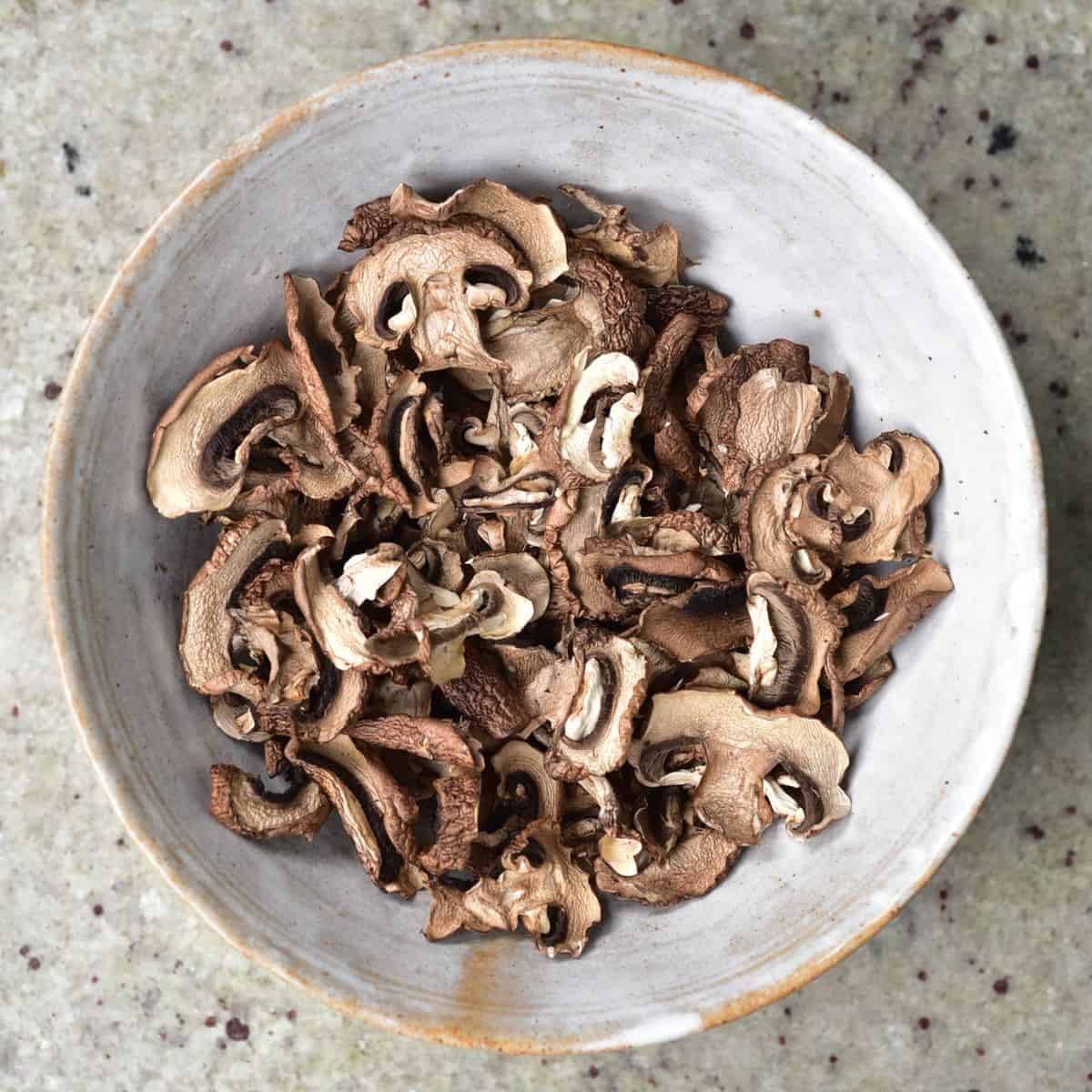
Credit: www.alphafoodie.com
How To Use Dried Mushrooms
Dried mushrooms are incredibly versatile and easy to use. Here’s how to get the most from them:
Rehydrating
- Place dried mushrooms in a bowl.
- Cover with hot water or broth for 15–30 minutes.
- Drain and squeeze gently. Save the soaking liquid—it’s full of flavor!
- Chop or use whole in your recipe.
Cooking Ideas
- Soups and stews: Add directly to simmering liquids.
- Risotto and rice: Stir in for a strong mushroom taste.
- Sauces: Blend rehydrated mushrooms for a creamy texture.
- Stir-fries: Soak first, then cook as usual.
Dried mushrooms expand to about twice their dry size when soaked. About 1 ounce (28g) of dried mushrooms equals 8 ounces (225g) fresh.
The Science Of Drying: Why Oven Drying Works
When you dry mushrooms, you remove the water that bacteria and mold need to grow. This makes mushrooms safe for long-term storage. The process also concentrates flavor, which is why dried mushrooms taste stronger than fresh ones.
Oven drying works because gentle heat speeds up evaporation. Air flow helps remove moisture from the mushroom surface. If the heat is too high, mushrooms can burn or cook instead of drying. If the air is too still, they can become rubbery or even rot.
A non-obvious insight: Oven drying is more forgiving than sun drying, which depends on weather and can expose mushrooms to insects and dust.
Troubleshooting: When Things Go Wrong
Drying mushrooms in the oven is simple, but problems can happen. Here’s how to fix common issues:
- Mushrooms are still soft after hours: Oven may be too cool, or slices too thick. Increase the temperature slightly or cut thinner next time.
- Edges turn dark or burn: Temperature is too high. Try a lower setting and check more often.
- Mushrooms lose flavor: Dried too hot or stored too long. Keep batches small and use within 6–12 months for best taste.
- Mold forms during storage: Mushrooms were not fully dried or container was not airtight. Discard and dry a new batch more thoroughly.
A tip most people miss: If you’re not sure mushrooms are dry enough, leave them out at room temperature for 24 hours before sealing. If they stay crisp, they’re ready.
Creative Uses For Dried Mushrooms
Dried mushrooms aren’t just for soup. Here are creative ways to use them:
- Mushroom powder: Grind dried mushrooms in a blender for a rich seasoning.
- Homemade stock: Simmer mushroom trimmings with vegetables for a deep, umami broth.
- Pasta and grains: Add powder to pasta dough or sprinkle on cooked grains.
- Herbal teas: Some mushrooms like reishi are used for tea.
- Garnish: Crispy dried mushrooms can be crushed as a topping for salads or casseroles.
Try adding mushroom powder to spice blends for an extra flavor boost.
Oven Drying For Foragers And Gardeners
If you grow or collect wild mushrooms, oven drying is a useful skill. It allows you to save your harvest and enjoy mushrooms all year. However, foraged mushrooms must always be 100% identified as edible. Some wild mushrooms are toxic, and drying does not remove toxins.
Foragers should also check for insects or dirt before drying. Brush mushrooms well and slice open any thick stems to check for bugs.
Drying your own mushrooms is rewarding, but always put safety first. If in doubt, consult a mushroom identification group or guide, such as the Wikipedia Edible Mushrooms page.
Comparing Oven Drying To Freeze Drying
Some advanced home cooks wonder about freeze drying. Here’s how it compares to oven drying:
| Feature | Oven Drying | Freeze Drying |
|---|---|---|
| Equipment Needed | Oven, racks | Special freeze dryer |
| Texture | Leathery, crisp | Light, crunchy |
| Flavor | Concentrated, cooked | Very fresh, raw taste |
| Shelf Life | 6–12 months | 1–2 years |
| Cost | Low | High (machine cost) |
Freeze drying is best for those who want to invest in special equipment and store food for very long periods. Oven drying is practical for most home cooks.
Safety Tips For Oven Drying Mushrooms
Safety is always important. Here are some rules to follow:
- Only dry mushrooms you know are safe.
- Use clean equipment.
- Don’t leave the oven unattended for long periods.
- If you smell burning, check mushrooms right away.
- If you see mold or smell anything strange after storage, discard the mushrooms.
Remember, drying does not kill all bacteria or toxins. Always start with fresh, clean mushrooms.
Frequently Asked Questions
How Do I Know If My Mushrooms Are Fully Dried?
They should feel dry, crisp, and break easily. If they are still flexible or rubbery, continue drying. Test several pieces, not just one, as some may dry faster than others.
Can I Dry Mushrooms Without A Wire Rack?
Yes, but air flow will be less. If you use a baking sheet, turn mushrooms every 30 minutes and watch for uneven drying. Wire racks are best for even results.
How Long Do Dried Mushrooms Last?
If stored in an airtight container in a cool, dark place, dried mushrooms can last 6–12 months. For best flavor, use within 6 months.
Do Dried Mushrooms Lose Nutrients?
Some vitamins (like vitamin C) may decrease, but most minerals and fiber stay. Dried mushrooms still offer a good source of umami flavor and nutrition.
Can I Dry Mushrooms In The Microwave?
No, microwaves heat unevenly and can cook or burn mushrooms instead of drying. Stick to an oven or dehydrator for safe, reliable results.
Drying mushrooms in the oven is a rewarding, simple way to reduce food waste and enjoy delicious mushrooms all year. With a little care, you’ll have a pantry full of flavor for any recipe you choose.
:max_bytes(150000):strip_icc()/__opt__aboutcom__coeus__resources__content_migration__serious_eats__seriouseats.com__recipes__images__20100726driedmushrooms-cb3d707aba04460e93af8bc42f069d92.jpg)
Credit: www.seriouseats.com