
Measuring pool chemicals by weight is one of the most reliable ways to keep your swimming pool water clean and safe. Many pool owners use liquid measuring cups or rough estimates, but these methods can lead to mistakes. Small measurement errors in pool chemicals can cause water problems, damage pool equipment, or even harm swimmers.
Knowing how to accurately measure pool chemicals by weight is a practical skill that can save you time, money, and frustration.
Most people focus on testing water and adding chemicals, but miss the importance of precise measurement. This article will guide you through everything you need to know about measuring pool chemicals by weight. You’ll learn why weight is more accurate than volume, what tools to use, how to avoid common mistakes, and how to handle chemicals safely.
Whether you are a new pool owner or want to improve your pool care routine, these clear steps will help you keep your pool perfect all season.
Why Accurate Measurement Of Pool Chemicals Matters
Many pool owners underestimate the impact of accurate chemical dosing. Adding too little or too much of a pool chemical can lead to several problems:
- Cloudy water that does not clear up
- Algae growth even after treatment
- Corroded equipment or stained pool surfaces
- Irritated eyes and skin for swimmers
When you measure by weight, you eliminate the guesswork. Chemicals can settle, compact, or clump, making cup or scoop measurements unreliable. For example, a cup of granular chlorine may weigh less after being exposed to humidity, but the scale will always tell you the exact weight.
Pro insight: Pool professionals and commercial pool operators always measure by weight for this reason. If you want professional results, this is the method to use.
Volume Vs. Weight: What’s The Difference?
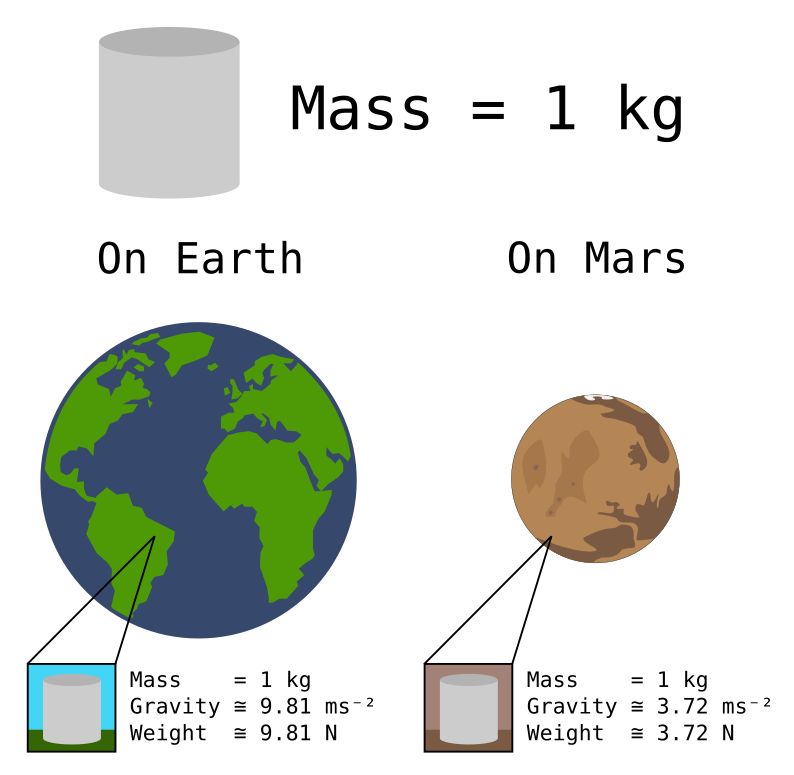
It’s easy to confuse measuring by volume (using cups, scoops, or spoons) and measuring by weight (using a scale). But the difference matters:
- Volume measures the amount of space something takes up.
- Weight measures how heavy something is.
Pool chemicals often settle during storage. For example, a scoop of calcium chloride from a fresh bag might be fluffy and light, but from a compacted bag, it could be dense and heavy. Both scoops look the same, but they can have very different weights.
Here’s a quick comparison of common pool chemicals:
| Chemical | 1 Cup (Volume) | Weight (Grams) |
|---|---|---|
| Calcium Hypochlorite | 1 cup | ~200g |
| Sodium Bicarbonate | 1 cup | ~220g |
| Calcium Chloride | 1 cup | ~270g |
As you see, even chemicals with the same volume can have different weights. This is why using a scale is more reliable.
Tools Needed To Measure Pool Chemicals By Weight
You do not need expensive equipment to measure pool chemicals accurately by weight. Here are the essential tools:
1. Digital Scale
Look for a digital kitchen or postal scale that can measure in grams, ounces, or pounds. It should have a “tare” function, so you can zero out the weight of the container.
2. Clean Containers
Use dry, chemical-resistant containers (like plastic bowls or cups) to hold and transfer chemicals. Never mix different chemicals in the same container.
3. Scoop Or Spoon
To transfer chemicals from the original bag to your weighing container. Never use household kitchen tools for pool chemicals.
4. Protective Gear
Wear gloves and goggles to protect your skin and eyes from splashes or dust.
Pro tip: Choose a scale that can measure at least 2kg (4.4 lbs) for home pools. Commercial pools may need a larger scale.
Understanding Pool Chemical Labels And Dosages
Every pool chemical comes with a label that shows how much to add based on your pool size and the current water chemistry. These instructions are usually given in weight (grams, ounces, or pounds) per a certain number of gallons or liters of water.
Example:
“Add 200 grams of calcium hypochlorite per 10,000 gallons of pool water to increase free chlorine by 2 ppm. ”
Non-obvious insight: Some pool chemicals list both volume and weight. Always use the weight amount if you have a scale.
Common mistake: Not all pools are the same size. Know your pool’s volume in gallons or liters before measuring chemicals. If you are not sure, use an online pool volume calculator.
How To Calculate Pool Chemical Dosage By Weight
Getting the right dose means matching the chemical amount to your pool size and the desired water change (like raising chlorine by 1 ppm).
Step 1: Know Your Pool Volume
If you don’t know your pool’s size, you can estimate it with simple formulas:
- Rectangular Pool: Length (ft) × Width (ft) × Average Depth (ft) × 7.5 = Gallons
- Round Pool: Diameter (ft) × Diameter (ft) × Average Depth (ft) × 5.9 = Gallons
Example:
A pool 20 ft long, 10 ft wide, and 5 ft deep on average:
20 × 10 × 5 × 7.5 = 7,500 Gallons
Step 2: Read The Label Instructions
Find the recommended weight of chemical to add per gallon or per 10,000 gallons. Adjust the dose for your pool’s actual size.
Step 3: Calculate The Amount Needed
If the label says “Add 200g per 10,000 gallons,” but your pool is 7,500 gallons, you need:
200g ÷ 10,000 × 7,500 = 150g
Step 4: Weigh The Chemical
Place your empty container on the scale, press “tare” to zero it, then slowly add the chemical until you reach the correct weight.
Step 5: Add The Chemical To The Pool
Follow manufacturer instructions for dissolving or distributing the chemical. Some chemicals must be dissolved in water first, others can be sprinkled directly.
Step-by-step: Measuring And Adding Pool Chemicals By Weight
Let’s break down the entire process for clarity and safety.
1. Test The Pool Water
Use a reliable test kit to check chlorine, pH, alkalinity, and other levels.
2. Decide What To Adjust
Based on test results, decide which chemical to add and how much.
3. Read The Chemical Label
Confirm the amount to add for your pool’s volume and the needed adjustment.
4. Put On Safety Gear
Wear gloves and goggles before handling any chemicals.
5. Set Up Your Scale
Place it on a flat, stable surface. Make sure it’s clean and dry.
6. Select A Clean Container
Place it on the scale, press “tare” to zero the weight.
7. Weigh The Chemical
Slowly add chemical to the container until you reach the target weight.
8. Add Chemical To Pool (as Instructed)
Some chemicals are pre-dissolved in a bucket of water, others are added directly to the pool.
9. Store Chemicals Safely
Reseal bags and containers, keep them dry and away from children and pets.
10. Wait And Retest
Allow chemicals to circulate for several hours, then retest the pool water.
Practical tip: Always add chemicals to water, not water to chemicals. This prevents dangerous reactions.
Credit: en.wikipedia.org
Specific Examples: Measuring Common Pool Chemicals By Weight
Let’s look at how to measure some of the most-used pool chemicals.
Measuring Chlorine (calcium Hypochlorite) By Weight
- Test your pool water for free chlorine.
- If you need to raise chlorine by 2 ppm in a 10,000-gallon pool, you’ll typically need about 200 grams of calcium hypochlorite.
- Weigh out 200 grams using your scale.
- Dissolve in a bucket of water, then pour around the pool’s edge.
Measuring Ph Increaser (soda Ash) By Weight
- Test the pH level. If it’s below 7.2, you may need about 170 grams (6 ounces) per 10,000 gallons to raise pH by 0.2 units.
- Weigh the soda ash, dissolve in water, add slowly to the pool.
Measuring Alkalinity Increaser (sodium Bicarbonate) By Weight
- To raise alkalinity by 10 ppm in 10,000 gallons, use about 700 grams (1.5 pounds) of sodium bicarbonate.
- Weigh, dissolve, and add as instructed.
Measuring Calcium Hardness Increaser (calcium Chloride) By Weight
- To increase hardness by 10 ppm in 10,000 gallons, use about 270 grams (0.6 pounds) of calcium chloride.
- Weigh the amount, spread it evenly in the water, or dissolve first.
Non-obvious tip: Never add large amounts of calcium chloride all at once—spread the dose over several hours to prevent cloudy water.
Comparison: Weighing Vs. Scooping Pool Chemicals
Many pool owners wonder if they can just use the scoop that comes with the chemical bag. Let’s compare:
| Method | Accuracy | Consistency | Risk of Over/Under Dose |
|---|---|---|---|
| By Weight (Scale) | High | Very Consistent | Low |
| By Volume (Scoop/Cup) | Low | Can Vary | High |
If you want trouble-free water, always measure by weight.
Credit: blog.orendatech.com
How To Convert Pool Chemical Dosages From Volume To Weight
Sometimes, you may only have volume instructions (like cups or scoops). You can convert to weight with a simple process:
- Use your scale to weigh one cup of the chemical.
- Write down this number.
- Use it for future conversions.
Example:
If 1 cup of soda ash weighs 220 grams, and you need 300 grams, you know you need about 1. 36 cups.
Practical tip: Check the weight every time you open a new bag, as density can change.
Safety Precautions When Measuring Pool Chemicals
Handling pool chemicals requires care. Here are key safety rules:
- Wear gloves and goggles to avoid contact with skin and eyes.
- Measure chemicals in a well-ventilated area to avoid inhaling dust.
- Keep chemicals dry and away from water until ready to use.
- Never mix different chemicals together, especially chlorine and acid.
- Store chemicals in their original containers with labels intact.
Expert warning: Some pool chemicals, like calcium hypochlorite, can cause fires if contaminated with organic material or other chemicals. Clean tools and containers thoroughly between uses.
Troubleshooting: Common Measurement Mistakes
Even careful pool owners make mistakes. Here are some common problems and how to fix them:
Mistake 1: Not Zeroing The Scale
If you forget to press “tare,” you will include the weight of the container, leading to an overdose.
Solution: Always zero the scale with the empty container before adding chemicals.
Mistake 2: Humidity Clumping Chemicals
Some chemicals absorb water from the air and become clumpy. This can make measuring by scoop unreliable.
Solution: Break up clumps before weighing and keep chemicals tightly sealed.
Mistake 3: Using The Wrong Scale
A bathroom scale is not accurate enough for small chemical doses.
Solution: Use a digital kitchen or postal scale with 1-gram accuracy.
Mistake 4: Guessing Pool Size
Dosing for the wrong pool volume leads to ongoing water problems.
Solution: Measure or calculate your pool’s volume accurately before dosing.
Advanced Tips For Accurate Chemical Management
Tip 1: Batch Weighing For Weekly Maintenance
If you add chemicals regularly, weigh out all needed doses for the week at once and store them in labeled containers. This saves time and reduces mistakes.
Tip 2: Record Keeping
Keep a log of the chemicals added, amounts, and water test results. This helps you spot trends and adjust dosing over time.
Tip 3: Use A Dedicated Scale
Don’t use your kitchen food scale for pool chemicals. Chemicals can contaminate food prep areas.
Tip 4: Adjust For Environmental Factors
Hot weather, rain, heavy pool use, or leaves can change chemical needs. Test and adjust your doses as needed.
Tip 5: Check For Product Purity
Some cheaper pool chemicals are less pure or have fillers. This can affect how much you need to add. Buy from reputable brands and check for “active ingredient” percentage.
How To Measure Liquid Pool Chemicals By Weight
Most pool owners use measuring cups for liquids, but you can get even more accurate results by weighing them.
- 1 milliliter (ml) of water weighs 1 gram, but liquid chemicals may be lighter or heavier.
- To be exact, weigh the empty container, add the liquid, and weigh again. Subtract the empty weight to get the chemical’s weight.
- For most pool use, volume is usually “good enough” for liquids, but weight is still more accurate for tricky adjustments.
Non-obvious insight: Some concentrated algaecides or clarifiers are very potent. For these, even small over- or under-doses can make a big difference. Weighing helps avoid mistakes.
Measuring Pool Chemicals For Different Pool Types
Inground Pools
Standard formulas and methods apply. Be extra careful with larger pools—measurement errors can be more expensive.
Above-ground Pools
These often hold less water, so small measurement mistakes make a bigger impact. Use a fine scale for accuracy.
Spa And Hot Tubs
These hold much less water, so always use a scale that can measure in small (1g or less) increments.
Example:
If your hot tub is 400 gallons and you need to raise chlorine by 1 ppm, you may only need 8 grams of chlorine. Eyeballing this is risky.
Table: Typical Pool Chemical Dosage By Weight
Here’s a quick reference for standard pool chemicals and doses per 10,000 gallons:
| Chemical | Effect | Amount Needed | Notes |
|---|---|---|---|
| Calcium Hypochlorite | Raises Chlorine 2 ppm | 200g | Dissolve before adding |
| Soda Ash | Raises pH 0.2 units | 170g | Dissolve and pour slowly |
| Sodium Bicarbonate | Raises Alkalinity 10 ppm | 700g | Add in small amounts |
| Calcium Chloride | Raises Hardness 10 ppm | 270g | Spread evenly |
Always check your specific product label for exact instructions.
What To Do If You Add Too Much Or Too Little Chemical
Too Much
- If you overdose a chemical, do not panic. Let the pool filter run and retest after several hours.
- In most cases, chemicals will dilute or dissipate over time.
- For serious overdoses, partially drain and refill your pool.
Too Little
- If you underdose, simply add the missing amount when you retest.
- Always wait for chemicals to mix fully before retesting and adjusting again.
Pro tip: Never try to “fix” a mistake by adding another chemical right away (like acid to counteract too much soda ash). Wait, test, and adjust slowly.
Pool Chemical Measurement Myths
Myth 1: “one Scoop Is Always Enough.”
Reality: Chemicals settle or clump, so one scoop today is not the same as one scoop next month.
Myth 2: “volume And Weight Are The Same For All Pool Chemicals.”
Reality: Each chemical has a different density and weight.
Myth 3: “measuring By Weight Is Complicated.”
Reality: With a digital scale, measuring by weight is fast and simple.
Frequently Asked Questions
How Often Should I Measure Pool Chemicals By Weight?
For the best results, measure every time you add chemicals. This ensures accuracy and keeps your water balanced. Even small mistakes, repeated over weeks, can cause major water problems.
Can I Use My Kitchen Scale For Pool Chemicals?
You can use a kitchen scale if it is accurate and you do not use it for food afterward. It’s better to buy a dedicated scale for safety and cleanliness.
What Should I Do If I Spill A Pool Chemical While Weighing?
Wear gloves, sweep up the chemical carefully, and dispose of it according to the label instructions. Never wash chemicals down the drain or mix spilled chemicals together.
Is Measuring By Weight Better Than Using Test Strips For Dosing?
Test strips show current water levels but do not tell you how much chemical to add. Measuring by weight ensures you add the precise amount needed after testing.
Where Can I Find More Information About Pool Chemical Safety?
Visit reputable sites like the CDC’s Pool Chemical Safety page for best practices and safety tips.
Maintaining a healthy pool is easier when you measure chemicals by weight. With the right tools and habits, you can avoid problems and enjoy crystal-clear water all season long. Accurate dosing not only protects your pool but also keeps swimmers safe.
Start measuring by weight today for peace of mind and the best swimming experience.
Credit: blog.orendatech.com