
Organizing mugs in a cabinet may seem simple, but for many people, it’s a small daily struggle. Cabinets fill up fast, mugs come in all shapes and sizes, and finding your favorite one can turn into a morning treasure hunt.
A cluttered mug cabinet can even lead to accidental breaks, wasted space, and frustration. But with the right steps, you can turn chaos into order, save time, and even make your kitchen feel bigger. Whether you have a few matching mugs or a colorful collection from travels, you’ll find practical advice here to help you organize mugs in your cabinet for good.
This guide goes deep into everything you need to know—from choosing the best storage solutions and decluttering, to smart arrangement strategies and essential maintenance. You’ll also find tips for small kitchens, family homes, and even how to display mugs if you want them to double as décor.
Let’s make your mug cabinet a place of calm, not clutter.
Why Organizing Mugs Matters
Most people don’t realize how much time they lose searching for a mug or how much cabinet space goes unused. A well-organized mug cabinet brings real benefits:
- Saves time every morning—no more hunting for the right mug.
- Prevents breakage and chipped handles.
- Frees up cabinet space for other kitchen items.
- Reduces stress and makes your kitchen more inviting.
- Makes it easier to host guests and serve drinks quickly.
A 2023 survey by the National Kitchen and Bath Association found that over 60% of homeowners wish they could better organize their kitchen cabinets. Mugs are one of the most commonly mentioned trouble spots.
Step 1: Declutter Your Mug Collection
Before you start, look at your mugs and ask—how many do you actually need? Most households only use 4–8 mugs regularly, but the average American home owns between 12 and 20.
- Empty the Cabinet: Take out all mugs so you can see what you have.
- Sort by Use: Set aside your most-used mugs, then group rarely used, seasonal, or chipped mugs.
- Check for Damage: Inspect for cracks, chips, or stains.
- Let Go: Donate or recycle mugs you don’t love or need. Keep only what fits your lifestyle and space.
Insight: Many people keep mugs for sentimental reasons, but rarely use them. Consider taking a photo of sentimental mugs before letting them go.
Step 2: Clean And Prepare The Cabinet
Even if you wipe cabinets often, mug shelves collect dust, tea stains, and sticky rings. Give your cabinet a fresh start:
- Remove shelf liners and wipe the shelves with warm, soapy water.
- Dry completely to prevent mold and mildew.
- Adjust shelf heights if possible. Make space for taller mugs or plan for double stacking shorter ones.
Extra Tip: Lay a fresh, non-slip liner. It keeps mugs stable and protects both the shelf and mug bottoms.
Step 3: Choose The Right Storage Solution
Cabinet sizes and mug collections vary, so there’s no one-size-fits-all answer. Here are several smart options:
Mug Stacking
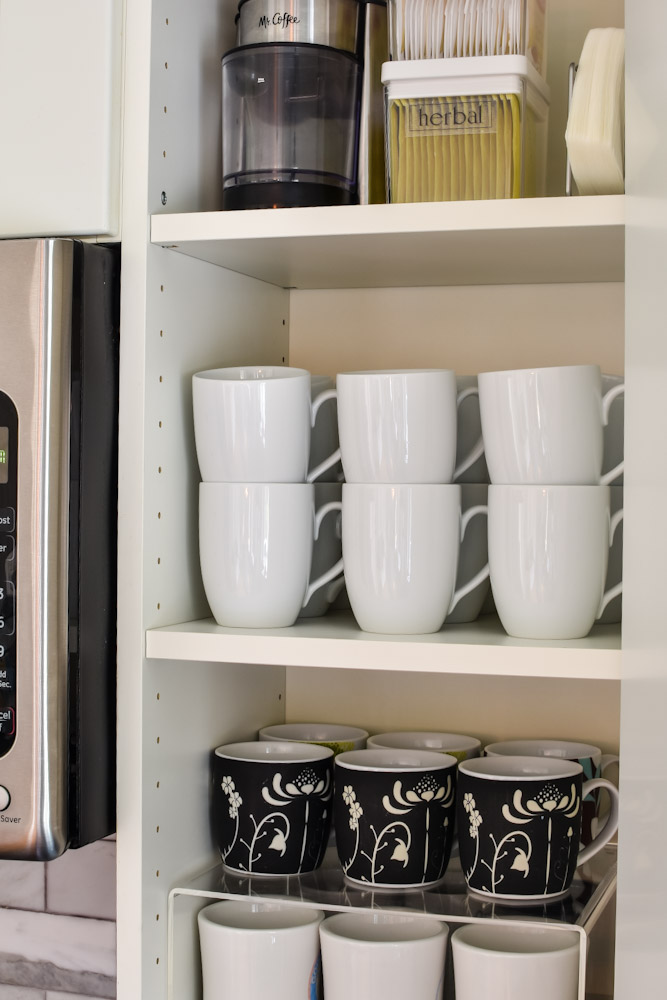
If your mugs are all one size, stacking is efficient and maximizes vertical space. However, not all mugs are stackable.
- Use stackable mugs with flat bottoms and straight sides.
- Never stack more than 2–3 mugs high to avoid tipping.
Beginner’s mistake: Stacking mugs with rounded bottoms or handles sticking out can cause chips and breakage.
Mug Hooks
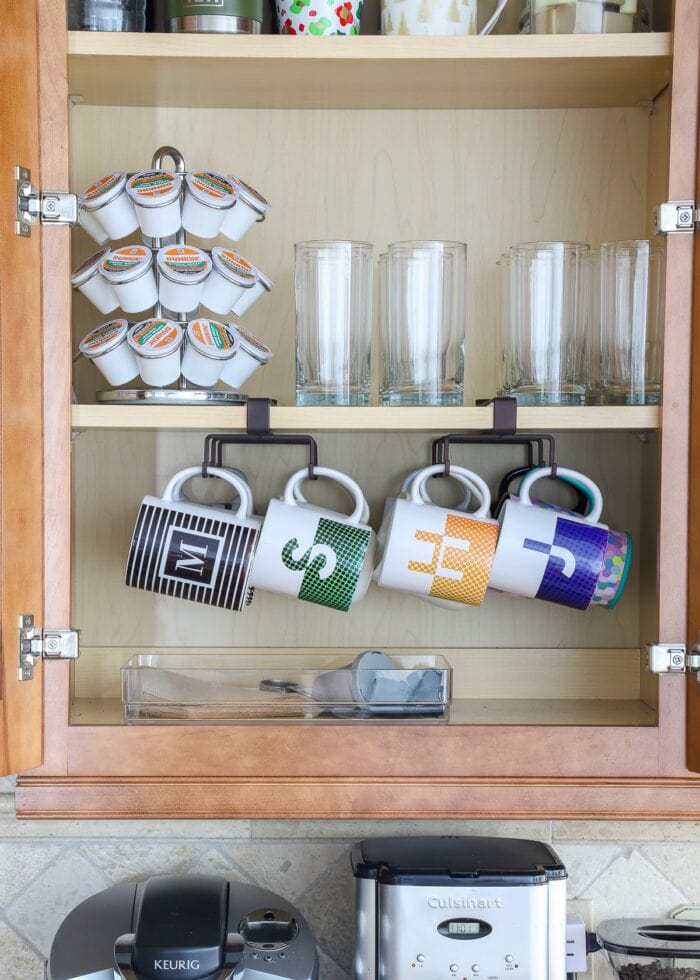
Install hooks under shelves or the top of the cabinet to hang mugs by their handles.
- Great for freeing up shelf space.
- Works best for sturdy mugs with large handles.
Non-obvious insight: Hanging mugs upside-down keeps dust out, especially if you don’t use them daily.
Mug Racks And Stands
A rack (horizontal or vertical) organizes mugs neatly and can fit inside a cabinet or on the counter.
- Racks with multiple tiers are ideal for small spaces.
- Choose a metal rack for durability and easy cleaning.
Mug Shelves And Risers
If your cabinet is tall, add a shelf riser. This creates a second level for mugs, making use of vertical space without stacking mugs on top of each other.
Example: A riser lets you keep everyday mugs on top and special occasion mugs below.
Pull-out Trays
Pull-out trays or sliding shelves make it easy to see all your mugs at once, especially in deep cabinets.
- Prevents mugs from getting lost at the back.
- Reduces the risk of bumping and breaking mugs.
Dividers Or Bins
For mismatched mugs or travel mugs, use small bins or dividers to keep everything in place.
- Group mugs by type or size for easy access.
- Bins also catch drips and make cleaning easier.
Comparison: Storage Solutions
Here’s a quick look at how popular solutions compare for different needs:
| Solution | Best For | Downside |
|---|---|---|
| Stacking | Uniform mugs, small cabinets | Risk of chipping; not for all mugs |
| Hooks | Large-handled mugs, more space | Not for delicate/irregular handles |
| Racks | Display, easy access | Takes up shelf space |
| Shelf Risers | Tall cabinets, more mugs | May not fit all cabinet types |
| Pull-Out Trays | Deep cabinets, large families | More expensive, needs installation |
| Bins/Dividers | Mismatched mugs, travel mugs | May reduce visible space |
Step 4: Sort And Arrange Your Mugs
Once you’ve picked a storage solution, it’s time to arrange your mugs. There are several smart ways to sort them for daily life:
By Frequency Of Use
Keep your most-used mugs front and center. Special occasion or seasonal mugs can go in the back or on higher shelves.
By Size And Shape
Group similar-sized mugs together. This prevents accidental tipping and makes stacking (if you do it) much safer.
By Set Or Theme
If you have matching sets, arrange them together for a neat, organized look. If you collect mugs from travel or events, group them by theme.
By User
In family homes, give each person their own section or row. This speeds up mornings and reduces fighting over the “best” mug.
Non-obvious insight: If you have children, store their mugs on a lower shelf for easy access.
Comparison: Mug Arrangement Methods
Here’s how different sorting strategies help in practice:
| Method | Good For | Main Benefit |
|---|---|---|
| Frequency of Use | Busy mornings, large families | Faster access to favorites |
| Size & Shape | Mixed mug collections | Reduces breakage risk |
| Set/Theme | Collectors, entertainers | Neat, coordinated appearance |
| User | Families, roommates | Personalized, less confusion |
Step 5: Make The Most Of Small Kitchens
Small kitchens need smart solutions. Here’s how to fit more mugs in less space:
- Use vertical space: Install hooks under shelves or on cabinet doors.
- Go corner to corner: Place mugs in the far ends of cabinets, saving the center for everyday items.
- Consider wall racks: If cabinet space is tight, use a wall-mounted rack or pegboard nearby.
- Double up: Use shelf risers or a two-tier rack to store mugs above and below.
- Rotate seasonally: Store holiday mugs elsewhere and swap them in as needed.
Extra tip: If you rarely use certain mugs, box them up and keep them in a closet to free up kitchen space.
Credit: smallishhome.com
Step 6: Keep Your Cabinet Safe And Clean
A well-organized cabinet is also a safe one. Here’s how to avoid accidents and keep things tidy:
- Leave space between mugs: Don’t cram mugs together. Handles should not overlap.
- Check shelf weight: Heavy mugs can stress weak shelves. Spread out the weight or reinforce shelves if needed.
- Clean regularly: Remove and wash all mugs and wipe the shelf every few months.
- Watch out for pests: In humid climates, check for bugs or mold, especially in the back corners.
Practical insight: If you live in an earthquake-prone area, consider using museum gel or sticky pads under display mugs.
Step 7: Organize For Special Needs And Families
Every household is different. Here’s how to adapt your mug storage:
For Families With Kids
- Keep kids’ mugs on the lowest shelf.
- Use plastic or metal mugs for children to avoid breakage.
- Label shelves or bins with names or pictures.
For Elderly Or Limited Mobility
- Avoid high or deep shelves.
- Use pull-out trays or lazy Susans for easy access.
- Choose lightweight mugs and keep them at the front.
For Collectors
- Use open racks or glass-front cabinets to display special mugs.
- Rotate displays seasonally to keep the look fresh.
- Store less-used or fragile mugs in padded bins elsewhere.
Step 8: Display Your Favorite Mugs
If you love your mug collection, why hide it? Displaying mugs can add personality to your kitchen and even start conversations.
- Use a decorative wall rack for special mugs.
- Hang mugs on hooks under open shelves.
- Arrange mugs by color or pattern for a bold look.
Example: A row of colorful mugs along a kitchen wall can brighten the whole room.
Insight: Displayed mugs collect dust faster. Choose mugs you use often, or wash them regularly.
Step 9: Maintain Your Mug Organization
Even the best system falls apart if you don’t maintain it. Here’s how to keep your mug cabinet organized for good:
- One-in, one-out: Every time you buy or receive a new mug, donate or recycle one.
- Regular checkups: Every few months, review your mugs and remove any you no longer use.
- Train your family: Show everyone the system and ask them to put mugs back correctly.
- Update as needed: If your needs change (new family member, move, etc. ), adapt your setup.
Real-life tip: Take a photo of your organized cabinet as a reference, so you can quickly reset it if it gets messy.
Step 10: Avoid Common Mug Organization Mistakes
Most mug organization failures come from a few simple mistakes:
- Overcrowding: Too many mugs in one cabinet causes chips and clutter.
- Random stacking: Stacking mugs of different shapes leads to accidents.
- Ignoring handle space: Handles need room—never squeeze mugs together.
- Neglecting deep cabinets: Mugs get lost at the back. Use trays or bins.
- Forgetting about kids or elderly: Store mugs where everyone can reach.
Non-obvious insight: If you love collecting mugs, set a maximum number before you start, not after. This prevents future clutter.
Step 11: Organizing Travel Mugs And Thermoses
Travel mugs and thermoses are often too tall or oddly shaped for regular shelves. Here’s how to handle them:
- Store them upright in a deep cabinet or tall bin.
- Use a separate section, so they don’t mix with coffee cups.
- Store lids in a small basket or bin to prevent loss.
- Clean and air-dry thoroughly before storing to prevent smells.
Credit: thehomesihavemade.com
Step 12: Organize Mugs For Entertaining
Love hosting friends or family? Smart mug organization makes serving easier:
- Store matching sets together for quick access.
- Use a tray or caddy to carry several mugs at once.
- Keep mugs near your coffee maker or tea kettle.
- For large gatherings, consider a portable mug rack.
Practical tip: Keep extra mugs in a nearby cabinet or shelf for larger parties.
Step 13: Maximizing Space With Cabinet Modifications
If you want to go further, small cabinet modifications can add space and order:
- Install adjustable shelves to fit mugs of all heights.
- Add pull-out drawers for easier access to back-row mugs.
- Attach hooks or pegboards to the inside of cabinet doors.
- Use under-shelf baskets for lightweight mugs or lids.
Example: Adding one extra shelf in a standard 24-inch cabinet can increase mug capacity by 20–30%.

Credit: bellaorganizing.com
Step 14: Sustainable Mug Organization
Organizing mugs is also a chance to be more sustainable:
- Donate extra mugs to local shelters, schools, or charities.
- Recycle broken mugs—some cities accept ceramics in special bins.
- Repurpose chipped mugs as plant pots or pen holders.
External Resource: For more on sustainable kitchen practices, visit EPA: Reducing Waste – What You Can Do.
Step 15: Advanced Tips And Tricks
Ready to take your mug cabinet to the next level? Try these:
- Color code by drink type: Tea mugs in one color, coffee mugs in another.
- Use chalkboard labels on shelves for easy organizing.
- Install soft-close hinges to prevent mug movement when closing doors.
- Place silica gel packets to keep humidity down in humid climates.
Pro tip: If you have expensive or collectible mugs, store them on a cushioned shelf or line the shelf with felt.
Step 16: When To Reorganize
Your mug organization should adapt as life changes. Here’s when to review your setup:
- After moving to a new home
- When your family grows or shrinks
- If you start a new coffee or tea habit
- After holidays if you get new mugs as gifts
- When you notice mugs piling up on counters
Non-obvious insight: Set a calendar reminder every 6 months to review your mug cabinet—it keeps clutter from creeping back.
Frequently Asked Questions
How Many Mugs Should I Keep In My Cabinet?
Most households need only 4 to 8 mugs for daily use. If you host guests often, keep a few extras. Declutter any mugs you rarely use, are chipped, or are purely sentimental. Aim to keep only what fits comfortably in your cabinet without overcrowding.
What Is The Best Way To Store Mugs In A Small Kitchen?
For small kitchens, use vertical space with hooks or racks, add a shelf riser, or use the inside of cabinet doors for extra storage. Only keep your favorite mugs in the kitchen; store extras elsewhere. Prioritize easy access and safety.
Can I Stack All Types Of Mugs?
No. Only stack mugs with flat bottoms and straight sides. Stacking irregular or delicate mugs increases the risk of chipping or breaking. Limit stacks to 2–3 mugs high, and never stack mugs with handles that touch each other.
How Do I Prevent Mugs From Getting Dusty In The Cabinet?
Hang mugs upside down on hooks to keep dust out. If your cabinet is rarely used, store mugs in bins with lids or behind closed doors. Regularly clean your cabinet, and rotate mugs so they all get used.
What Should I Do With Mugs I Don’t Want To Keep?
Donate usable mugs to charities, shelters, or schools. Recycle broken mugs if your area allows. For sentimental mugs, take a photo before letting them go. Repurpose chipped mugs as planters or pen holders.
Organizing mugs in your cabinet is a small project that brings daily benefits. With a little effort, you can create a space that’s practical, safe, and even beautiful. Every time you reach for your favorite mug, you’ll be glad you took the time to get organized.