
A hot shower can be one of the simplest pleasures in daily life. When you turn the shower faucet expecting a stream of warm water and only get lukewarm or cold, it’s frustrating. Many homeowners face a common issue: the shower faucet won’t turn all the way to hot. This problem doesn’t just affect comfort; it can point to bigger plumbing concerns, wasted energy, or even safety risks if the water temperature is unpredictable.
Understanding why your shower isn’t delivering hot water as it should is important. The reasons range from simple fixes to complex plumbing repairs. In this article, you’ll discover why your shower faucet won’t turn to hot, how to diagnose the cause, and what solutions really work.
We’ll also help you decide when you can fix the problem yourself and when you should call a professional. If you want a complete guide that covers both quick checks and deeper technical issues, you’re in the right place.
How Shower Faucets Control Water Temperature
Before diving into problems and solutions, it’s useful to know how shower faucets mix hot and cold water. Most modern showers use a mixing valve. When you turn the handle, the valve blends hot and cold water from your pipes to reach your chosen temperature.
There are several common types of shower valves:
- Single-handle mixing valves: One lever controls both flow and temperature.
- Double-handle systems: One handle for hot, one for cold.
- Thermostatic valves: Maintain a set temperature, even if water pressure changes.
If the faucet won’t go all the way to hot, something is likely blocking or limiting the hot water flow, or the valve isn’t mixing correctly. Knowing your valve type helps with diagnosis.
Common Reasons The Shower Faucet Won’t Turn All The Way To Hot
Several things could stop your shower faucet from reaching hot water. Here are the most frequent causes:
1. Temperature Limit Stop Or Scald Guard Setting
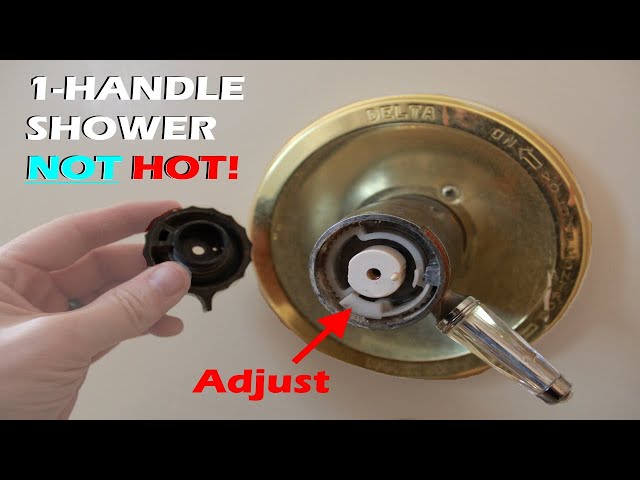
Most single-handle faucets have a temperature limit stop (also called a “scald guard”) to prevent water from getting too hot. If this is set too low, you can’t turn the handle far enough for hot water.
2. Cartridge Problems
Inside the faucet, a cartridge controls the mix of hot and cold. Over time, mineral buildup or wear can make it stick, jam, or fail to open fully for hot water.
3. Water Heater Issues
If the water heater isn’t working right, the hot supply to your shower will be limited. Problems include low temperature settings, sediment in the tank, or a failing heating element.
4. Cross-connected Pipes
Improper plumbing can let cold water “cross over” into hot lines, making the water lukewarm even with the handle turned fully.
5. Supply Line Blockages
Clogs or partial blockages in the hot water pipe can reduce flow. Common causes are mineral deposits or rust, especially in older homes.
6. Pressure-balancing Valve Malfunction
Pressure-balance valves are supposed to keep water temperature steady even if pressure changes. When these fail, they can limit hot water.
7. Broken Or Misaligned Handle
Sometimes, the handle itself is cracked or slipping on the valve stem, so it can’t rotate fully.
8. Shower Valve Not Fully Opened During Installation
After repairs or installation, the valve may not be fully opened, limiting hot water range.
9. Thermostatic Valve Problems
If you have a thermostatic mixing valve, it could be stuck or not responding to temperature changes.
10. Hot Water Demand Exceeds Supply
If several people are using hot water at the same time, your shower may not get enough.
Diagnosing The Problem
Solving the issue starts with proper diagnosis. Here’s how you can narrow down the cause:
Check Other Faucets
Test hot water at other taps in your home. If all taps have weak or lukewarm hot water, the problem is likely with your water heater or main hot water supply.
Isolate To The Shower
If only the shower has the issue, focus on the faucet, mixing valve, or shower plumbing.
Examine The Faucet Handle
Remove the faucet handle (usually held by a screw) and check for broken or stripped parts. If it’s loose, it may not be turning the valve fully.
Inspect Temperature Limit Stop
Look for a plastic or metal disk behind the handle – this is the temperature limit stop. If set too low, adjust it (see the next section).
Listen For Odd Noises
Hissing, banging, or rattling when you turn the faucet can signal blockages or valve problems.
Notice Any Sudden Changes
If the problem started after recent plumbing work, the valve may be misaligned or not fully open.
How To Fix A Shower Faucet That Won’t Turn All The Way To Hot
Once you know the likely cause, you can try one or more of these solutions. Some fixes are easy, others require plumbing skills.
Adjust The Temperature Limit Stop (scald Guard)
This is one of the most common and easiest fixes.
- Turn off the water supply (if needed).
- Remove the faucet handle (usually a screw under the cap).
- Find the temperature limit stop – a plastic or metal piece that stops the handle turning further.
- Adjust it: Move the stop to allow more rotation toward hot.
- Reassemble the handle and test the water temperature.
Most manufacturers have guides for this; check their website for your model.
Replace Or Clean The Cartridge
A sticky or clogged cartridge will block hot water.
- Shut off the water supply to the shower.
- Remove the handle and escutcheon plate.
- Pull out the cartridge (you may need pliers).
- Inspect for mineral deposits or damage.
- Soak in vinegar to remove limescale, or replace with a new cartridge if worn.
- Reassemble and test.
Cartridges are model-specific. Bring the old one to a hardware store to find a match.
Check And Adjust Water Heater Settings
If all hot water taps are cold or lukewarm:
- Set the water heater thermostat to 120-140°F (49-60°C)
- Flush the tank to remove sediment
- Test if the heater recovers temperature after use
If the heater is old (10+ years), it may need replacement.
Fix Cross-connected Pipes
This is more complex. If cold water is mixing into hot lines, a plumber may need to correct the pipe layout.
Clear Supply Line Blockages
If you suspect a blockage, turn off water, disconnect the hot supply line to the shower, and check for debris.
Replace A Faulty Pressure-balancing Valve
If the pressure-balance valve is stuck, it may need cleaning or replacement. This often means removing the valve body from the wall, so consider calling a pro.
Repair Or Replace The Handle
If the handle is cracked or stripped, replace it with a matching part. Make sure the new handle fits tightly.
Reinstall Or Reposition The Valve
If the valve was not installed fully open, loosen and adjust it so the handle has full range.
Service Or Replace Thermostatic Valve
Thermostatic valves can sometimes be reset or recalibrated by following the manufacturer’s instructions. If not, replacement may be needed.
Reduce Hot Water Demand
Try staggering showers and laundry, or upgrade to a larger water heater if your household outgrows the current one.
Step-by-step: Adjusting A Temperature Limit Stop
Let’s walk through a practical example. Suppose your single-handle shower faucet won’t turn all the way to hot.
- Gather Tools: Phillips screwdriver, flathead screwdriver, towel.
- Turn Off Water (optional): Some models let you adjust with water on, but for safety, shut off water at the valve.
- Remove Handle Cap: Pry off the decorative cap to reveal the handle screw.
- Unscrew and Remove Handle: Keep screws in a safe place.
- Locate the Limit Stop: You’ll see a plastic or metal piece that blocks rotation.
- Adjust: Move the stop slightly to allow more rotation toward hot. Don’t set it to maximum right away—test gradually.
- Reassemble and Test: Put the handle back and turn on the water. Check the temperature.
- Fine Tune: Repeat as needed for safe but comfortable hot water.
Tip: Always test with a thermometer to make sure water doesn’t get dangerously hot, especially if children use the shower.
When To Call A Professional
Some problems need expert help. Call a licensed plumber if:
- You find cross-connected pipes or suspect major plumbing errors
- The valve is inside the wall and you’re not comfortable disassembling it
- There are major leaks or water damage
- The cartridge or valve body is stuck and won’t come out
- You have old galvanized pipes with heavy rust or debris
A pro has the tools and experience to fix complex or hidden issues without damaging your home.

Credit: www.reddit.com
Table: Common Causes And Diy Difficulty
Here’s a quick comparison of causes and whether you can usually fix them yourself.
| Cause | DIY-Friendly? | Tools Needed | Typical Cost |
|---|---|---|---|
| Temperature Limit Stop | Yes | Screwdrivers | Free |
| Cartridge Replacement | Yes/Maybe | Pliers, Screwdrivers | $20–$50 |
| Water Heater Settings | Yes | Thermometer | Free |
| Cross-Connected Pipes | No | Plumbing tools | $150–$500+ |
| Supply Line Blockage | Maybe | Wrenches | $0–$100 |
| Pressure-Balancing Valve | Maybe | Pliers, Screwdrivers | $30–$150 |
| Broken Handle | Yes | Screwdrivers | $10–$30 |
Table: Signs Of Each Shower Faucet Issue
Identifying the exact cause is easier if you know what to look for. Here’s a summary.
| Symptom | Likely Cause | Check This First |
|---|---|---|
| Handle stops before “hot” | Temperature limit stop | Remove handle, check stop |
| Handle turns but only lukewarm | Cartridge/Valve | Inspect cartridge |
| All taps have cool hot water | Water heater issue | Check heater settings |
| Shower only; sudden problem | Installation or valve alignment | Check recent work |
| Intermittent hot water | Pressure-balance or demand | Test with other fixtures on/off |
| Handle wobbly, doesn’t rotate fully | Broken handle | Inspect handle and stem |
Two Non-obvious Issues That Can Block Hot Water
Many homeowners miss these factors:
1. Hidden Mineral Deposits In The Valve Body
Even if you clean or replace the cartridge, hard water can cause scale inside the valve body itself. This restricts movement and blocks hot water. Sometimes, only a full valve replacement solves the problem.
2. Incorrect Replacement Parts
If a cartridge or handle is replaced with the wrong model (even if it fits), it can limit the rotation and hot water range. Always match parts by brand and model number.
How To Prevent Shower Faucet Problems
Preventing issues saves time and money. Here’s what you can do:
- Flush your water heater every 6–12 months to reduce sediment.
- Clean faucet aerators and shower heads regularly to prevent buildup.
- Check for leaks and fix them early to avoid bigger plumbing problems.
- Use water softeners if you have hard water—this reduces mineral scaling.
- Hire a pro for major plumbing changes to avoid cross-connection mistakes.
What If You Live In An Older Home?
Older homes often have unique challenges:
- Galvanized pipes rust and clog more easily, blocking hot water.
- Valves may be obsolete; finding replacement parts can be tricky.
- Access panels may not exist, making repairs harder.
If your shower faucet or pipes are very old, replacement is often more cost-effective in the long term.
How Much Does It Cost To Fix A Shower Faucet That Won’t Turn To Hot?
Costs depend on the cause and whether you DIY or hire a pro.
- Adjust temperature stop: Free (DIY), $50–$100 (pro)
- Replace cartridge: $20–$50 (DIY), $100–$250 (pro)
- Replace valve: $50–$200 (DIY parts), $300–$800+ (pro)
- Water heater repairs: $0–$500+, depending on part
- Major plumbing (cross-connected pipes): $150–$500+
Always get quotes before large jobs. If you’re unsure, a diagnostic visit from a plumber can clarify the cause for a small fee.
Credit: www.youtube.com
Safety Tips When Working With Shower Faucets
- Turn off water supply before removing handles or valves.
- Test water temperature after repairs to avoid scalding.
- Wear gloves to protect hands from sharp edges or hot parts.
- Keep small parts organized during disassembly.
- Double-check for leaks before replacing wall covers or escutcheons.
If you need guides for your specific faucet, check the manufacturer’s website or user manual. For example, The Home Depot offers step-by-step repair instructions for common brands.
When Replacement Is Better Than Repair
If your faucet or valve is very old, repair may only be a short-term solution. Consider replacement if:
- The valve is over 15 years old
- There is heavy mineral buildup or corrosion
- Replacement parts are hard to find
- Leaks keep returning
- You want to upgrade to a modern thermostatic or pressure-balanced valve for better comfort and safety
A new valve often improves water temperature control, flow rate, and reliability.
How To Choose The Right Replacement Parts
Here’s what matters when buying new parts:
- Brand and model: Always match the manufacturer (e.g., Moen, Delta, Kohler).
- Type of valve: Single-handle, double-handle, thermostatic, pressure-balanced.
- Size and fit: Bring the old part to the store or check model numbers.
- Material: Brass lasts longer than plastic.
- Included parts: Some cartridges come with O-rings and seals; others don’t.
Avoid the mistake of buying a “universal” part without checking compatibility—it can limit handle rotation or leak.
Table: Comparison Of Common Valve Types
To help you decide if you need to upgrade, here’s a quick look at popular valve types.
| Valve Type | Main Feature | Best For | Common Problems |
|---|---|---|---|
| Single-handle mixing | Simple control | Most homes | Cartridge wear, limit stop issues |
| Double-handle | Separate hot/cold | Older homes | Washer leaks, stem jams |
| Pressure-balanced | Stable temp | Multi-user homes | Valve sticking |
| Thermostatic | Precise temp | High-end showers | Thermostat failure |
Real-world Example: Fixing A Stuck Cartridge
Imagine you have a Moen single-handle shower and only get warm water. You remove the handle, pull the cartridge, and see it’s covered in white mineral deposits. After soaking it in vinegar for an hour, you reinstall, but still only get warm—not hot.
You buy a new cartridge (matching model) and install it. Now, the faucet turns fully and you get hot water.
Insight: Cleaning sometimes isn’t enough—mineral deposits inside the valve body can also block movement. Replacement is often faster and more reliable.
What If The Problem Returns?
If your shower faucet keeps losing hot water range:
- Re-check the temperature limit stop; it can slip if not tightened.
- Inspect for new mineral deposits—hard water may require regular cleaning or a softener.
- Make sure the handle isn’t stripped or loose.
- If your water heater is old, consider replacement.
Persistent problems usually mean a deeper issue—don’t keep replacing cartridges if the main valve or plumbing is failing.

Credit: www.youtube.com
Frequently Asked Questions
Why Does My Shower Only Get Warm, Not Hot, Even Though The Sink Gets Hot Water?
If your sink gets hot water but your shower does not, it’s often a problem with the shower faucet’s cartridge or temperature limit stop. The cartridge may be clogged or worn, or the stop is set too low. Try adjusting or replacing these parts before checking for deeper plumbing issues.
Can A Faulty Mixing Valve Cause The Shower Faucet Not To Turn All The Way To Hot?
Yes, a faulty mixing valve is a very common cause. If the valve is stuck, blocked by debris, or worn out, it may not allow enough hot water to pass even if you turn the handle all the way. Replacing the cartridge or valve usually solves this problem.
How Do I Know If My Shower Cartridge Needs Replacing?
Signs your cartridge needs replacing include the handle feeling stiff, water temperature not changing smoothly, or leaking from the faucet. If cleaning the cartridge does not help, and you still can’t reach hot water, a new cartridge is usually the best fix.
Is It Safe To Adjust The Temperature Limit Stop Myself?
Yes, adjusting the temperature limit stop is safe for most homeowners. Always move the stop in small increments and test the temperature with a thermometer to avoid scalding. If unsure, consult your faucet’s manual or a plumber.
What Temperature Should My Water Heater Be Set To For Safe Showers?
The recommended water heater temperature is 120°F (49°C) for safety and energy savings. This is hot enough for comfort and to prevent bacteria, but not so hot as to risk burns, especially for children and the elderly. For more details, see CDC guidance on water temperatures.
A shower that won’t turn all the way to hot can be annoying, but with the right steps you can solve most issues yourself or know when to call for help. Regular maintenance and a bit of troubleshooting knowledge go a long way toward keeping your showers comfortable and safe.