
Sizing the right gas line for your 400,000 BTU pool heater is not just about following codes. It’s about ensuring safety, efficiency, and the long-term health of your pool system. If you use the wrong line size, your heater may underperform, turn off unexpectedly, or even pose safety risks. This guide will walk you through everything you need to know—explained in simple terms, and with practical tips, so you can make smart choices and avoid common mistakes.
Most pool owners want reliable heat and easy maintenance. But when it comes to gas lines, things can get confusing. You’ll see numbers, codes, and charts that might not make sense at first. This article breaks everything down for you, step by step, covering all the key considerations for a 400,000 BTU pool heater gas line size—from the basics of BTU and gas types, through to how pipe material and length affect sizing, plus real-world examples, expert insights, and answers to common questions.
What Does 400,000 Btu Mean For Your Pool Heater?
BTU stands for British Thermal Unit. It’s a measure of heat energy. When you see “400,000 BTU,” that tells you how much heat your pool heater can produce per hour. For large pools, this is a common size—giving you fast heating and steady temperature control even in cooler weather.
But high BTU means high gas demand. A 400,000 BTU heater needs a lot more gas than a smaller unit. If the gas line is too small, the heater won’t get enough fuel. It may run poorly or shut down. So, the gas line size must match the heater’s needs.
A heater of this size is chosen for pools that are used often or where fast temperature recovery is needed, like after a cold night or when opening the pool for the season. If your pool is 30 feet or longer, or you live in a climate with cool evenings, a 400,000 BTU heater will keep the water comfortable much faster than a smaller model.
It’s also important to remember that the BTU rating isn’t about how “hot” the heater gets, but how much heat it can transfer to the water every hour. For example, a 400,000 BTU heater can raise the temperature of a 20,000-gallon pool by about 1.
6°F each hour under ideal conditions. But if your gas supply can’t keep up, those numbers drop fast.
Why Gas Line Size Is So Important
Choosing the right gas line size is about more than just connecting pipes. Here’s why it matters:
- Safety: Undersized lines can cause low pressure, incomplete combustion, and dangerous carbon monoxide buildup.
- Performance: Your heater may run weakly or not reach the set temperature.
- Longevity: Straining the system can cause early wear and maintenance problems.
- Efficiency: Correct sizing means less wasted energy and lower gas bills.
A common beginner mistake is assuming “any pipe will do,” or copying what a neighbor uses. But pipe sizing depends on your heater’s BTU, the gas type (natural gas or propane), the distance from the meter, and the pipe material.
If your gas line is too small, the heater might “short-cycle”—turning on and off often, which wears out internal parts quickly. Low pressure also means the heater’s safety systems may shut it down, leaving you with cold water and frustration.
Proper sizing prevents these issues and gives you reliable performance year after year.
Basic Gas Line Sizing Concepts
Before we get into exact numbers, let’s look at the main ideas:
- Gas flow rate is measured in cubic feet per hour (CFH).
- The further the gas has to travel, the bigger the pipe needs to be (to prevent pressure loss).
- Pipe material affects how much gas can flow (iron, copper, plastic, etc. ).
- Fittings (bends, tees, valves) create resistance—so always plan for a bit larger than the bare minimum.
For a 400,000 BTU heater, the gas line must handle that demand comfortably, even if other appliances share the line.
A non-obvious point: Even small details like how many elbows are used, or the quality of pipe threading, can make a measurable difference in pressure drop. Professional installers often use software or detailed tables to fine-tune sizing, but you can avoid most trouble by simply sizing up if you’re close to the limit.
Btu To Cubic Feet Per Hour: The Math
To size your line, you need to convert BTUs to CFH (cubic feet per hour), which is how gas flow is measured.
- For natural gas: 1 cubic foot = 1,000 BTUs
- For propane: 1 cubic foot = 2,500 BTUs
So, for a 400,000 BTU heater:
- Natural gas: 400,000 ÷ 1,000 = 400 CFH
- Propane: 400,000 ÷ 2,500 = 160 CFH
You’ll use these numbers when looking at pipe sizing charts.
A beginner mistake is to confuse BTU input (how much energy the heater consumes) with BTU output (what goes into the pool). For gas line sizing, always use the input rating from the heater’s data label.
Factors That Affect Gas Line Size
Let’s break down the main factors:
- Gas Type: Natural gas and propane have different energy content and pressure, so they use different pipe sizes.
- Pipe Length: The longer the run, the larger the pipe needed (to overcome friction and pressure drop).
- Pipe Material: Black iron, copper, and plastic all handle gas differently.
- Number of Appliances: If your pool heater shares a line with other appliances, add up the total BTU demand.
- Local Codes: Always check with your city or installer—some regions have special rules.
Also, remember to factor in elevation if you’re at high altitude. Gas volume and pressure behave differently above 2,000 feet, so your installer might adjust sizing upward to compensate.
Common Gas Line Sizes For 400,000 Btu Pool Heaters
While every installation is unique, here are typical line sizes for a 400,000 BTU natural gas pool heater at various distances:
| Distance (Feet) | Pipe Size (Inches) | Material | BTU Capacity |
|---|---|---|---|
| 10-20 | 1-1/4″ | Black Iron | ~450,000 |
| 20-50 | 1-1/2″ | Black Iron | ~700,000 |
| 50-100 | 2″ | Black Iron | ~1,200,000 |
These numbers can vary depending on pipe fittings, pressure, and local codes. It’s always safer to go one size up if you’re close to the limit.
A detail people miss: Sizing charts often assume a “worst-case” pressure drop, but if your gas meter is already near its maximum flow, you may need to upsize both the line and the meter itself.
Credit: jfreeman.dev
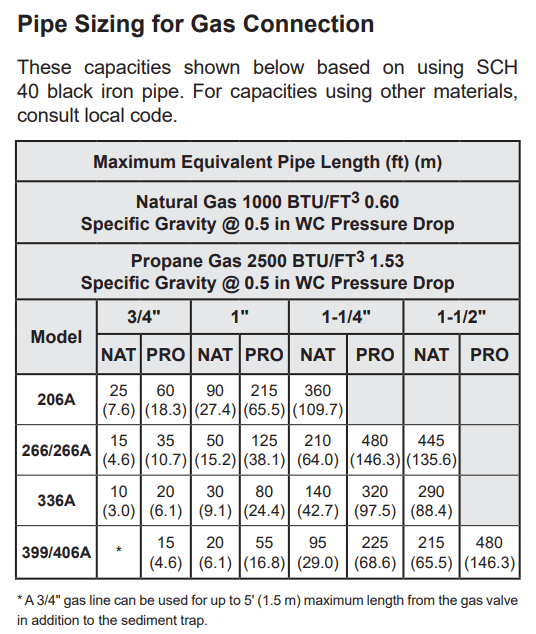
Step-by-step: How To Size Your Gas Line
Let’s walk through the process for a 400,000 BTU pool heater:
- Calculate Total BTUs
- If only the pool heater is on the line: 400,000 BTUs.
- If sharing with other appliances, add their BTUs.
- Convert to CFH
- Natural gas: 400,000 ÷ 1,000 = 400 CFH.
- Measure Pipe Length
- Measure the actual distance from the gas meter or tank to the heater, including all turns.
- Check Sizing Chart
- Use a chart for your pipe material and gas type.
- Find the pipe size that supports your total CFH at the measured length.
- Account for Fittings
- Add 5-10% to the length to account for bends, tees, and valves.
- Consult Local Codes or a Pro
- Rules can vary, so double-check.
Example Calculation
Suppose your heater is 60 feet from the meter, and you’re using black iron pipe with only the heater on the line:
- 400,000 BTU = 400 CFH
- 60 feet + 10% (for fittings) = 66 feet
- From the chart above, a 1-1/2″ iron pipe handles up to ~700,000 BTU at this distance. So, 1-1/2″ is correct.
Non-obvious tip: If you plan to add another appliance later (like an outdoor kitchen), consider sizing up now. It’s much harder to upgrade the pipe once everything is buried.
It’s also wise to check the main gas meter’s capacity. If your home’s meter can’t provide enough flow for the heater and other appliances at the same time, you may need a meter upgrade—a step that’s often overlooked until the heater won’t run reliably.
Natural Gas Vs Propane: What’s Different?
Natural gas is common in cities, while propane is used in rural areas with tanks. Key differences:
- Pressure: Propane is delivered at higher pressure, so smaller pipes can often be used.
- BTU per cubic foot: Propane has more energy per cubic foot (2,500 BTU), so you need less volume.
- Pipe material: Some codes restrict copper for natural gas, but allow it for propane.
Here’s a quick comparison:
| Feature | Natural Gas | Propane |
|---|---|---|
| BTU per cubic foot | 1,000 | 2,500 |
| Typical pressure | 0.5 psi | up to 10 psi |
| Pipe size needed (for 400,000 BTU at 60 ft) | 1-1/2” | 1” |
Pro insight: Even though propane can use smaller pipes, installers often use iron pipe for both gases for strength and code compliance.
Another practical tip: If your propane tank is far from the pool, installers may use high-pressure pipe for the long run and a regulator near the heater to drop the pressure to appliance level. This can reduce pipe size and cost, but always needs proper planning.
Pipe Materials: Pros And Cons
You’ll see several choices for pool heater gas lines:
Black Iron Pipe
- Strong, durable, and standard for most installations
- Handles both natural gas and propane
- Requires threading and cutting
Black iron is the industry standard, especially above ground. It’s not affected by sunlight or temperature swings and is rarely damaged by landscaping work.
Copper
- Flexible and easy to install
- Usually allowed only for propane (check local codes)
- Can corrode with natural gas
Copper is sometimes chosen for short runs where flexibility is needed. However, it’s soft and can be easily bent or pierced, so it’s not for exposed locations.
Polyethylene (pe) Plastic
- Used for underground runs
- Needs special fittings and transitions
- Must be installed by a qualified pro
PE is great for long, straight underground lines. It doesn’t rust and resists root intrusion. But it can’t be used above ground and must be transitioned to metal pipe before entering the house or heater.
Corrugated Stainless Steel Tubing (csst)
- Flexible, easy to route around obstacles
- Requires grounding/bonding for safety
CSST is popular for remodeling, as it can snake through tight spaces. However, it’s sensitive to lightning strikes, so proper electrical bonding is essential.
Non-obvious tip: For long underground runs, PE is often cheaper and easier to install, but always check if your area allows it.
Another detail: When using mixed materials (like PE underground and iron above), make sure the transition fittings are designed for gas, not water. This avoids leaks and corrosion problems.
How Pipe Length And Fittings Affect Sizing
Every foot of pipe creates friction, which lowers gas pressure. The longer the run, the bigger the pipe needs to be. And every fitting (elbow, tee, union) adds resistance too.
Practical rule: Add about 2 feet to your total length for every 90-degree bend in the pipe.
If you have a complicated run with many turns, size up your pipe to keep pressure strong.
Also, check for any “choke points” where the pipe narrows or splits. Even a short section of smaller pipe can limit the whole system’s flow. It’s best to keep the entire run at the recommended size.
Credit: montanafirepits.com
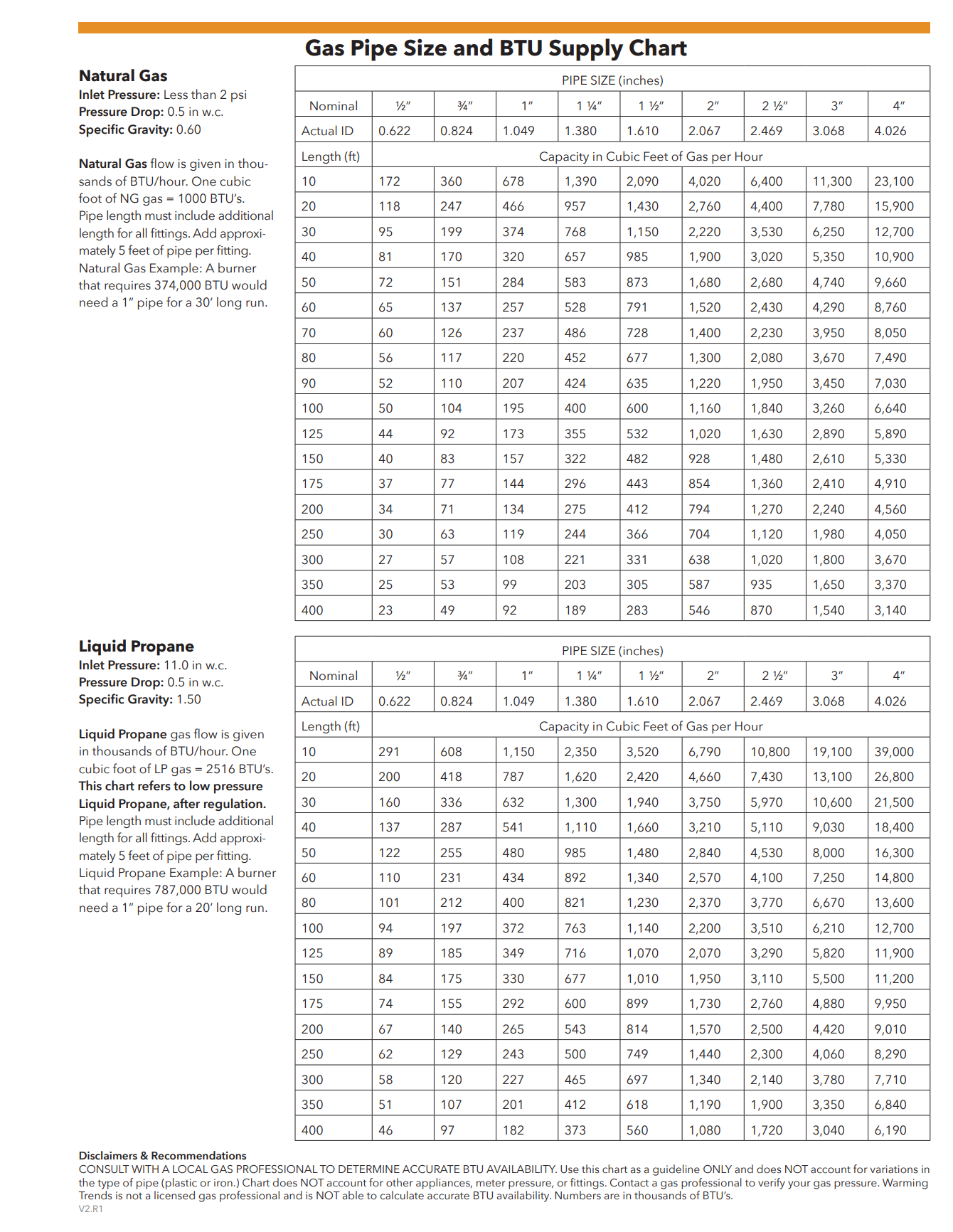
Sizing Chart: Common Black Iron Pipe Sizes
Here’s a reference for black iron pipe capacity for natural gas at 0.5 psi:
| Pipe Size | 10 ft | 20 ft | 40 ft | 60 ft | 100 ft |
|---|---|---|---|---|---|
| 1″ | 285,000 | 195,000 | 136,000 | 110,000 | 82,000 |
| 1-1/4″ | 547,000 | 374,000 | 259,000 | 210,000 | 157,000 |
| 1-1/2″ | 850,000 | 590,000 | 410,000 | 330,000 | 247,000 |
| 2″ | 1,600,000 | 1,090,000 | 760,000 | 620,000 | 472,000 |
So, for a 400,000 BTU heater at 60 feet, 1-1/2” pipe is suitable (handling up to 330,000 BTU at 60 feet). But remember to go up a size if you have many fittings or future needs.
A helpful tip: If your line is close to the maximum listed BTU, and your climate is cold or you’re at high altitude, always jump up to the next pipe size.
Installation Tips And Best Practices
- Use straight runs where possible—fewer turns means less pressure loss.
- Slope outdoor pipes slightly away from the house to prevent water buildup.
- Support long runs every 4-6 feet to prevent sagging.
- Pressure test the system before use (required by code).
- Label shut-off valves clearly.
Non-obvious insight: If you’re running the line underground, use caution to avoid tree roots, driveways, or future landscaping plans.
Another practical tip: Use thread sealant or Teflon tape that is rated for gas lines. Some types are only for water and can break down in gas applications.
If you ever smell gas after installation, shut off the supply immediately and call a pro. Never ignore a gas smell, even if it seems faint.
Common Mistakes To Avoid
- Guessing the size: Always use charts, not gut feeling.
- Ignoring fittings: Bends and tees add resistance—add extra length for each fitting.
- Mixing pipe materials: Transitions require special fittings and can leak if done wrong.
- Skipping permits: Gas work is serious—permits protect you and ensure safe work.
- Using old or rusty pipe: Always use new, code-approved pipe.
Another often-missed mistake: Relying on general plumber’s advice rather than someone who specializes in gas pool heaters. Pool heaters have different needs than kitchen ranges or small water heaters.
Real-world Example: Suburban Pool Heater Install
Let’s look at a typical case. John wants to install a 400,000 BTU natural gas heater for his 20×40 foot pool. The gas meter is 80 feet from the heater location. No other appliances share the line.
- BTU: 400,000
- Pipe length: 80 feet + 10% = 88 feet
- Sizing chart: 1-1/2” black iron pipe can carry up to 247,000 BTU at 100 feet—too small.
- Solution: Upgrade to 2” black iron pipe, which handles up to 472,000 BTU at 100 feet.
John chooses 2” pipe, even though it costs more, because it guarantees reliable heater performance and meets code.
A bonus: John’s installer also checks the gas meter size and finds it’s right at its limit. They coordinate with the utility to upgrade the meter—a step that saves future headaches.
Permits, Codes, And Professional Installation
Gas lines must meet strict local codes. Cities often require:
- Permits before work starts
- Inspections after installation
- Licensed installers for any gas work
Never try to install a gas line yourself unless you’re qualified. Improper installation can cause leaks, fires, or even explosions.
For more details, check with your local building department or see this NFPA code resource.
A non-obvious safety point: If you ever move your pool equipment or add a new deck, always re-check your gas lines for proper support and clearances. Building inspectors often find lines buried too shallow or without proper protection.
Upgrading Or Replacing An Existing Gas Line
Many pool owners replace older heaters with larger models. Before upgrading:
- Check your existing line size. Older lines may be too small for today’s large heaters.
- If the old line is undersized, you’ll need to upgrade the pipe.
- Don’t “cheat” by cranking up the pressure—this is unsafe and illegal.
If you plan to add other appliances (fire pit, BBQ), factor those in now.
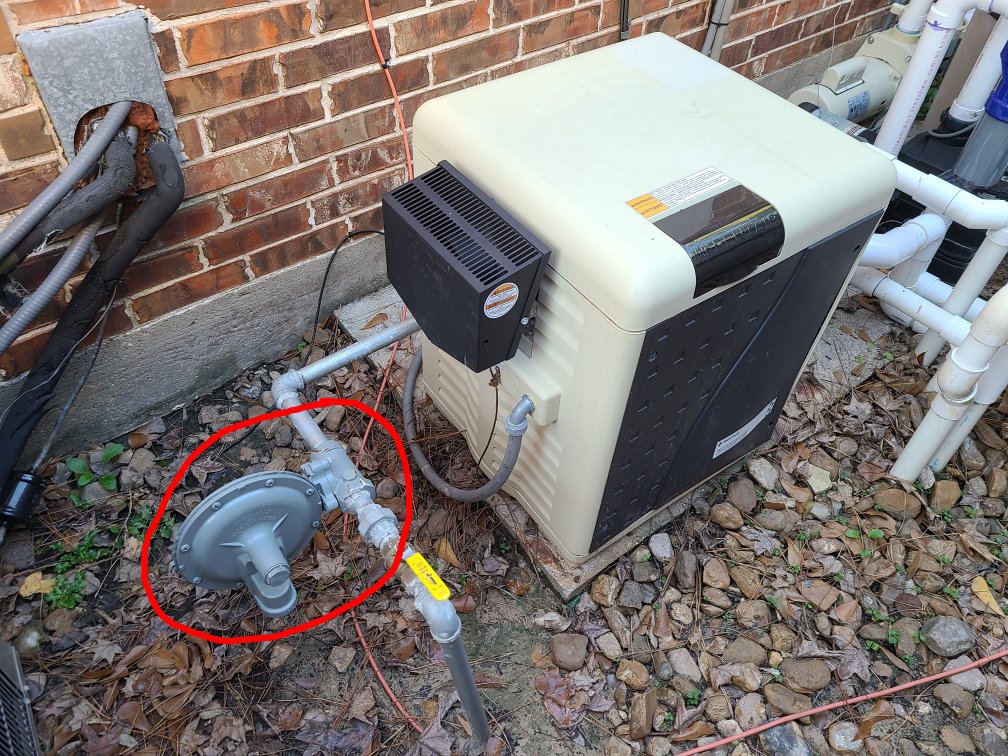
A detail that’s easy to miss: When swapping out a heater for a bigger one, the gas regulator may also need to be changed to match the higher flow rate. Always check the manufacturer’s requirements.
Credit: www.troublefreepool.com
Weather And Climate Considerations
Cold climates may require longer heating cycles, putting more demand on the gas line. In areas with freezing soil, use proper burial depth and insulation to prevent pipe damage.
Expert advice: For buried lines, use caution near driveways or heavy traffic areas—crushed pipe can cause leaks.
If you live in a region with frequent freeze-thaw cycles, consider using flexible connectors at the heater. This allows for slight ground movement without stressing the connections.
Future-proofing Your System
If you might add a spa, outdoor kitchen, or fire feature, size your gas line for future needs now. It’s much cheaper to install a larger line at the start than to dig up your yard later.
When in doubt, go a size larger. It rarely adds much cost, but can save big headaches.
Also, keep a detailed record of the gas line route and size. It helps for future additions and avoids accidental damage during other projects.
Maintenance And Safety
Once installed, check your gas line system yearly:
- Inspect for leaks (smell of gas, dying plants near buried lines).
- Keep the area around the heater clear.
- Make sure all connections are tight and rust-free.
Tip: Many local utilities offer free annual safety checks—take advantage of these services.
If you notice rust, loose fittings, or unexplained drops in heater performance, call a professional right away. Small issues can become dangerous fast.
Frequently Asked Questions
What Size Gas Line Do I Need For A 400,000 Btu Pool Heater?
For most natural gas pool heaters at 60-100 feet from the meter, a 1-1/2” or 2” black iron pipe is recommended. Always check charts for your exact length and add extra for fittings.
Can I Use The Same Gas Line For My Heater And Other Appliances?
Yes, but you must add up the BTU demand of all appliances and size the pipe for the total. Oversized lines are better than undersized—never guess.
Is Propane Piping Different From Natural Gas?
Yes. Propane has higher energy per cubic foot and is delivered at higher pressure, so smaller pipes can often be used. But always check with your local installer and codes.
What Happens If My Gas Line Is Too Small?
An undersized line causes poor heater performance, frequent shutdowns, and can be unsafe. It may also void your warranty and fail inspection.
Do I Need A Permit To Install A Pool Heater Gas Line?
In almost all areas, yes. Gas work is tightly regulated for safety. Always get the proper permits and inspections.
Who Should I Call If I Suspect A Gas Leak?
Leave the area immediately and call your local gas utility or emergency services. Do not try to fix the leak yourself.
Final Thoughts
Sizing the gas line for your 400,000 BTU pool heater isn’t complicated once you know what to check. Use BTU charts, measure your run carefully, allow for fittings, and always follow local codes. If you’re unsure, go a size bigger or call a licensed pro. The right gas line keeps your pool warm, your system efficient, and your family safe for years to come.
Planning ahead and using expert resources will give you peace of mind—and a pool that’s always ready when you are.