
Hiding a microwave in the kitchen is a smart way to create a cleaner, more organized space. Many people love the convenience of a microwave, but dislike how it stands out on the countertop or disrupts the kitchen’s style. Whether you want to achieve a minimalist look, optimize a small kitchen, or simply want less clutter, learning how to hide a microwave in your kitchen can make a big difference.
This article explores practical solutions, creative ideas, and real-world advice for making your microwave almost invisible. You’ll find options for all budgets, kitchen sizes, and design preferences. Along the way, you’ll learn about common mistakes, clever tricks, and the best ways to balance style with everyday convenience.
By the end, you’ll know exactly how to choose the right method for your home and how to avoid problems that many beginners face.
Why Hide A Microwave?
Most kitchens today include a microwave. But not everyone wants it in plain view. Here’s why:
- Aesthetics: A hidden microwave keeps your kitchen looking clean and uncluttered.
- Maximizing space: When counter space is limited, every inch matters.
- Safety: Hidden microwaves are often safer for homes with kids, as they are placed out of easy reach.
- Resale value: Stylish kitchens with integrated appliances often appeal more to buyers.
These reasons drive many homeowners to find creative ways to keep their microwave accessible but out of sight.
Factors To Consider Before Hiding Your Microwave
Before you pick a method, think about these important factors:
- Kitchen layout: Where are your cabinets, counters, and electrical outlets?
- Microwave size: Measure your appliance carefully. Not all hiding places fit every model.
- Ventilation: Microwaves need airflow to prevent overheating.
- Budget: Some solutions are quick and cheap, while others require investment.
- Frequency of use: If you use your microwave daily, choose a spot that’s easy to reach.
Let’s look at some popular options and how to do each one right.
Built-in Microwave Cabinets
One of the most seamless ways to hide a microwave is with a built-in cabinet. Many modern kitchens include a special spot for the microwave. You can create this in an existing cabinet or design it when you remodel.
How It Works
A built-in cabinet is usually installed at eye level or below the counter. The microwave fits inside, flush with the cabinet front. Some built-in cabinets have doors that close to fully hide the appliance.
Steps To Install
- Measure your microwave (height, width, depth).
- Choose a cabinet with enough space and ventilation.
- Cut out the back panel if needed for the power cord and airflow.
- Install a dedicated outlet inside the cabinet.
- Slide the microwave in and check that the door opens easily.
Benefits
- Looks streamlined and custom.
- Saves counter space.
- Easy to access.
Drawbacks
- Can be expensive to build or retrofit.
- Less flexible if you replace your microwave with a new size.
Real-world Example
A 2023 survey by the National Kitchen & Bath Association found that 56% of new kitchens now include a dedicated built-in microwave spot.
Use An Appliance Garage
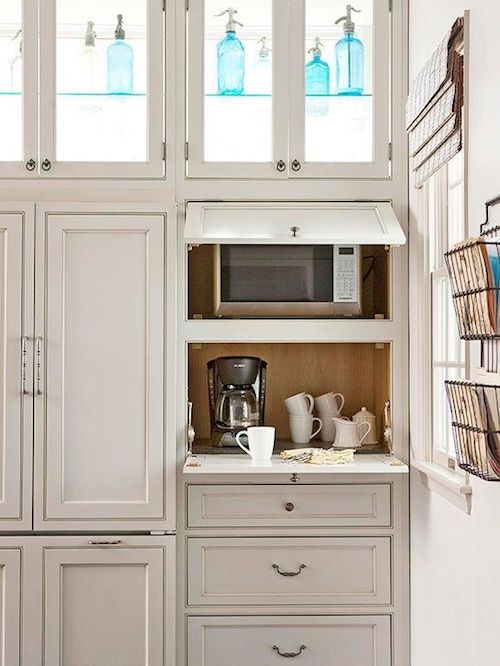
An appliance garage is a small cabinet with a roll-up, flip-up, or swing door that sits on the counter. It’s designed to store small appliances out of sight but within easy reach.
How It Works
You place the microwave inside the garage. When you need it, open the door. When you’re done, close it to keep the kitchen tidy.
Tips For Success
- Make sure the garage is deep and wide enough for your microwave.
- Choose a garage with good ventilation (some have vents or open backs).
- Install an outlet inside the garage.
Benefits
- Keeps the microwave off the main counter area.
- Great for storing other appliances too.
Drawbacks
- Takes up some counter space.
- Not all kitchens have room for an appliance garage.
Non-obvious Insight
If you have a small kitchen, consider a vertical appliance garage. These use height instead of width, freeing up more workspace.
Hide It In A Pantry
If you have a walk-in pantry or a large pantry cabinet, hiding the microwave inside is a practical solution. This keeps the appliance out of the main kitchen area but still easily accessible.
How To Do It
- Clear a shelf at waist or eye level.
- Make sure there’s an outlet nearby.
- Leave space around the microwave for airflow.
- Use a tray under the microwave for easy cleaning.
Benefits
- Completely hides the microwave.
- Keeps heat and smell away from main kitchen area.
Drawbacks
- Less convenient if your pantry is far from your main prep space.
- May require electrical work to add an outlet.
Example
Many new homes feature a “butler’s pantry” that includes a microwave, coffee maker, and other appliances hidden from view.
Install An Under-counter Microwave Drawer
Microwave drawers are a modern solution where the appliance sits under the counter, often in a lower cabinet. The microwave pulls out like a drawer, so you can place food inside from above.
How It Works
A special microwave drawer is installed below the counter, often near the stove or prep area.
Steps
- Buy a microwave designed as a drawer (regular microwaves don’t work for this).
- Hire a professional to install it.
- Test the drawer’s smooth opening and closing.
Benefits
- Saves counter space.
- Easy to use, especially for kids or people with limited mobility.
- Modern, high-end look.
Drawbacks
- Expensive (usually $900–$2,000).
- Not suitable for all kitchen layouts.
Non-obvious Insight
Microwave drawers are safer for kids because hot food is lifted up, not down. But bending to use it may be hard for some older adults.
Place It In A Lower Cabinet
If you want a budget-friendly option, you can place your microwave inside a regular lower cabinet. This works best if you have extra storage space.
How To Do It
- Remove the cabinet doors (optional).
- Place the microwave inside, close to the front edge.
- Plug it into an accessible outlet.
Benefits
- Cheap and easy.
- Keeps the microwave out of sight.
Drawbacks
- Not as stylish as built-in options.
- May require bending to use.
Practical Tip
To make it look better, add a custom trim kit around the microwave opening.
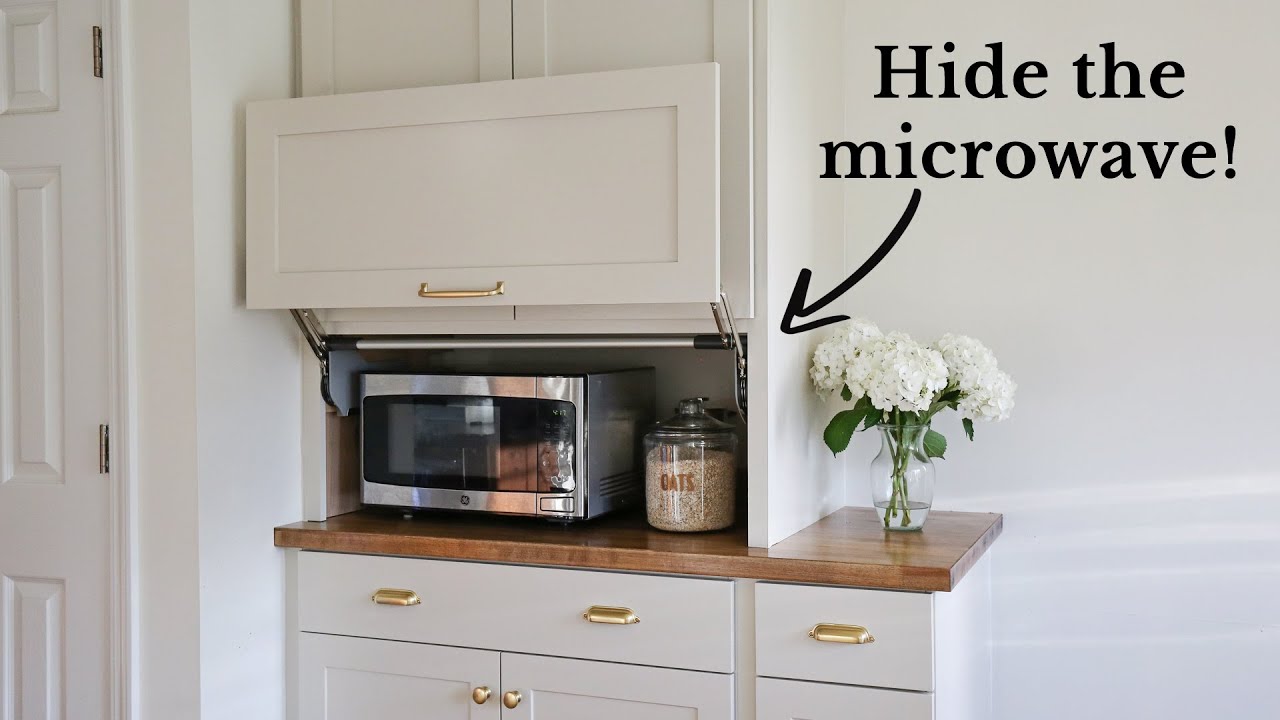
Conceal With A Pull-down Or Flip-up Door
Some cabinets feature a pull-down or flip-up door that covers the microwave completely when not in use.
How It Works
The door lifts up or pulls down smoothly. You open it to use the microwave, then close it when done.
Key Considerations
- The cabinet must be deep enough for both the microwave and the door hardware.
- Use soft-close hinges for quiet operation.
Benefits
- Hides the microwave totally.
- Matches your kitchen’s style.
Drawbacks
- May require custom cabinetry.
- Slightly less convenient to open and close each time.
Example
European kitchens often use this method for a very sleek, modern look.
Integrate With A Wall Oven Stack
If you have a wall oven, you can often place the microwave above or below it within the same vertical cabinet unit. This creates a unified “cooking center.”
How To Do It
- Choose a microwave and wall oven from the same manufacturer, if possible.
- Install both in a tall cabinet.
- Use a matching trim kit for a seamless look.
Benefits
- Professional, built-in appearance.
- Keeps all cooking appliances together.
Drawbacks
- Takes up a tall cabinet, reducing other storage.
- More expensive than other options.
Non-obvious Insight
Some brands offer “speed ovens,” which combine microwave and convection features—saving even more space.
Use A Sliding Door Or Pocket Door
A sliding door or pocket door can cover a microwave tucked into a niche or shelf. Unlike hinged doors, these slide out of the way completely.
How It Works
- The microwave sits in a cabinet or cubby.
- The door slides sideways (or into the wall) to reveal or hide the microwave.
Key Details
- Good for narrow spaces where a swinging door would block movement.
- Custom carpentry is usually required.
Benefits
- Door disappears when open.
- Works well for modern or minimalist kitchens.
Drawbacks
- More expensive and complex to build.
- Harder to add to an existing kitchen.
Practical Tip
Ask your carpenter to use soft-close hardware to avoid slamming.
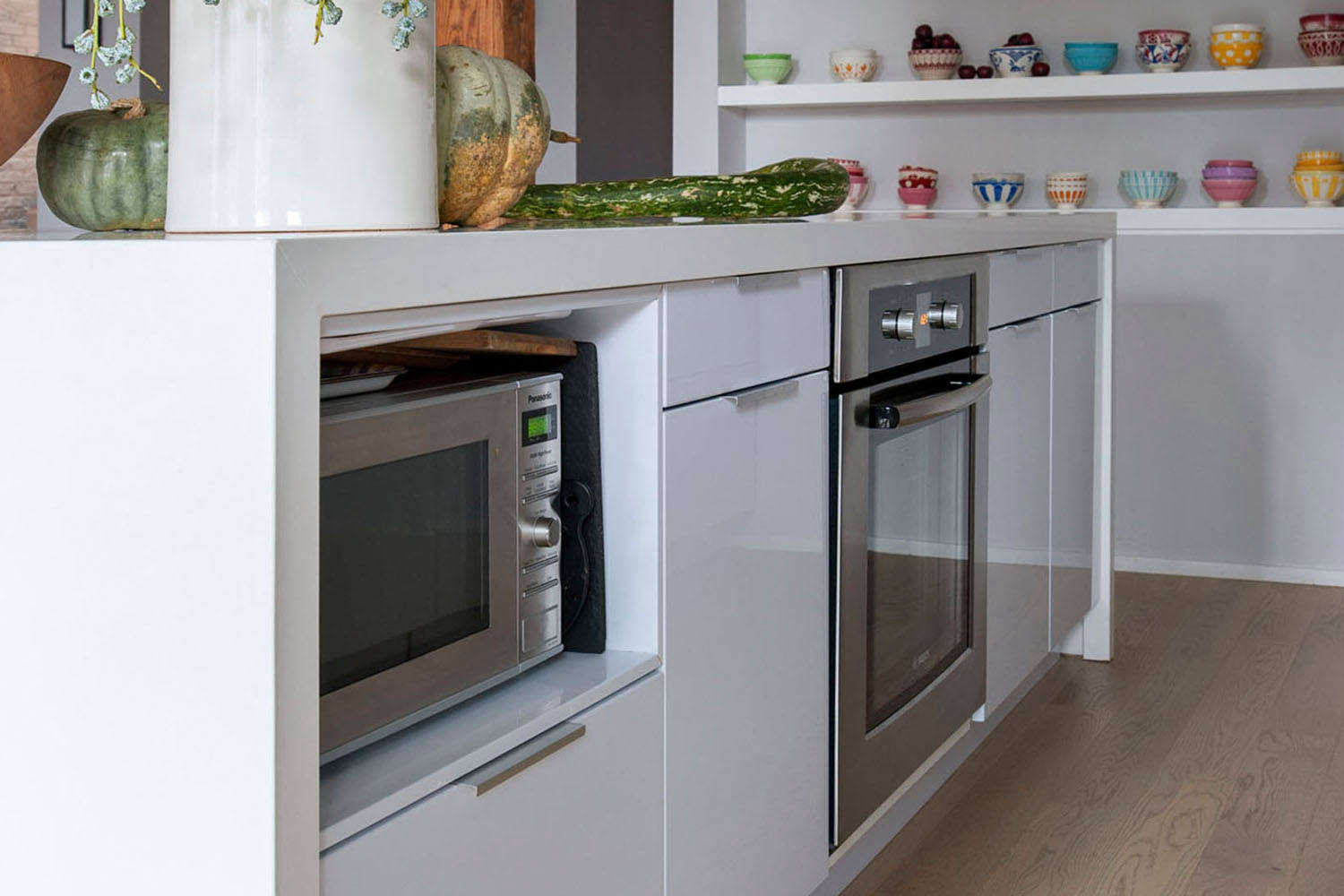
Hide It In An Island
Kitchen islands often have extra storage and power. Placing a microwave inside the island keeps it out of sight and central to the kitchen.
How To Do It
- Choose a spot that’s easy to reach from your main prep area.
- Install an outlet inside the island.
- Use a microwave drawer or place a standard microwave behind a door.
Benefits
- Saves counter space.
- Keeps microwave near the action but hidden.
Drawbacks
- Can be costly if you need to add wiring.
- Not all islands have enough depth.
Example
In many open-plan kitchens, the microwave is placed in the island to keep wall space free for cabinets or windows.
Place It Behind A Decorative Panel
Custom cabinetry can include a decorative panel or “faux drawer” front that blends the microwave with the rest of your kitchen.
How It Works
- The panel is attached to the microwave door or sits in front of it.
- When you open the panel, you access the microwave.
Key Points
- Panels must be heat-resistant.
- Hinges should allow for easy opening.
Benefits
- Matches your cabinets perfectly.
- Microwave is almost invisible.
Drawbacks
- Expensive, custom work.
- May reduce airflow.
Non-obvious Insight
Some panels use magnets or touch latches instead of handles for a cleaner look.
Tuck It Inside A Tall Cabinet
Tall cabinets, sometimes called pantry towers, can hide a microwave at eye or waist level. This keeps it off the counter but still easy to use.
How To Do It
- Remove a shelf to create enough space.
- Add a power outlet behind the microwave.
- Leave at least 2–3 inches of space on all sides for ventilation.
Benefits
- Keeps microwave close to other food storage.
- Good for galley or small kitchens.
Drawbacks
- Takes away pantry shelf space.
- May require rerouting electrical lines.
Example
A 2022 survey found that 28% of kitchen remodels included a microwave inside a tall pantry cabinet.
Cover With A Curtain Or Fabric Panel
If you’re renting or want a quick, temporary solution, a curtain or fabric panel can hide your microwave.
How To Do It
- Hang a tension rod or hook-and-loop tape above the microwave.
- Attach a fabric panel or curtain that matches your kitchen.
Benefits
- Cheap and easy to install or remove.
- Adds color or softness to the kitchen.
Drawbacks
- Less “high-end” than cabinet solutions.
- May need to be cleaned often.
Non-obvious Insight
Choose flame-retardant fabric for extra safety near appliances.
Credit: www.youtube.com
Place It On A Rolling Cart
A microwave cart keeps your appliance mobile. You can wheel it out when needed, then tuck it away in a corner or closet.
How It Works
- Microwave sits on a sturdy shelf.
- Cart may include storage for dishes or ingredients.
Benefits
- Flexible placement.
- Useful in very small kitchens or studios.
Drawbacks
- Microwave is not always hidden.
- Carts need space to move.
Practical Tip
Choose a cart with locking wheels to keep it steady during use.
Hide In A Corner Cabinet
Corner cabinets can be hard to use for regular storage, but they’re perfect for hiding a microwave.
How To Do It
- Install a “lazy Susan” or shelf in the corner cabinet.
- Place the microwave on the shelf, close to the door.
- Cut a hole for the power cord.
Benefits
- Uses otherwise wasted space.
- Keeps microwave out of main sight lines.
Drawbacks
- Access can be awkward.
- Corner cabinets may not be deep enough for large microwaves.
Use A Drop-down Shelf
Some kitchens have drop-down shelves that lower when needed and fold away when not in use. You can mount a small microwave on one of these shelves.
How It Works
- The shelf is fixed to the wall or inside a cabinet.
- When you need the microwave, lower the shelf into place.
Benefits
- Saves counter space.
- Can be hidden behind a cabinet door.
Drawbacks
- Only suitable for lightweight, small microwaves.
- Needs strong hardware for safety.
Hang It Under A Cabinet
Some compact microwaves are designed to hang under a cabinet. This keeps them off the counter but still easy to access.
How To Do It
- Buy a microwave with under-cabinet mounting hardware.
- Attach securely to the cabinet bottom.
- Plug into an outlet above the cabinets.
Benefits
- Saves space.
- Keeps microwave at eye level.
Drawbacks
- Limited to smaller, lighter microwaves.
- May block some cabinet storage above.
Credit: victoriaelizabethbarnes.com
Comparison Of Popular Microwave Hiding Methods
To help you decide, here’s a comparison of some top methods:
| Method | Cost | Difficulty | Space Saved | Best For |
|---|---|---|---|---|
| Built-in Cabinet | Medium–High | Medium | High | Remodels |
| Appliance Garage | Medium | Low | Medium | Small Kitchens |
| Microwave Drawer | High | High | High | Modern Kitchens |
| Pocket Door Cabinet | High | High | Medium | Custom Designs |
| Curtain/Fabric | Low | Low | Low | Renters |
Common Mistakes To Avoid
Many people make errors when hiding their microwave. Here’s what to watch for:
- Ignoring ventilation: Without enough airflow, your microwave can overheat or break.
- Blocking the door: Make sure the microwave door opens fully and safely.
- Choosing the wrong size: Double-check your measurements before building or buying.
- Overcomplicating the solution: Sometimes, a simple fix (like a curtain or lower cabinet) is best for your needs.
How To Measure And Plan
Careful planning prevents mistakes. Here’s what you need to do:
- Measure your microwave (width, depth, height) and add 2–3 inches for airflow.
- Check the available space in cabinets, pantries, or on shelves.
- Locate power outlets or plan for new wiring.
- Test the opening angle of doors and drawers to avoid bumping into walls or counters.
Budget-friendly Options
Not every solution requires a big investment. Here are ways to hide your microwave on a budget:
- Use a curtain or fabric panel.
- Place it in a lower cabinet.
- Use a rolling cart you already own.
- Tuck it in a pantry if you have one.
If you’re handy, you can DIY a simple appliance garage with basic tools and materials.
Credit: www.remodelista.com
High-end And Custom Solutions
For those who want a seamless look and are ready to invest:
- Install a microwave drawer or custom built-in.
- Use a pocket door or custom cabinetry with matching panels.
- Integrate with a wall oven stack for a “pro kitchen” look.
These options often require a designer or carpenter, but the result is a kitchen that looks organized and expensive.
Table: Diy Vs. Professional Installation
Here’s a quick look at when you can DIY and when to call an expert:
| Method | DIY Possible? | Professional Needed? |
|---|---|---|
| Curtain/Fabric Panel | Yes | No |
| Lower Cabinet | Yes | No |
| Built-in Cabinet | Somewhat | Yes |
| Microwave Drawer | No | Yes |
| Sliding/Pocket Door | No | Yes |
Safety And Ventilation
Never sacrifice safety for style. Microwaves need to “breathe. ” Without proper ventilation, they can overheat, waste energy, or even become a fire risk. Always follow the manufacturer’s instructions for spacing. If you’re building a custom solution, consult with a kitchen designer or appliance expert.
Matching Your Kitchen Style
Every kitchen is different, and the way you hide your microwave should fit your style. Some ideas:
- Modern kitchens: Microwave drawers, built-in cabinets, pocket doors.
- Traditional kitchens: Appliance garages, decorative panels.
- Small kitchens: Rolling carts, corner cabinets, under-cabinet mounts.
- Open kitchens: Islands with hidden microwaves, wall oven stacks.
You don’t have to spend a fortune to get a clean look—creativity and good planning matter most.
Real-world Tips From Homeowners
- “We put our microwave in a lower pantry cabinet and added a child lock for safety.”
- “A pocket door was expensive, but it was worth it for our small kitchen.”
- “I used a tension rod and curtain to hide the microwave in my rental—easy and cheap!”
- “Our built-in microwave failed, and the new one was a different size. Next time, I’ll choose a more flexible solution.”
Table: Pros And Cons Of Each Method
To summarize, here are the main pros and cons:
| Method | Pros | Cons |
|---|---|---|
| Built-in Cabinet | Seamless look, saves space | Expensive, less flexible for new appliances |
| Appliance Garage | Easy to access, hides multiple appliances | Takes up counter space |
| Microwave Drawer | Modern, ergonomic | High cost, harder to install |
| Pocket Door | Door disappears, stylish | Custom work, cost |
| Curtain/Fabric | Cheap, renter-friendly | Not as durable, less stylish |
| Rolling Cart | Flexible, adds storage | Microwave not always hidden |
Final Thoughts
Hiding your microwave can make your kitchen feel bigger, cleaner, and more stylish. There is no “one size fits all” answer—the right solution depends on your space, budget, and how you use your kitchen. The best results come from good planning and careful measuring. Don’t be afraid to try simple, creative ideas if you’re on a budget, or to invest in a custom solution if you want a seamless look. Most important of all: make sure your microwave is always safe and easy to use.
For more design inspiration and technical details, you can check resources like Houzz.
Frequently Asked Questions
What Is The Safest Way To Hide A Microwave?
The safest way is to place the microwave in a well-ventilated built-in cabinet or a purpose-built appliance garage. Always leave enough space for airflow, and follow the manufacturer’s installation instructions.
Can You Put Any Microwave In A Cabinet?
Not all microwaves are designed for enclosed spaces. Some need more ventilation than others. Check your microwave’s manual before placing it in a cabinet. Built-in models or those labeled as “cabinet safe” are best.
How Much Space Does A Microwave Need For Ventilation?
Most microwaves need at least 2–3 inches of clearance on all sides, plus space at the back for the power cord. Always check your user manual for exact requirements.
Is It Expensive To Add A Built-in Microwave Cabinet?
Costs vary. Simple conversions may only need $100–$300 for labor and materials. Full custom cabinetry or microwave drawers can cost over $1,000. DIY solutions like curtains or carts are much cheaper.
Are There Alternatives To Built-in Solutions For Renters?
Yes! Renters can use curtains, fabric panels, or a rolling cart to hide a microwave without making permanent changes. These methods are quick, cheap, and easy to remove when you move out.