
Replacing a kitchen faucet can feel like a simple job, but getting the right fit is not always easy. If you buy a new faucet without measuring first, you could end up with water leaks, installation problems, or a tap that doesn’t match your sink.
Many homeowners and even some professionals make mistakes at this stage—often because they skip critical measurements or misunderstand what matters. The good news is that with the right steps, measuring for a new kitchen faucet is straightforward, and you can avoid all the common headaches.
This guide will walk you through everything you need to know, from the basic tools to advanced tips, so you can shop for your new faucet with confidence.
Why Accurate Measurement Matters
Choosing a kitchen faucet is more than just picking a style you like. The right measurement ensures proper installation, prevents leaks, and gives your kitchen a finished look. If your faucet is too large, it might not fit or could block windows and cabinets. If it’s too small, it may not reach all areas of your sink. A faucet that doesn’t fit can also cause water to splash outside the sink, making daily tasks messy.
Another key reason for measuring is compatibility. Kitchen sinks and counters come in different shapes and sizes. Faucets are designed for specific configurations—like the number of holes in your sink or the thickness of your countertop. Knowing these details lets you narrow down your choices and avoid costly returns.
Tools You Will Need
Before you start, gather some simple tools. Having everything ready saves time and helps you measure accurately.
- Tape measure: The most important tool for this job. Make sure it’s long enough to measure across your sink.
- Flashlight: Sinks can be dark underneath, and you’ll want to see all the mounting holes and pipes.
- Pen and paper: For writing down measurements and faucet features.
- Camera or smartphone: Taking photos of your current setup can be very helpful when shopping or asking for advice.
- Adjustable wrench: In case you need to loosen anything to get a better look.
Some people also use a level to check for a straight faucet, especially if the sink or countertop is not perfectly flat.
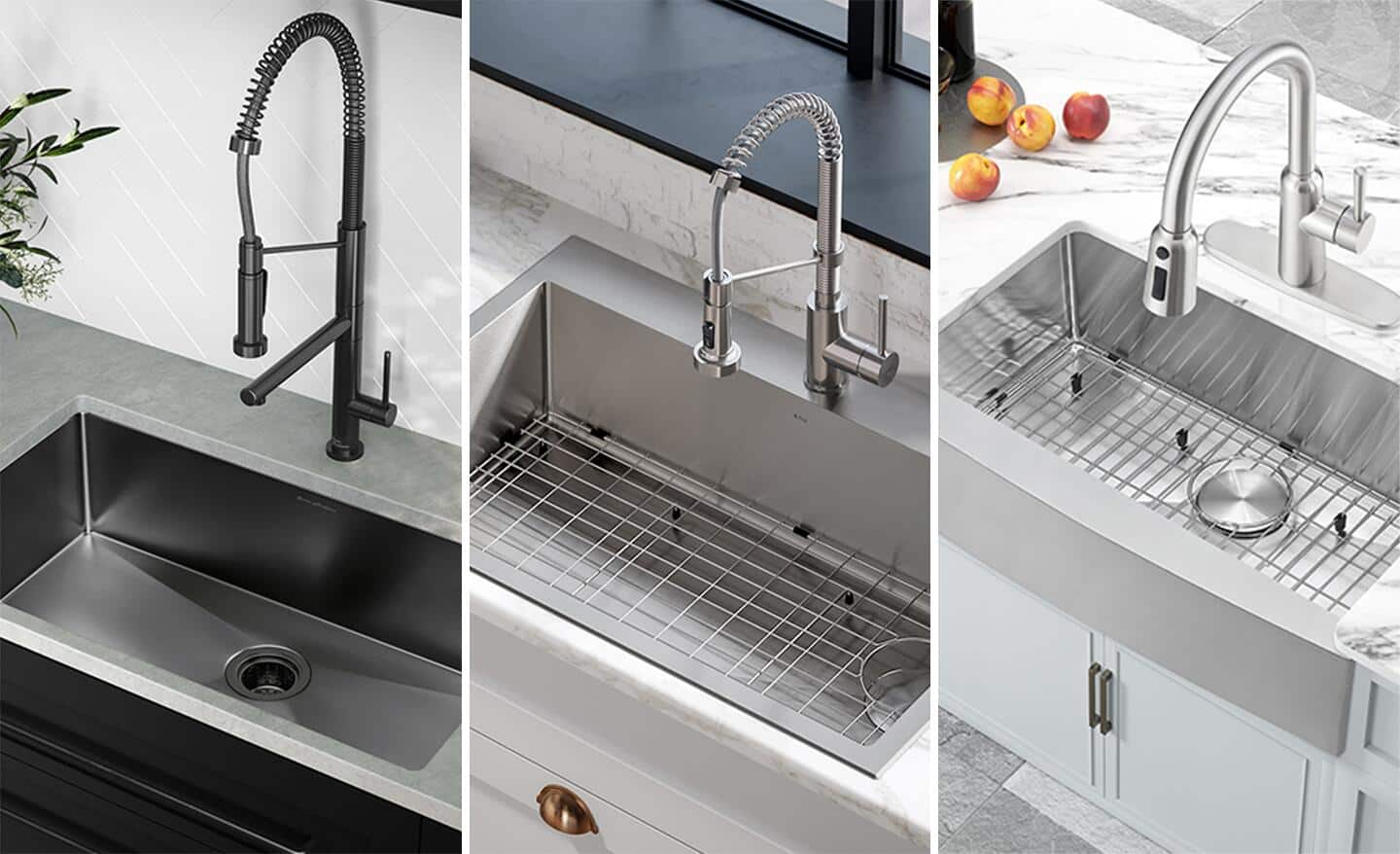
Credit: www.homedepot.com
Understanding Kitchen Faucet Configurations
Not all kitchen sinks are the same, and neither are faucets. One of the first things to check is your current sink configuration. This includes the number of mounting holes, the distance between them, and where they are located.
Number Of Faucet Holes
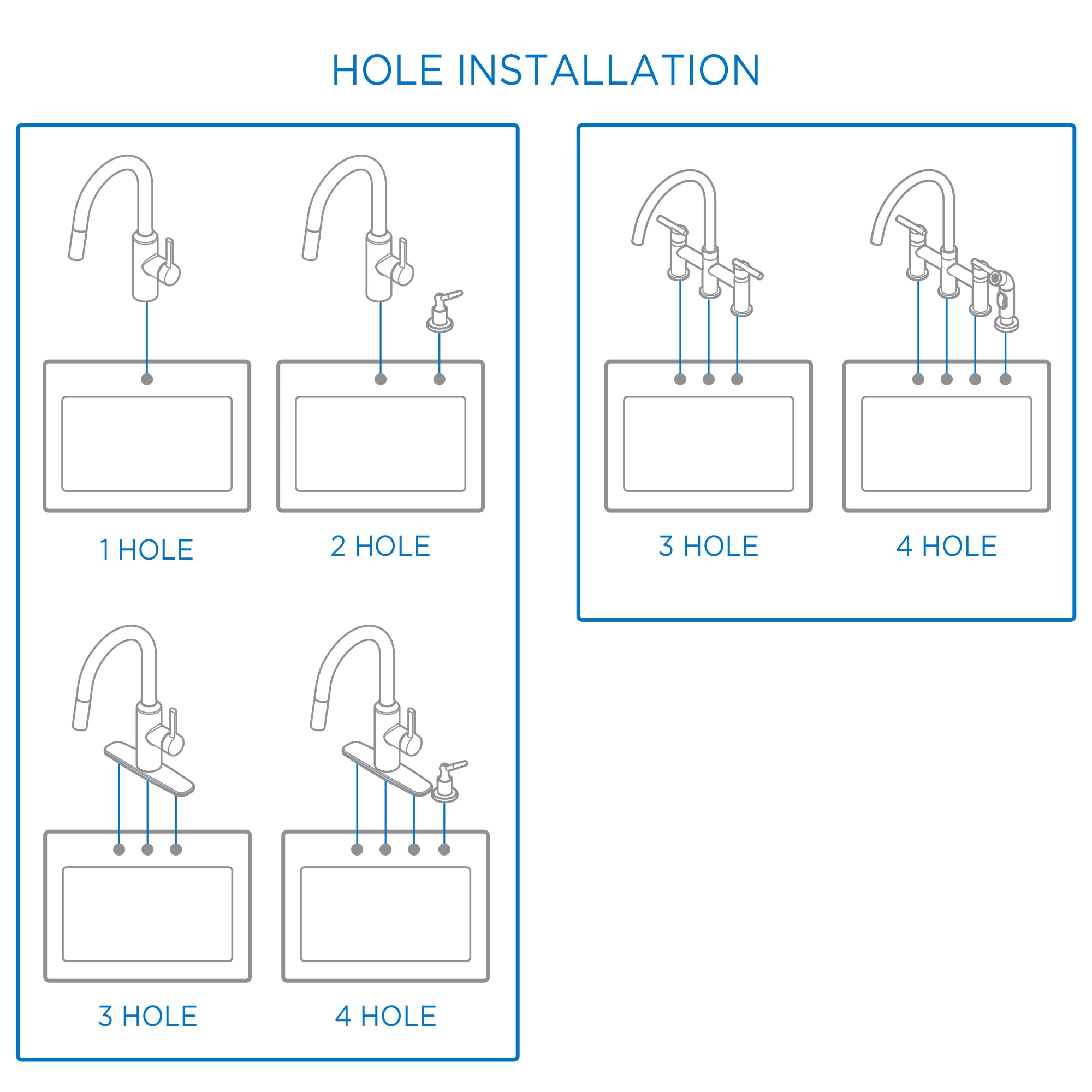
Kitchen faucets usually need 1, 2, 3, or 4 holes in the sink or countertop. Each hole has a purpose:
- One-hole: For single-handle faucets, often with a pull-out sprayer.
- Two-hole: Common for faucets with a separate sprayer or soap dispenser.
- Three-hole: Typical for two-handle faucets with a separate spout.
- Four-hole: For setups with a faucet, sprayer, soap dispenser, and maybe a filtered water tap.
Count the number of holes in your sink or countertop. If you want to change from a three-hole to a one-hole faucet, you can use an escutcheon plate (a metal cover) to hide extra holes.
Hole Spacing (center-to-center Distance)
For faucets with two or more mounting points, the center-to-center distance is critical. This is the measurement from the center of one hole to the center of the next.
- Standard spacing: Most kitchen sinks use an 8-inch (203 mm) center-to-center distance for widespread faucets.
- Other common sizes: Some sinks, especially bar sinks, might use a 4-inch (102 mm) spacing.
Use your tape measure to get this distance exactly. Write it down—many people forget this step and choose a faucet that does not fit.
Deck Vs. Wall Mount
Most kitchen faucets are deck-mounted (installed on the countertop or sink), but some are wall-mounted. Wall-mount faucets need a different installation and require different measurements.
- If your faucet is wall-mounted, measure the distance from the wall to the edge of the sink. This ensures the spout will reach over the basin.
Key Measurements For A New Kitchen Faucet
Now it’s time to measure. Pay close attention to these areas:
1. Faucet Hole Size
Measure the diameter of the faucet holes in your sink or countertop. Most kitchen faucets fit a standard hole size of 1 3/8 inches (35 mm), but some may be larger or smaller.
- Place the tape measure across the center of the hole.
- If you have multiple holes, measure each one—they might not all be the same size.
2. Sink Or Countertop Thickness
Faucets are designed to fit a certain maximum and minimum thickness. If your countertop is very thick (like granite or butcher block), you may need a special faucet or an extension kit.
- Measure from the top of the countertop to the bottom where the faucet will be mounted.
- Most faucets fit a thickness between 1/4 inch (6 mm) and 2 1/2 inches (64 mm).
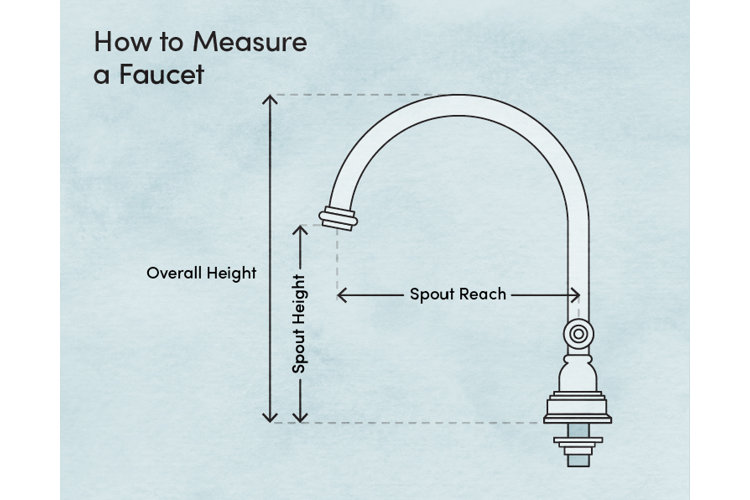
3. Spout Reach
Spout reach is the distance from the center of the faucet base to the center of the spout outlet (where the water comes out). This tells you how far the water will land into the sink.
- Place your tape measure at the center of the mounting hole, then measure straight out to where you want the water stream to hit.
- Standard spout reach is between 8 and 10 inches (203-254 mm).
- For double sinks, a longer reach may be better to cover both sides.
4. Spout Height
Spout height is the vertical distance from the base of the faucet to the top of the spout. This is especially important if you have shelves, cabinets, or windows above your sink.
- Measure from the countertop to the lowest point of any obstruction above.
- Standard spout heights are around 8-10 inches (203-254 mm), but high-arc faucets can be 12 inches (305 mm) or more.
5. Clearance To Backsplash Or Wall
You need enough space behind the faucet for the handle to move freely. This is often called the backsplash clearance.
- Measure from the center of the mounting hole to the backsplash or wall behind the sink.
- Most faucets need at least 2 1/2 inches (64 mm) clearance.
If your faucet has a single lever, make sure it can move all the way back without hitting the wall.
6. Space Below The Sink
Look under the sink to check for pipes, garbage disposals, or other obstacles. You need enough room to install the faucet nuts and connect water lines.
- Measure from the bottom of the sink or countertop to any obstacles underneath.
- Write down the available space. Some modern faucets have large mounting nuts that need extra room.
7. Water Supply Line Location
Check where your hot and cold water lines come up. Some sinks have lines in the center, others to the left or right.
- Measure the distance from the center of the faucet hole to the supply lines.
- Make sure your new faucet’s hoses or supply lines are long enough. If not, you may need extension hoses.
Step-by-step Measuring Process
Let’s put all these measurements into an easy-to-follow process. You’ll only need about 20–30 minutes.
- Clear the area: Remove anything around your sink and under the cabinet. This makes measuring easier.
- Count the holes: Look on top of your sink or under the countertop to see how many holes you have and if they’re being used.
- Measure hole spacing: Use your tape measure to find the center-to-center distance between holes.
- Check hole size: Measure the width of each hole.
- Check sink/countertop thickness: Use the tape measure under the sink to find this.
- Measure spout reach and height: See how far your current faucet reaches and how high it sits.
- Check clearance: Measure from the mounting hole to the backsplash or wall.
- Check below the sink: Make sure there’s room for installation.
- Water supply line location and length: Measure how far they are from the faucet hole and how long the hoses need to be.
Here’s a quick summary in a visual format:
| Measurement | How to Measure | Standard Size |
|---|---|---|
| Hole Count | Count on sink or countertop | 1–4 holes |
| Hole Spacing | Center to center between holes | 8″ (widespread) or 4″ (centerset) |
| Hole Size | Diameter across hole | 1 3/8″ |
| Spout Reach | Center base to spout outlet | 8–10″ |
| Spout Height | Countertop to spout top | 8–10″ |
| Baksplash Clearance | Mounting hole to wall | 2 1/2″ min |
| Sink/Counter Thickness | Top to bottom of sink/counter | 1/4″–2 1/2″ |
Types Of Kitchen Faucets And Their Requirements
Different faucet types need different measurements. Here’s a quick guide to help you decide.
Single-handle Faucets
These are the most common and easy to use. Usually, they need just one hole, but some come with a plate to cover extra holes.
- Spout reach is important for covering the whole sink.
- Handle clearance is needed, especially behind the faucet.
Double-handle Faucets
They need at least three holes—one for the spout and two for the handles.
- Measure the distance between holes carefully.
- Make sure your sink matches the faucet’s layout.
Pull-out And Pull-down Faucets
Popular for their flexibility, these faucets have a spray head that pulls out or down.
- Check under-sink space for the hose and weight system.
- A high-arc design may need extra clearance above the sink.
Bridge Faucets
These have a classic look and are mounted in two or three holes.
- Require accurate measurement between hot and cold handles.
- Often need a wider sink.
Wall-mount Faucets
Used in some modern or farmhouse kitchens.
- Measure from the wall to the sink to ensure the spout will reach.
- Check that your water lines are in the wall, not the floor.
Common Measuring Mistakes (and How To Avoid Them)
Even careful people make mistakes when measuring for a new kitchen faucet. Here are some common errors and how to prevent them.
- Forgetting the number of holes: Always check under soap dispensers or covers—there may be hidden holes.
- Measuring from the edge instead of the center: Always measure from the center of holes, not the edges, for accuracy.
- Ignoring spout reach: A faucet that looks good may not reach the middle of your sink, making it hard to wash large pots.
- Not checking backsplash clearance: Many single-handle faucets need extra room for the lever to move back.
- Not considering under-sink space: Garbage disposals or water filters may block installation.
- Skipping supply line measurement: Some faucets come with short hoses; always check if you need longer ones.
- Overlooking countertop thickness: Thick counters may need special mounting kits.
A practical tip: Take photos and bring your measurements when shopping. Store staff or online support can quickly tell you if a faucet fits your setup.
Comparing Faucet Sizes And Features
Let’s look at how different faucet sizes and types match common kitchen sink setups.
| Faucet Type | Number of Holes Needed | Typical Spout Reach | Best for Sink Type |
|---|---|---|---|
| Single-Handle | 1–3 | 8–10″ | Standard, small sinks |
| Double-Handle | 3 | 8–9″ | Double-basin sinks |
| Pull-Out/Down | 1–3 | 8–10″ | Deep sinks |
| Bridge | 2–3 | 9–10″ | Wide farmhouse sinks |
| Wall-Mount | 2 | 8–12″ | Apron sinks, custom setups |
Practical Examples
Let’s look at two real-world examples to show how measuring works.
Example 1: Standard Single-basin Sink
Suppose you have a regular kitchen sink with three holes and a single-handle faucet.
- Count the holes: 3 (two covered by a plate).
- Hole spacing: 8 inches between centers.
- Hole size: 1 3/8 inches.
- Spout reach and height: Current faucet has 9-inch reach, 10-inch height.
- Backsplash clearance: 3 inches.
- Supply lines: Centered and 18 inches long.
You can choose a single-handle faucet with an escutcheon plate or a two-handle widespread faucet.
Example 2: Farmhouse Sink With Wall-mount Faucet
You have a deep farmhouse sink and want a wall-mount faucet.
- Count the holes: None in the sink, but two in the wall.
- Distance from wall to sink: 6 inches.
- Sink width: 28 inches.
- Spout reach: Should be at least 10 inches to reach the center.
- Height to window: 14 inches above sink.
A wall-mount faucet with 10-inch reach and 12-inch spout height fits well. Check that the water lines in the wall match the faucet’s inlet spacing.
Advanced Tips For Difficult Kitchens
Some kitchens have unusual layouts or older plumbing that makes measuring harder. Here are expert tips:
- If your sink is custom-sized: Always measure both width and depth. Some large sinks need faucets with extra-long spouts.
- If you have a thick countertop: Check the manufacturer’s specs for maximum deck thickness. If you’re over the limit, ask for a mounting extension kit.
- If you’re switching from a two-handle to a single-handle faucet: Use a deck plate to cover unused holes, but check that the plate is wide enough.
- For under-mount sinks: Measure from the edge of the sink, not the countertop, if the faucet will be close to the sink rim.
- If replacing a wall-mount faucet: Know that wall pipes can be hard to move. Measure precisely and consider hiring a plumber.
A little planning here saves hours of work later.
How To Use Your Measurements When Shopping
Once you’ve written down all your measurements, keep them handy. When you shop online or in stores, check the specifications for each faucet model. Look for:
- Minimum and maximum deck thickness
- Required hole size and spacing
- Spout reach and height
- Handle movement range
If you’re unsure, ask the manufacturer or store staff. Share your notes and photos. Many brands also have online tools or guides—like those from Home Depot—to help match your kitchen with the right faucet.
Non-obvious Insights For A Perfect Fit
Many guides skip these advanced tips, but they can make a big difference:
- Check for sprayer hose length: If you use large pots, make sure the pull-out sprayer hose is long enough to reach every corner of your sink.
- Think about water filtration: If you plan to add a filter or instant hot water tap, you may need an extra hole or a special faucet model.
- Plan for future upgrades: If you might add a dishwasher or water filter later, choose a faucet and sink with extra holes or flexible mounting options.
- Measure twice: Double-check all measurements before buying. It’s much easier to measure twice than to return a faucet after purchase.
Credit: www.wayfair.com
Troubleshooting Common Problems
If you’ve already bought a faucet and it doesn’t fit, don’t panic. Here’s what you can do:
- If the hole is too small: Use a hole saw (carefully) to widen it, or ask a professional for help.
- If the hole is too large: Use a mounting plate or washer to cover the extra space and secure the faucet.
- If hoses are too short: Buy extension hoses at any hardware store.
- If handles hit the wall: Choose a faucet with a forward-only handle or a side handle.
Most problems have a solution, but measuring first helps you avoid them.
Preparing For Installation
Once you have the right faucet, you’re ready to install. Here’s how to prepare:
- Shut off water supply: Turn off hot and cold water valves under the sink.
- Clear cabinet contents: Make space to work.
- Gather tools: Wrench, bucket, towels, and new supply hoses if needed.
- Read the instructions: Each faucet model is different.
- Dry fit the faucet: Place it on the sink or countertop to be sure everything lines up.
If you’re not confident, a plumber can usually install a faucet in under an hour—especially if you’ve done all the measuring and prep.
Credit: www.gerber-us.com
Frequently Asked Questions
How Do I Know If A New Faucet Will Fit My Sink?
Measure the number of holes, hole spacing, and the size of each hole. Also, check your sink’s thickness and the space behind the faucet for handle movement. If your measurements match the new faucet’s requirements, it will fit.
Can I Install A Single-handle Faucet In A Three-hole Sink?
Yes, you can. Most single-handle faucets come with a deck plate (escutcheon) to cover extra holes. Just check that the plate is wide enough to hide all unused holes.
What Should I Do If My Countertop Is Thicker Than The Faucet Allows?
Look for a faucet with a higher maximum deck thickness, or buy an extension kit from the faucet manufacturer. If you’re still unsure, ask a plumber for advice.
How Important Is Spout Reach When Choosing A Kitchen Faucet?
Spout reach is very important. If the spout is too short, water may not reach the middle of the sink, making washing difficult. Too long, and water could splash outside. Measure your sink’s width to choose the right reach.
Are Pull-down Or Pull-out Faucets Harder To Install?
They are usually as easy to install as standard faucets, but you need extra space under the sink for the hose and weight system. Make sure nothing blocks the hose’s movement.
Getting the right kitchen faucet starts with careful measurement. By following these steps and tips, you’ll avoid common mistakes and find a faucet that fits perfectly and works well for years. Remember, a few extra minutes spent measuring can save hours of trouble later.
Enjoy your new kitchen upgrade!