
Keeping a Cangshan knife sharp is not just about having a tool that cuts well—it’s about safety, food quality, and the joy of cooking. Many people buy a premium knife like a Cangshan because they want professional results in their own kitchen. But even the best blade gets dull with time and use. Dull knives can slip, crush food instead of slicing, and make meal prep frustrating. Sharpening your Cangshan knives the right way keeps them working as they should for years.
If you’re new to knife care, sharpening can seem confusing or even risky. You might wonder about the right tools, angles, and techniques. Maybe you’re afraid you’ll damage the blade or waste your investment. This guide will walk you through everything, step by step, with tips and details that help beginners avoid common mistakes.
You’ll learn about the different sharpening methods, what makes Cangshan knives special, and how to get a truly sharp edge safely at home.
What Makes Cangshan Knives Unique
Cangshan knives are well-known for their German and Swedish steel, precision craftsmanship, and modern design. These knives are made with careful attention to balance, hardness, and edge geometry. Most Cangshan blades use high-carbon stainless steel, such as X50CrMoV15 or Swedish Sandvik 14C28N. These materials are tough and resist rust, but they also need the right approach to sharpening.
The hardness of these steels is usually around 58-60 HRC (Rockwell Hardness), which is harder than basic kitchen knives but not as hard as Japanese super steels. This means Cangshan knives hold an edge longer, but they’re not so brittle that sharpening becomes difficult. Still, the blade geometry—often a 16-degree edge angle—means you need to be precise when restoring the edge.
Cangshan also makes blades with a full tang (the steel runs through the handle), giving excellent control. Some collections, like the Thomas Keller Signature, use even harder Swedish steel. Knowing your specific knife’s steel and angle helps you choose the best sharpening method.
Why Knife Sharpness Matters
A sharp knife is safer because it requires less force. When you push hard on a dull blade, it can slip and cut your hand. Sharp knives also make cleaner cuts, which keeps food looking and tasting better. For example, a sharp chef’s knife slices tomatoes or herbs without crushing them, while a dull one smashes the cells and releases juice.
Professional kitchens sharpen knives every day because performance drops quickly with regular use. At home, you might sharpen your Cangshan knives every few weeks or months, depending on how often you cook. You’ll notice a dull knife if it squashes tomatoes, can’t slice onions thinly, or requires sawing back and forth.

Credit: www.amazon.com
Understanding Knife Sharpening
What Does “sharpening” Mean?
Sharpening is the process of grinding away metal to create a new, clean edge. This is different from honing, which realigns the edge without removing much metal. Honing is like brushing your hair straight, while sharpening is like cutting split ends. You need both, but sharpening is the only way to restore a truly dull knife.
How Sharp Should A Cangshan Knife Be?
A Cangshan knife should cut through a sheet of paper or a ripe tomato with almost no effort. The edge should feel smooth, not rough, when you run your finger across (carefully, without touching the very edge). If the knife snags, slips, or needs a lot of force, it’s time to sharpen.
Common Beginner Mistakes
- Using the wrong angle: Cangshan knives are usually sharpened to 16 degrees per side. Using a wider angle makes the knife duller; a narrower angle can weaken the edge.
- Confusing honing with sharpening: Honing rods do not make a dull blade sharp again.
- Skipping fine grits: Stopping after coarse sharpening leaves a toothy, rough edge.
- Applying too much pressure: This can scratch or even chip the steel.
- Sharpening too often: Removing too much steel shortens the life of the knife.
Choosing A Sharpening Method
There are several ways to sharpen Cangshan knives at home. Each method has pros and cons, depending on your skill, tools, and knife collection.
Sharpening Stones (whetstones)
Whetstones are the gold standard for professional sharpening. They give you control over the edge angle and finish. You’ll need to soak most stones in water first, then draw the knife across the surface at the correct angle.
Pros:
- Most precise results
- Suitable for all Cangshan steels
- Can repair chips and reshape edges
Cons:
- Takes practice to master
- Slow process compared to other methods
- Requires soaking and flattening stones
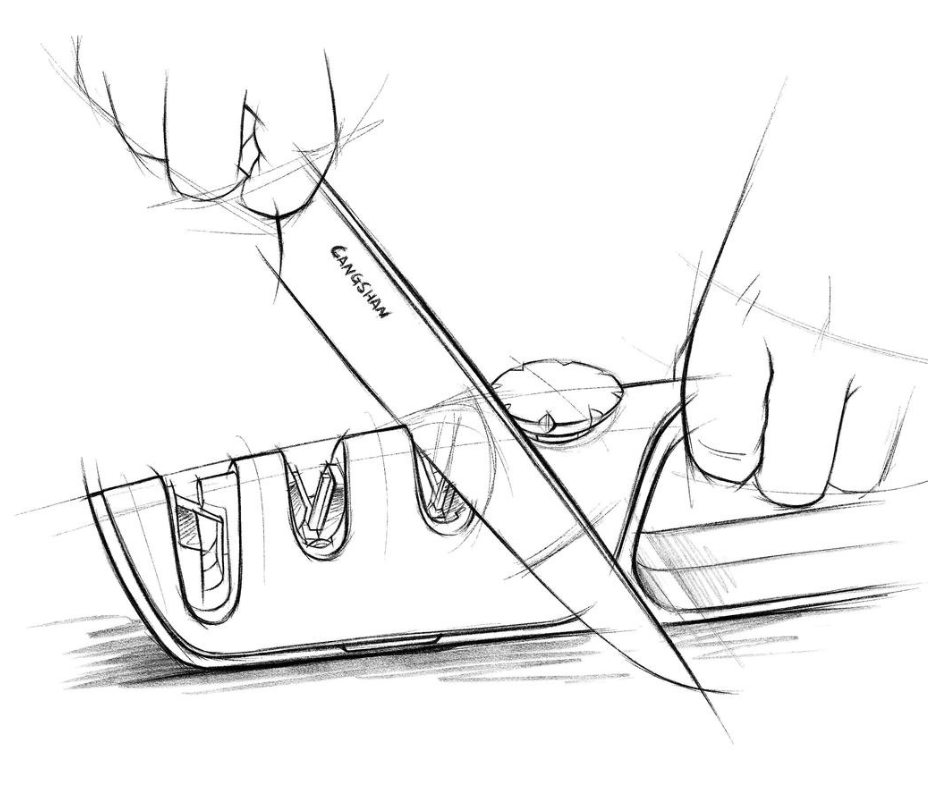
Pull-through Sharpeners
These devices have preset angles inside a slot. You pull the knife through, and abrasive wheels grind the edge.
Pros:
- Fast and easy for beginners
- Angle is fixed, so less guesswork
Cons:
- Can remove too much metal
- Not as precise as stones
- Some can damage high-quality steel
Electric Sharpeners
Electric sharpeners use motorized abrasives to sharpen quickly. Some models have settings for different angles.
Pros:
- Very fast
- Consistent results
- Good for busy kitchens
Cons:
- Expensive for quality models
- Can wear out knives if overused
- May not fit all blade shapes
Professional Sharpening Services
You can send your knives to a professional or visit a sharpening service.
Pros:
- Best for damaged or expensive blades
- No learning curve
Cons:
- Costs add up over time
- You’re without your knives for a while
Tools Needed For Sharpening Cangshan Knives
To sharpen your Cangshan knives at home, you’ll need a few basic tools. Choosing the right ones makes the process safer and more effective.
Essential Tools
- Sharpening stone(s): Get at least a medium (1000 grit) and a fine (3000–8000 grit) stone. Some sets include a coarse (400–600 grit) for repairing chips.
- Angle guide: A small tool that clips to the spine, helping you keep a consistent angle (especially important for beginners).
- Honing rod: Usually made of steel or ceramic, for regular maintenance.
- Towel or non-slip mat: Keeps stones stable and your workspace clean.
- Water spray bottle: Keeps stones wet during sharpening.
Optional Tools
- Strop: A leather strip for extra-polishing and razor-sharp edges.
- Sharpening guide rail: Holds the knife at a steady angle.
- Cleaning brush: Removes metal filings from the stone.
Comparing Sharpening Tools
Here’s a quick comparison of sharpening methods and tools:
| Method | Skill Needed | Edge Quality | Time Required | Cost |
|---|---|---|---|---|
| Whetstone | High | Excellent | Moderate | Medium |
| Pull-Through Sharpener | Low | Good | Fast | Low |
| Electric Sharpener | Low | Very Good | Very Fast | High |
| Professional Service | None | Professional | Slow | High |
Step-by-step: Sharpening Cangshan Knives With A Whetstone
Using a whetstone is the best way to sharpen Cangshan knives because it matches the quality of the steel and the edge angle. Here’s how to do it, even if you’re a beginner.
Step 1: Prepare The Whetstone
Most sharpening stones need to be soaked in water for 10–15 minutes before use. Place the stone in a tray or on a damp towel to keep it stable.
Step 2: Set The Angle
For Cangshan knives, aim for a 16-degree angle per side. If you’re not experienced, use an angle guide. Place it on the spine of the knife to keep the blade at the correct tilt.
Step 3: Start With The Coarse Grit (if Needed)
If your knife is very dull or has small chips, start with a 400–600 grit side. Hold the knife with your index finger on the spine and three fingers on the handle. Starting at the heel, draw the blade across the stone toward the tip, moving in a smooth arc, as if trying to slice a thin layer off the stone.
Apply gentle, even pressure. Repeat this motion 8–12 times on one side, then switch to the other side.
Step 4: Move To Medium Grit
Most sharpening is done with 1000 grit. Repeat the same motion, 8–12 times per side. This refines the edge and removes scratches from the coarse grit.
Step 5: Finish With Fine Grit
Use a 3000–8000 grit stone for a polished, razor-sharp edge. This step makes the knife glide through food. Use light pressure and make 8–10 passes per side.
Step 6: Remove The Burr
After sharpening both sides, a tiny wire edge (burr) forms. To remove it, make alternating light strokes on each side of the blade. You can also strop the knife on a piece of leather for an even smoother finish.
Step 7: Clean And Test The Knife
Rinse the blade with water, dry it, and check the sharpness. Try slicing a piece of paper or a ripe tomato. If the knife still struggles, repeat the fine sharpening step.
Practical Tips For Better Results
- Keep the stone wet: Water flushes away metal filings and keeps the stone’s surface smooth.
- Use the whole stone: Move the knife so you use every part of the stone, preventing uneven wear.
- Don’t rush: Take your time to maintain the right angle.
- Wipe the knife often: Metal dust can scratch the blade if not cleaned away.
Sharpening With A Pull-through Sharpener
If you want speed and simplicity, a pull-through sharpener can help. These tools have two or three slots with different abrasives. For Cangshan knives, choose a model with a 15–16 degree angle setting.
How To Use:
- Place the sharpener on a stable surface.
- Insert the knife blade into the slot, heel first.
- Pull the knife straight through from heel to tip, using light pressure.
- Repeat 4–6 times per slot, moving from coarse to fine.
Things To Watch Out For
- Never press down hard; let the abrasive do the work.
- Clean the blade after sharpening.
- Overuse can wear out the edge quickly, so use this method mainly for touch-ups.
Using An Electric Sharpener
Electric sharpeners are perfect for busy cooks who want fast results. Make sure the model you buy has a setting for 16-degree edges to match your Cangshan knife.
Steps:
- Place the sharpener on a flat, stable surface.
- Turn it on and insert the knife into the first slot.
- Draw the blade slowly through, following the machine’s guides.
- Repeat as needed in each slot, from coarse to fine.
- Wipe the blade clean and test the sharpness.
Important Tips
- Don’t use electric sharpeners for knives with special finishes or very thin blades.
- Avoid over-sharpening; two or three passes are usually enough.
- Cheap models can damage good knives—invest in a trusted brand.
Professional Sharpening Services
For very dull or damaged knives, or if you’re not comfortable sharpening at home, professional services are an option. Many kitchen stores, hardware shops, or specialty services offer sharpening. Look for providers who understand high-quality knives and the correct angle for Cangshan blades.
What To Expect
- Most services use water-cooled grinding wheels or advanced stones.
- Turnaround time is usually 1–3 days.
- Costs range from $5–$10 per knife.
When To Use Professional Sharpening
- Knife has chips or a broken tip
- You can’t restore sharpness at home
- You want a perfect, polished edge
How Often Should You Sharpen Cangshan Knives?
How often you need to sharpen depends on how you use your knives. Home cooks who use their Cangshan knife daily may sharpen every 1–2 months. If you only cook a few times a week, 2–4 times per year is enough.
Honing with a rod should be done much more often—every few uses.
Here’s a rough guide:
| Usage Level | Honing Frequency | Sharpening Frequency |
|---|---|---|
| Professional Chef | Daily | Every 2–4 weeks |
| Home Cook (Daily Use) | Every 2–3 days | Every 1–2 months |
| Home Cook (Weekly Use) | Every 1–2 weeks | Every 3–6 months |

Credit: www.youtube.com
Honing: The Secret To A Long-lasting Edge
Many people think their knife is dull when it just needs honing. Honing rods (or steels) do not sharpen; they realign the microscopic edge that bends during use. Regular honing keeps a sharp knife working longer between sharpenings.
How To Hone A Cangshan Knife
- Hold the honing rod vertically, tip resting on a towel or cutting board.
- Hold the knife at a 16-degree angle to the rod.
- Starting at the heel, draw the blade down and across the rod, moving toward the tip.
- Repeat 5–7 times per side, alternating sides.
Key Insights
- Ceramic rods are gentler and work well for Cangshan’s hard steels.
- If the knife doesn’t respond to honing, it’s time for sharpening.
Maintenance Tips For Sharp Cangshan Knives
Keeping a sharp edge is easier than restoring a blunt one. Here’s how to make your edge last:
- Use a wooden or plastic cutting board: Avoid glass or stone, which dulls edges quickly.
- Hand wash only: Dishwasher detergents and heat damage the steel and edge.
- Store knives safely: Use a block, magnetic strip, or blade guard to protect the edge.
- Avoid twisting or prying: Never use your knife to cut bones, frozen food, or as a screwdriver.
- Dry immediately: Water can cause rust spots, even on stainless steel.
Two Insights Beginners Miss
- Even small chips or rolls in the edge can be felt by running a cotton swab along the blade. If the swab snags, you need to sharpen.
- Leaving food residue (like acidic tomato juice) on the blade can corrode the edge—clean knives right after use.
Advanced Techniques: Stropping And Polishing
For those who want a truly razor-sharp Cangshan knife, stropping is the final step. Stropping uses a leather strip (sometimes loaded with polishing compound) to refine the edge further.
How To Strop
- Lay the leather strop on a flat surface.
- Hold the knife at a slight angle (just less than the sharpening angle).
- Draw the blade away from the edge (not into it) along the strop.
- Repeat 5–10 times per side.
Stropping removes any last bits of burr and polishes the edge to a mirror finish. This step is optional but highly recommended if you want the sharpest possible edge.
Troubleshooting Common Problems
Knife Feels Sharp But Doesn’t Cut Well
This often means the edge is too thick or rounded. Resharpen at the correct angle with a medium and fine grit stone.
Edge Chips Easily
You may be sharpening at too narrow an angle or using too much force. Stick to 16 degrees per side and use gentle pressure.
Uneven Edge
This happens if you spend more time on one side or use uneven strokes. Count your strokes and check the edge regularly.
Knife Gets Dull Quickly
Check your cutting board and cleaning habits. Avoid hard surfaces and always dry your knife after washing.
Safety Precautions When Sharpening
Sharpening involves handling sharp blades and abrasive tools. Here’s how to stay safe:
- Always sharpen away from your body.
- Keep fingers clear of the blade’s path.
- Secure your sharpening stone or tool on a non-slip surface.
- Use slow, controlled movements—never rush.
- Wear cut-resistant gloves if you’re nervous.
How To Tell When It’s Time To Sharpen
Not sure if your Cangshan knife needs sharpening? Here are simple tests:
- Paper test: Hold a sheet of paper and try slicing it. A sharp knife will glide through cleanly.
- Tomato test: Slice a ripe tomato. If the skin resists or the tomato crushes, sharpen the knife.
- Visual check: Hold the edge under a light. If you see reflections or shiny spots, that’s a flat, dull area.
Caring For Different Cangshan Knife Collections
Cangshan makes many different lines, like S Series, Thomas Keller Signature, and German X50CrMoV15. All can be sharpened with the same basic method, but harder steels (like Swedish Sandvik) may need more time on coarse grits.
For serrated knives (like bread knives), use a special tapered sharpening rod or send them to a professional. Don’t use standard stones on serrated blades.
When To Replace A Knife Instead Of Sharpening
Even the best knives eventually reach the end of their life. If your Cangshan knife has:
- A blade that’s worn down to a thin sliver
- Cracks or deep chips that sharpening can’t fix
- A loose or broken handle
…it’s safer to replace than repair. Well-cared-for knives can last decades, but nothing lasts forever.
How Cangshan Compares To Other Premium Brands
Cangshan knives are often compared to Wüsthof, Zwilling, and Shun. Here’s how their sharpening needs stack up:
| Brand | Steel Hardness (HRC) | Edge Angle | Sharpening Difficulty |
|---|---|---|---|
| Cangshan | 58–60 | 16° | Medium |
| Wüsthof | 58 | 14° | Medium |
| Shun | 61 | 16° | High |
| Zwilling | 57 | 15° | Easy |
As you can see, Cangshan knives are similar to other German and Japanese brands in terms of sharpening, but their specific angle and steel type matter for best results.
Frequently Asked Questions
What Is The Best Angle To Sharpen Cangshan Knives?
The ideal sharpening angle for most Cangshan knives is 16 degrees per side. This keeps the edge sharp but strong enough for daily use. Using a wider angle makes the edge duller and less effective.
Can I Use An Electric Sharpener On My Cangshan Knife?
Yes, but only if the sharpener has a 16-degree setting and is designed for high-quality kitchen knives. Avoid cheap models, as they can damage the edge. Always read your Cangshan manual for recommendations.
How Do I Hone My Cangshan Knife Between Sharpenings?
Use a ceramic or steel honing rod. Hold the knife at a 16-degree angle and make 5–7 gentle passes per side. Honing doesn’t replace sharpening but keeps the edge aligned.
How Do I Avoid Damaging My Cangshan Knife During Sharpening?
Keep a steady angle, use gentle pressure, and don’t rush. Use proper tools (quality stones or sharpeners) and avoid using aggressive, coarse abrasives unless fixing chips. Always finish with a fine grit for a smooth edge.
Can I Send My Cangshan Knives To A Professional For Sharpening?
Absolutely. Professional sharpening is a great choice for restoring very dull or damaged blades. Find a reputable service that understands the correct angle and steel type for Cangshan knives. For more on professional sharpening, see this Wikipedia guide on sharpening stones.
Keeping your Cangshan knives sharp is an investment in your kitchen and your safety. With the right tools and a bit of practice, you’ll enjoy effortless slicing and perfect results every time you cook. Don’t be afraid to learn—your knives (and your fingers) will thank you.
Credit: cangshancutlery.com.au