
If you’ve ever admired a knife with beautiful, flowing patterns on its blade, you’ve likely seen what’s called Damascus steel. These blades are famous for their unique look and long-standing reputation for strength and sharpness. But today, the market is full of knives labeled as Damascus, and not all are truly made with the traditional technique. Many are fake, using surface treatments or printed patterns. So, how can you tell if a knife is real Damascus steel or just an imitation? Understanding the answer can save you money, disappointment, and help you appreciate genuine craftsmanship.
Learning how to spot authentic Damascus steel is not just for collectors or knife enthusiasts. It’s important for anyone who wants value, quality, and a knife that will last. In this guide, you’ll discover clear ways to identify real Damascus, signs of fakes, and practical tests you can do—even if you’re not an expert.
You’ll also learn about common mistakes, myths, and get answers to the most frequent questions. By the end, you’ll feel confident in recognizing genuine Damascus knives and making smart buying choices.
What Is Real Damascus Steel?
Damascus steel is a type of metal known for its wavy, water-like patterns on the blade. Traditionally, it was made by forging and folding different steels together. This process creates layers that are visible on the blade’s surface. Real Damascus is not just about looks—it’s valued for its strength, durability, and ability to hold a sharp edge.
Historically, true Damascus steel was made in the Middle East, especially in Syria and India, over a thousand years ago. The original process, using special ores and techniques, was lost around the 18th century. Modern Damascus knives use a method called pattern welding. Blacksmiths layer different steels, heat them, and hammer them together, folding and twisting to make complex patterns. While not identical to ancient Damascus, this technique creates a real, functional layered steel.
Many fake Damascus knives are just regular steel with a pattern printed, etched, or laser-marked onto the surface. These look similar but do not have the layered structure or strength of real Damascus.
Why Are Real Damascus Knives Special?
Real Damascus knives are prized by chefs, collectors, and outdoor enthusiasts for several reasons:
- Unique pattern: No two blades are exactly the same. The patterns are natural results of the forging process.
- Toughness: The layers combine the best qualities of different steels, making the blade strong yet flexible.
- Sharpness: Damascus blades can be sharpened to a very fine edge that lasts.
- Heritage: Owning a real Damascus knife connects you to a rich history of craftsmanship.
However, these qualities only apply to authentic Damascus. Fakes may look impressive but lack these benefits.
Common Myths About Damascus Knives
Before diving into how to identify real Damascus, let’s clear up some myths:
- All patterned knives are Damascus: Not true. Many knives have etched or printed patterns but are not real Damascus.
- Damascus knives never rust: False. Most Damascus blades can rust if not properly cared for, unless made from stainless steel types.
- Real Damascus is always expensive: While genuine Damascus is more costly due to the labor, some simple, small knives can be affordable.
- Damascus is always super strong: Quality depends on the steels used and the maker’s skill. Poorly made Damascus can be weak.
Understanding these myths will help you avoid mistakes when shopping or evaluating a knife.
How To Identify Real Damascus Steel: Key Signs
Let’s look at practical ways to tell if a knife is real Damascus or a fake. You don’t need expensive tools—just a keen eye, some basic tests, and a little knowledge.
1. Inspect The Pattern
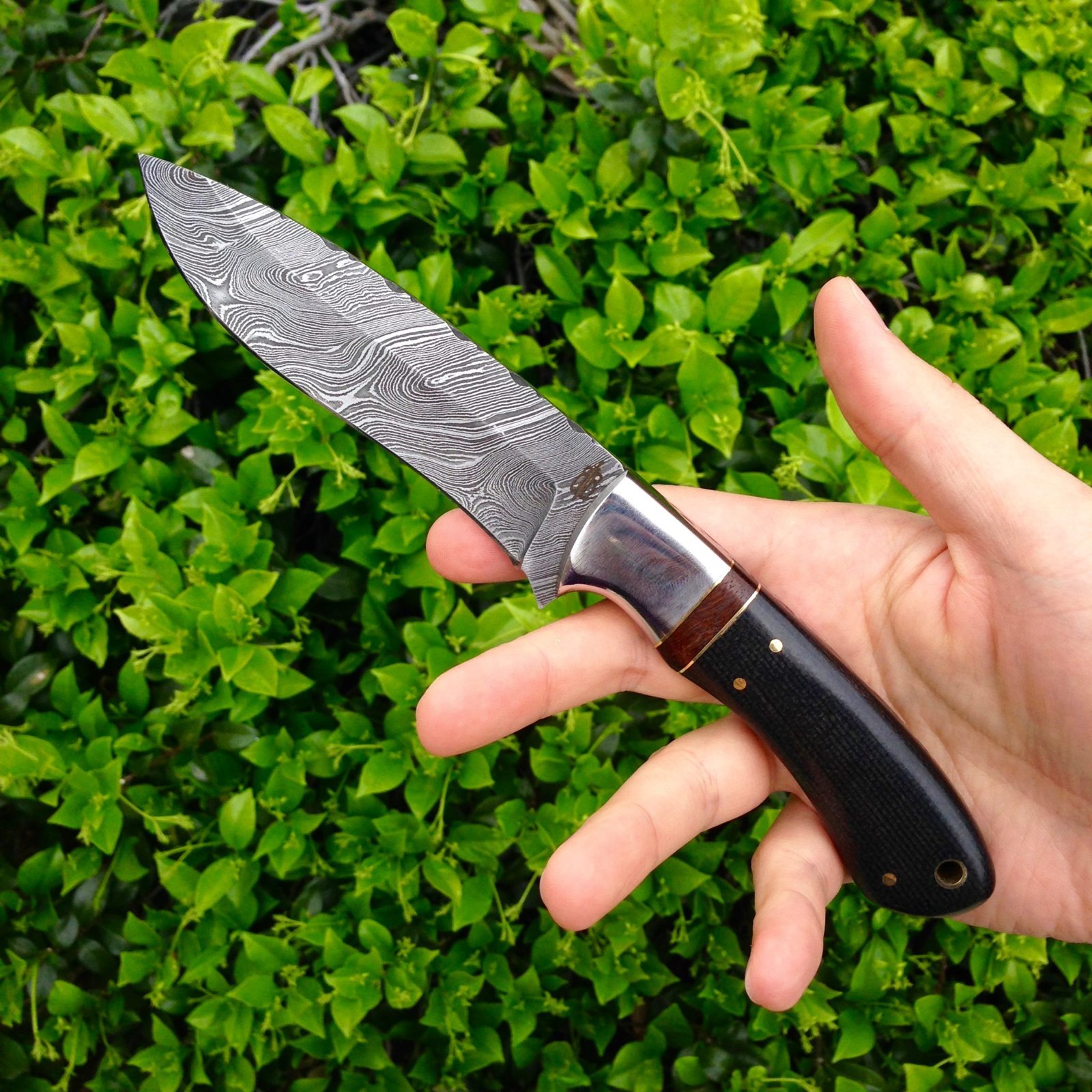
Genuine Damascus steel has complex, flowing patterns. Here’s what to look for:
- Depth: The pattern is not just on the surface. If you look closely (with a magnifying glass if possible), you’ll see the pattern goes below the surface, especially at the edge.
- Variation: The design should not repeat exactly. Fake patterns often have clear repeats or look printed.
- Edges: Check the spine, tang, and edge. On real Damascus, the pattern continues across these parts. On fakes, it may stop or look faded.
A simple test: Lightly sand a small, hidden area (like under the handle) with fine sandpaper. If the pattern disappears, it’s likely fake; if it remains, it’s genuine.
2. Feel The Surface
The texture of real Damascus is often slightly uneven, with small rises and dips where different steels meet. Run your finger gently along the blade:
- Textured feel: Real Damascus may have a subtle, wavy texture.
- Smooth but not flat: Some makers polish blades until smooth, but you should still feel tiny transitions.
Beware: Some fakes add artificial texture, so combine this with other tests.
3. Examine The Pattern At The Edge
A key sign of real Damascus is the pattern at the cutting edge. This is often hard to fake because:
- Real layers: The pattern continues all the way through, even at the edge.
- Fakes: Printed or etched patterns often stop before the edge or look blurry.
Look closely or use a magnifier to see if the wavy lines are visible right at the cutting edge.
4. Acid Etching Clues
Most modern Damascus blades are acid etched to reveal their patterns. Here’s what to check:
- Consistent color changes: Acid brings out light and dark areas in the steel. Real Damascus will have subtle variations, not just black and silver.
- Pattern depth: If you can scratch the dark parts and see no change, it’s only a surface coloring.
Some fakes use paint or shallow etching, so if the pattern scratches off easily, it’s not genuine.
5. Check The Price And Seller
While not a technical test, price and seller reputation matter:
- Low price: Be suspicious of knives labeled “Damascus” that are very cheap. The process takes time and skill, so real Damascus is rarely the cheapest option.
- Reputable sellers: Buy from well-known knife makers or stores with good reviews and clear product descriptions.
If a deal seems too good to be true, it probably is.
6. Look For The Maker’s Details
Many real Damascus knives are made by skilled blacksmiths who mark their work. Look for:
- Maker’s mark or logo: This shows pride in their craft.
- Details about the steel: Information on the types of steel used, the number of layers, or the forging process is a good sign.
Generic, mass-produced knives with no maker’s info are often fake.
7. Test The Blade’s Performance
If you can use the knife, check how it performs:
- Edge retention: Real Damascus holds a sharp edge longer than basic stainless steel.
- Toughness: Genuine blades flex slightly without breaking.
- Sharpness: They should cut smoothly through paper, vegetables, or rope.
However, performance alone is not a sure test, because some fakes use decent steel. Use it along with visual checks.
8. Research The Pattern Types
There are several traditional Damascus patterns, including:
- Ladder
- Twist
- Raindrop
- Feather
- Wavy (Watered)
Each has a unique look. If you see a “Damascus” blade with a pattern that looks unnatural or too regular (like a straight grid or perfect dots), it’s likely fake.
9. Compare With Known Examples
If possible, compare the knife to photos of authentic Damascus from trusted sources or museums. You can find many examples online, like at Wikipedia. Notice the natural flow and irregularity in real patterns.
Differences Between Real And Fake Damascus: Side-by-side
Sometimes, the best way to learn is to compare. Here’s a handy comparison:
| Feature | Real Damascus | Fake Damascus |
|---|---|---|
| Pattern Depth | Goes through the blade | Surface only |
| Pattern Consistency | Unique, flowing, irregular | Repeats, looks printed |
| Edge Pattern | Visible at cutting edge | Often missing or faded |
| Price | Higher (reflects effort) | Often lower |
| Maker’s Info | Often present | Usually generic |
| Feel | Slight texture or transition | Completely smooth or fake texture |
Simple At-home Tests For Damascus Knives
You don’t always need a lab to check a knife. Here are some easy tests you can try:
1. The Scratch Test
Use a small file or fine sandpaper. In a hidden spot, lightly scratch the blade:
- If the pattern vanishes, it’s likely a surface print or etch.
- If it remains, it’s likely real Damascus.
Note: Don’t damage an expensive knife. Only do this on a spot that will not be seen.
2. The Vinegar Test
Put a drop of vinegar on the blade and wait a few minutes. Wipe it off:
- On real Damascus, the pattern may darken slightly but stays visible.
- On fake knives, the pattern may smear, fade, or change color in odd ways.
3. Edge Examination
Use a magnifying glass to look at the very edge of the blade:
- Real Damascus has the pattern visible even at the thin edge.
- Fakes usually don’t.
These tests are not perfect, but they help you spot obvious fakes.
Credit: blog.knife-depot.com
How Modern Damascus Is Made
Modern Damascus is created using the pattern welding process. Here’s how it works:
- The maker selects two or more types of steel with different properties.
- The steels are stacked in layers, heated, and hammered together.
- The billet is folded, twisted, or manipulated to create patterns.
- The process is repeated, sometimes hundreds of layers are made.
- The blade is shaped, ground, and then acid-etched to reveal the pattern.
This process requires skill and experience. The final product is both beautiful and functional.
Common Types Of Fake Damascus
There are several ways that fakes are made to look like Damascus:
- Laser Etching: A laser burns a pattern onto the surface. It looks good but doesn’t go below the top layer.
- Acid Etching Only: A single steel blade is acid-etched to create a pattern, but there are no real layers.
- Printed Foil or Film: Some knives have a thin patterned film applied, which can wear off easily.
- Photo Transfer: A picture of a Damascus pattern is transferred onto the blade.
These methods are cheap and quick but do not produce the same qualities as real Damascus.

Credit: www.coldland.ca
Real Damascus In The Market: What To Expect
If you’re shopping for a real Damascus knife, here’s what you’ll likely see:
- Price: Real Damascus knives usually start at around $100 for small, simple blades and can go up to thousands of dollars for custom work.
- Brands: Well-known brands or custom makers often provide certificates or detailed information about the blade.
- Appearance: Each knife will have a unique pattern. If you see multiple knives with exactly the same pattern, they are probably fake.
Mistakes People Make When Buying Damascus Knives
Many buyers—especially beginners—fall into these traps:
- Focusing only on appearance: Some fakes look beautiful, but lack performance and durability.
- Ignoring the edge: The edge tells a lot about real Damascus.
- Trusting low prices: Real Damascus is labor-intensive. If it’s too cheap, question its authenticity.
- Missing the maker’s reputation: Buy from trusted sources with clear information.
- Believing all patterns are Damascus: Some patterns are simply laser-etched or acid-printed.
Credit: turwho.com
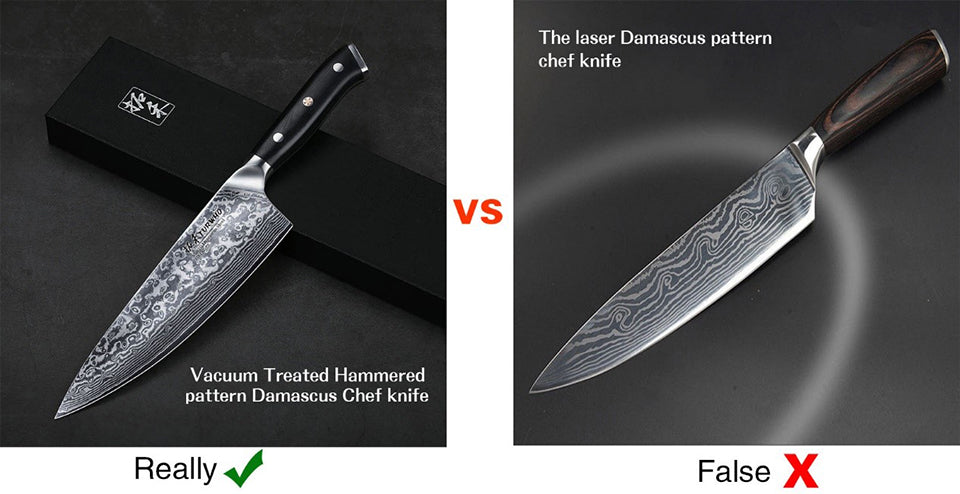
Examples Of Real Vs. Fake Damascus Patterns
To visualize the difference, here’s a comparison of pattern characteristics:
| Pattern Feature | Real Damascus | Fake Damascus |
|---|---|---|
| Waves and Swirls | Complex, random flow | Regular, repetitive |
| Depth of Pattern | Visible at all angles | Flat, only visible straight on |
| Pattern on Spine/Tang | Continues over edges | Stops or fades at edges |
| Layer Count | Visible layers, often stated | Not visible or mentioned |
How To Buy An Authentic Damascus Knife Online
Buying online adds extra risk. Here are tips for safe shopping:
- Look for real photos: Insist on clear, close-up photos of the blade, edge, and spine.
- Ask questions: Contact the seller and ask about the forging process, steels used, and pattern type.
- Check reviews: Read buyer reviews for clues about authenticity.
- Return policy: Only buy from sellers who offer returns if the knife is not as described.
Real Damascus knives are often sold by specialty shops, custom makers, or high-end retailers.
Key Factors That Affect Damascus Quality
Not all Damascus blades are equal. Quality depends on:
- Steels used: The mix of hard and tough steels creates better performance.
- Layer count: More layers don’t always mean better, but at least 60-100 layers are common in good knives.
- Maker skill: A skilled maker creates stronger, sharper blades.
- Heat treatment: Proper heat treatment is crucial for strength and edge retention.
- Pattern clarity: Well-defined, attractive patterns show good craftsmanship.
Non-obvious Insights Most Beginners Miss
Here are two important facts most new buyers don’t know:
- Pattern can be manipulated: Skilled makers can create complex patterns (like “feather” or “mosaic”) that look almost unreal. Don’t assume simple patterns are always better—ask about the process.
- Not all Damascus is equal: Even real Damascus can be poor if made with low-quality steel or bad heat treatment. Always check the reputation of the maker.
What To Do If You Already Own A “damascus” Knife
If you suspect your knife is fake, here’s what you can do:
- Try the at-home tests above (scratch, vinegar, edge).
- Research the maker or brand online.
- Ask a local knife expert or blacksmith for help.
- Use your knife! Even if it’s fake, it may still be a good tool.
If you discover it’s a fake, don’t feel bad—use it for practice, or as a lesson for your next purchase.
Damascus Steel Care Tips
Whether real or fake, Damascus knives need proper care:
- Dry after use: Most Damascus will rust if left wet.
- Oil the blade: Light oil helps prevent rust.
- Store safely: Keep in a dry place, avoid leather sheaths for long-term storage.
- Sharpen carefully: Use a fine stone or send to a pro.
Real Damascus is tough, but not magic—it rewards care with years of use.
Frequently Asked Questions
What Is The Difference Between Real And Fake Damascus Steel?
Real Damascus is made by forging layers of different steels together, creating unique, deep patterns that go through the blade. Fake Damascus usually has a surface pattern made by etching, printing, or laser, with no real layered structure. Real Damascus also offers better strength and edge retention.
Can A Fake Damascus Knife Still Be Good Quality?
Yes, some fakes are made with decent steel and work well as knives. However, they lack the history, uniqueness, and layered benefits of real Damascus. Always check if you’re paying a fair price for what you get.
Does Real Damascus Steel Rust?
Unless made from stainless steel, most real Damascus will rust if not cared for. Always keep your blade dry and apply a light oil after cleaning. Rust can damage both appearance and performance.
Are There Any Certified Tests For Real Damascus?
Some experts use acid etching or metallurgical microscopes to confirm real Damascus. These tests reveal the layered structure inside the blade. For most buyers, the visual and at-home tests in this article are enough.
Where Can I Find Real Damascus Knives?
Look for custom knife makers, reputable brands, or specialty shops. Avoid suspiciously cheap deals or unknown sellers. For more information, you can visit Wikipedia.
A real Damascus knife is more than just a tool—it’s a piece of history and art. By learning to spot the real thing, you can enjoy the quality, beauty, and tradition of this legendary steel for years to come. With the knowledge from this guide, you’re now ready to identify, buy, and care for genuine Damascus knives with confidence.