
Testing how sharp your knife is might sound simple, but there’s a lot more to it than just slicing a tomato. Whether you’re a home cook, a professional chef, or someone who uses knives for outdoor activities, knowing if your knife is really sharp changes everything.
A sharp knife saves time, gives better results, and is much safer to use. In this guide, you’ll learn practical methods, expert tips, and important safety advice on how to test the sharpness of a knife. You’ll also discover mistakes most people make and how to avoid them.
By the end, you’ll feel confident checking any knife, from kitchen blades to pocket knives.
Why Knife Sharpness Matters
A sharp knife is not just about speed or clean cuts. It’s about control and safety. Dull knives are more likely to slip, which can lead to accidents. Sharp knives, on the other hand, require less pressure and let you cut exactly where you want. Food preparation is easier, ingredients look better, and your hand gets less tired.
Many people think a knife is sharp if it cuts food, but that’s not always true. Some foods, like tomatoes or onions, need a very sharp edge, while others, like bread, can be sliced even with a dull blade. Real sharpness means the knife easily slices through things with little effort, no crushing, and no tearing.
Common Signs Of Dull Vs. Sharp Knives
To test knife sharpness, you first need to know the difference:
- Sharp knife: Cuts cleanly, no force needed, slices paper or tomato easily, feels smooth when slicing.
- Dull knife: Struggles with soft items, needs pressure, slips off food, crushes or tears instead of slicing.
But to be sure, you need to test it properly.
Basic Safety Before Testing Sharpness
Testing sharpness means handling the knife in ways that might risk your fingers. Always remember:
- Keep your fingers away from the blade’s path.
- Work on a stable surface with good lighting.
- Never test on skin; even a dull knife can cut you.
A good tip: Use gloves with grip, especially if you’re new to handling knives.
10 Practical Methods To Test Knife Sharpness
There are many ways to check how sharp a knife is. Some use common kitchen items, others rely on observation or special tools. Here are the most reliable methods:
1. Paper Test
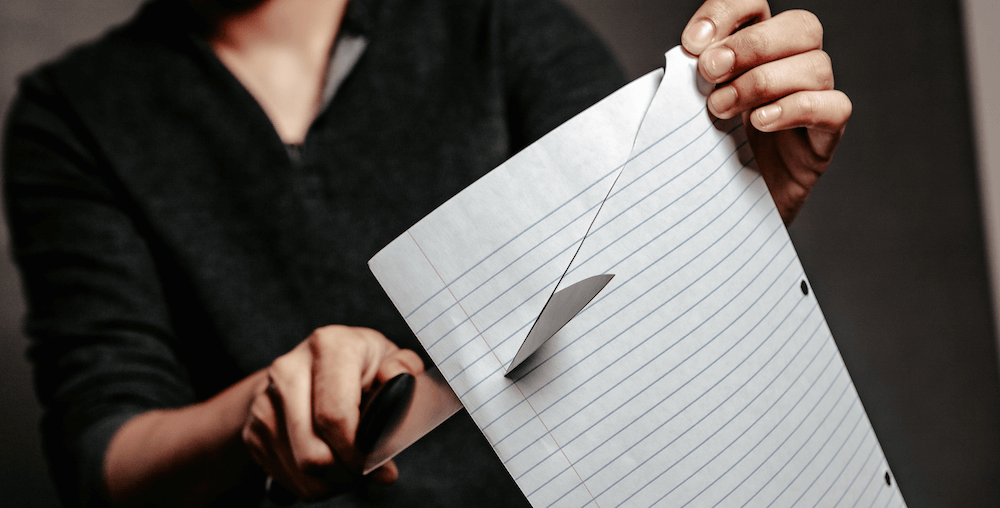
One of the most popular and visual ways to test a knife’s sharpness is the paper test.
- Hold a piece of printer paper upright.
- Place the knife’s edge at the top of the paper.
- Slice downward, letting the knife’s weight do the work.
A sharp knife will slice smoothly and quietly, with almost no resistance. A dull knife will tear, snag, or fold the paper.
Tip: Use standard printer paper. Thicker paper can make even dull knives seem sharp.
2. Tomato Test
Tomatoes have thin, slippery skin and soft flesh, making them a classic test.
- Place a tomato on a cutting board.
- Try to slice through the skin without pushing down.
A sharp knife will pierce and glide through. A dull knife slides off or squashes the tomato before cutting.
3. Arm Hair Shaving Test
This method is common among knife enthusiasts, but use it carefully.
- Gently try to shave a few hairs from your arm.
- Do not press hard; just let the knife glide.
If the knife easily shaves hair, it is extremely sharp. If it skips or pulls, the edge needs work.
Warning: Only do this if you’re experienced and careful.
4. Fingernail Test
This test checks the very edge of the knife.
- Hold the blade at a slight angle to your thumbnail.
- Gently touch the edge to the nail.
A sharp knife will “bite” and not slide off. A dull knife will slip or feel rounded.
5. Onion Skin Test
Onion skin is tough and slippery.
- Try to slice through the dry skin without crushing the onion.
A sharp knife cuts smoothly, while a dull one slides or crushes.
6. Magazine Or Receipt Paper Test
Glossy or thin paper makes this harder.
- Try slicing through a magazine page or a store receipt.
If the knife can cut it cleanly, the edge is razor-sharp.
7. Visual Light Reflection Test
This method uses light to see dull spots.
- Hold the blade under a bright light.
- Look at the edge: A dull knife will show shiny, flat spots where it’s rounded.
A sharp edge will not reflect light; it will look like a thin, dark line.
8. Free-hanging Hair Test
This is a test for extreme sharpness, usually for straight razors.
- Hold a hair between your fingers.
- Try to slice it in the air.
Most kitchen knives won’t pass this, but if yours does, it’s extremely sharp.
9. Vegetable Slicing Test
Try slicing a carrot or potato with gentle pressure.
- A sharp knife will glide through, making thin, even slices.
- A dull knife will require force and make uneven cuts.
10. Cutting Sound Test
Listen as you cut.
- A sharp knife makes a soft, smooth sound.
- A dull knife sounds rough or makes a scraping noise.
Non-obvious insight: Some foods, like cooked meat, can “hide” dullness because even a blunt edge will cut if you use enough force. Always test with foods that need a keen edge.
Comparing Knife Sharpness Tests
To help you see which test fits your needs, here’s a quick comparison:
| Test Name | Best For | Risk Level | Accuracy |
|---|---|---|---|
| Paper Test | Kitchen knives, all users | Low | High |
| Tomato Test | Kitchen knives | Low | Medium |
| Hair Shaving Test | Enthusiasts, razors | High | Very High |
| Light Reflection | All knives | None | Medium |
| Onion Skin | Kitchen knives | Low | Medium |
How To Choose The Right Test For Your Knife
Selecting the best test depends on your knife type and how sharp you need it. Here’s what to consider:
- Kitchen knives: Paper test, tomato test, and onion skin test are most useful.
- Outdoor knives: Paper test and visual test are fast and safe.
- Straight razors: Hair shaving and free-hanging hair tests show the finest edge.
- Utility knives: Look for clean slicing through cardboard or rope.
Non-obvious insight: Sometimes, you need to use more than one test. For example, a knife might pass the paper test but still struggle with tomatoes, showing that the edge is sharp but not polished.
Mistakes People Make When Testing Knife Sharpness
Testing sharpness seems easy, but many people do it wrong. Here’s what to avoid:
- Testing on fingers or skin: Never slide the blade against your finger to check sharpness. Even a dull knife can cut.
- Using the wrong paper: Cardboard or thick paper can make dull knives seem sharp. Use thin, standard paper for accuracy.
- Applying too much force: If you push hard enough, almost any knife will cut. True sharpness means minimal effort.
- Ignoring edge damage: Small chips or bends will make a knife feel sharp in one spot but dull in another.
- Testing only one spot: Check the entire edge, not just the middle. Many knives are sharp at the tip but dull at the heel, or vice versa.
How Sharp Should Your Knife Be?
Not every knife needs a “razor” edge. The right sharpness depends on the job:
- Chef’s knives: Should cleanly slice tomatoes, onions, and paper.
- Steak knives: Need a sharp edge for cooked meats but not for delicate slicing.
- Utility knives: Should cut rope, plastic, and cardboard easily.
- Outdoor or survival knives: Need enough sharpness to cut wood, rope, or food but also must be durable.
Practical tip: For most kitchen tasks, a knife that passes the paper test is sharp enough. For sushi or fine work, aim for the tomato or hair shaving test.
Credit: knifeaid.com
Tools To Measure Knife Sharpness
Besides hands-on tests, there are special tools that measure sharpness more scientifically.
Edge-on-up Sharpness Tester
This device measures the force needed to cut a thin test medium. It gives a number (in grams) that shows how sharp the knife is.
- Below 200 grams: Extremely sharp (razor level)
- 200-400 grams: Very sharp (kitchen use)
- Above 400 grams: Needs sharpening
Magnifying Glass Or Loupe
A 10x loupe lets you see the edge’s condition. Chips, rolls, or flat spots mean dullness.
Professional Testing Machines
In labs, devices test sharpness with special materials and sensors. While not for home users, they set standards for knife makers.
Non-obvious insight: Even without fancy tools, combining visual inspection with cutting tests gives a very accurate picture of sharpness.
How Often Should You Test Knife Sharpness?
Testing too often is not necessary. Here’s a good schedule:
- Home cooks: Test monthly, or when slicing feels harder.
- Professional chefs: Test weekly or before big prep sessions.
- Outdoor users: Test before and after long trips.
You should also test after sharpening, honing, or if the knife is dropped.
What To Do If Your Knife Is Not Sharp
If your knife fails the sharpness test, it’s time to fix it.
- Honing: Use a honing rod to realign the edge. This works if the knife is only slightly dull.
- Sharpening: Use a whetstone or professional sharpener to grind a new edge.
- Professional service: For expensive knives, consider a pro sharpening service.
- Replace: If the knife is chipped or damaged, replacement might be needed.
Tip: Honing does not sharpen, it only straightens the edge. Sharpening actually removes metal and creates a new edge.
Knife Edge Types And Their Impact On Sharpness Testing
Different knives have different edge shapes. This affects how you should test and what results to expect.
| Edge Type | Common Use | Best Test Method |
|---|---|---|
| Flat ground | Chef’s knives | Paper, tomato |
| Serrated | Bread knives | Cutting bread, visual |
| Convex | Outdoor knives | Paper, wood shaving |
| Chisel grind | Japanese blades | Paper, tomato |
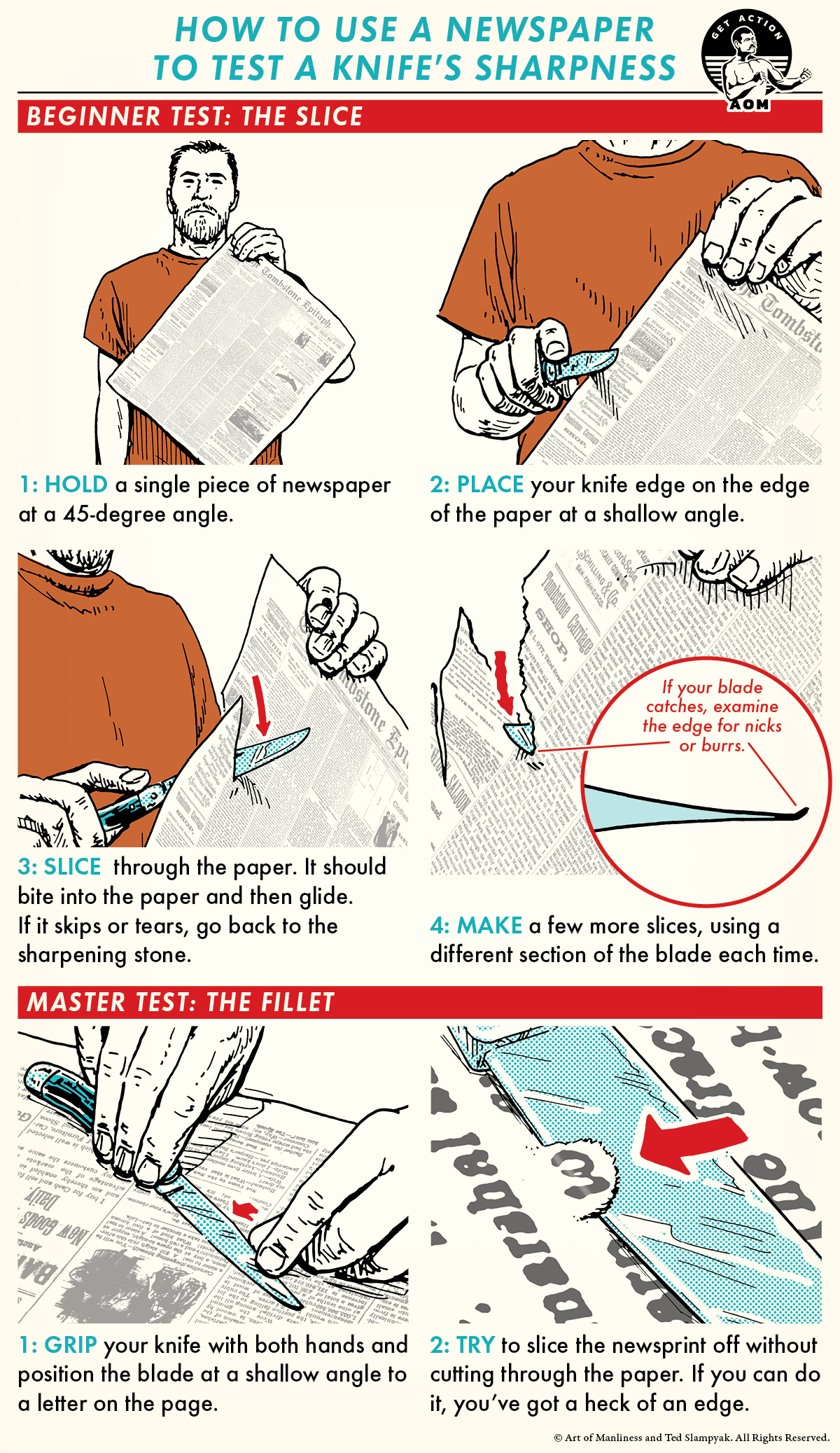
Non-obvious insight: Serrated knives are tested differently. They often “grab” food even when dull, so test by cutting crusty bread or rope, not paper.
Credit: www.artofmanliness.com
How To Maintain Sharpness After Testing
Once your knife is sharp, proper care keeps it that way.
- Clean after use: Wash and dry the blade by hand. Dishwashers dull knives quickly.
- Use a cutting board: Wood or plastic boards are best. Avoid glass, stone, or metal.
- Store safely: Use a knife block, sheath, or magnetic strip. Avoid tossing knives in a drawer.
- Hone regularly: A few swipes on a honing rod before each use helps maintain the edge.
Practical tip: Never cut frozen food or bones with a fine-edged knife. It will damage the edge quickly.
Advanced Methods: Testing With Specific Materials
Sometimes you need to test sharpness for special tasks:
Rope Cutting
Outdoor and rescue knives should cut rope with one clean slice. Try slicing through 1/4 inch rope with gentle pressure.
Cardboard Slicing
Utility knives should slice through cardboard without snagging. Dull knives will crush or tear the material.
Paracord Test
A sharp outdoor knife will slice paracord in one smooth motion, not requiring sawing.
Example: A rescue worker might test sharpness by cutting seat belts, a challenging but real-world test.
How To Record And Track Knife Sharpness
For professionals or enthusiasts, tracking sharpness helps manage maintenance:
- Keep a log: Write the date and test results after each sharpening.
- Take photos: Visual records show how the edge changes over time.
- Note the test: Mark whether the knife passed paper, tomato, or hair tests.
This helps you spot patterns—maybe your knives dull quickly because of your cutting board or technique.
Sharpness Testing For Different Knife Uses
Not all knives are created for the same tasks, so adjust your expectations:
- Sushi knives: Must pass the tomato and hair tests for clean fish slicing.
- Camping knives: Paper test and rope test are more important than tomato.
- Butcher knives: Should slice meat smoothly, but don’t need to pass hair shaving.
- Pocket knives: Should slice paper and cardboard easily.
Matching the test to the knife’s job saves time and avoids over-sharpening.

Credit: www.sharpeningsupplies.com
The Science Behind Sharpness
Knife sharpness is about the angle and finish of the edge.
- Lower angle (15 degrees): Razor sharp, but less durable.
- Higher angle (20-25 degrees): Less sharp, but tougher.
A polished edge slices better, while a toothy (rough) edge grips food better.
Example: Japanese knives often have a lower angle and are sharper, but need more care.
Comparing Sharpness: New Knives Vs. Used Knives
Many people think new knives are always sharper. That’s not always true.
| Knife Condition | Expected Sharpness | Test Result |
|---|---|---|
| New, high-end | Very sharp | Passes paper, tomato |
| New, budget | Medium sharp | Passes paper, struggles on tomato |
| Used, well-maintained | High sharpness | Passes all tests |
| Used, neglected | Dull | Fails most tests |
Non-obvious insight: Some budget knives are not sharp even when new. Always test before use.
Cultural Differences In Testing Knife Sharpness
Different countries and chefs have their own traditions:
- Japanese chefs: Use tomato, paper, and even hair tests for sushi knives.
- Western chefs: Focus on paper and vegetable slicing.
- Butchers: Often test by slicing meat against the grain.
Learning from different cultures can help you find a test that matches your knife.
When To Stop Sharpening
Over-sharpening can wear out a knife. If your knife passes the key tests for your needs, stop sharpening. Too much grinding reduces the blade’s life.
Practical tip: If your knife slices paper and tomatoes easily, it’s sharp enough for most kitchen work.
Real-world Example: Professional Chef’s Knife Testing Routine
Chef Maria, who runs a busy restaurant, tests her knives every Monday before prep begins.
- She slices paper—if it glides, she moves to the next knife.
- For her sushi knife, she tries the tomato test.
- If any knife struggles, she hones it. If still dull, she sharpens it fully.
By the end of the week, she repeats the process. Her knives stay sharp, safe, and ready for anything.
Frequently Asked Questions
How Do I Know If My Knife Is Too Dull To Use?
If your knife can’t slice through standard printer paper or crushes soft foods like tomatoes, it’s too dull. You’ll need to sharpen it before further use.
Is The Paper Test Reliable For All Knife Types?
The paper test works well for most kitchen and utility knives. For serrated or very thick blades, other tests like rope or bread slicing are better.
Can I Test Knife Sharpness Without Cutting Anything?
Yes. The visual light reflection test lets you spot dull spots without cutting. Also, gently touching the edge to your thumbnail can show if it “bites” or slips.
How Often Should I Test Knife Sharpness?
For home cooks, once a month or when you notice cutting gets harder is enough. Professionals should check more often, such as weekly or after sharpening.
What’s The Safest Way To Test Knife Sharpness For Beginners?
The paper test is safest. Hold the paper with one hand and slice downward, keeping fingers clear of the blade’s path. Never test by running your finger along the edge.
Testing the sharpness of a knife is more than a quick check—it’s about working smarter, safer, and with confidence. Use the right method for your needs, combine visual checks with cutting tests, and always put safety first. With these skills, you’ll get the most from your knives, whether in the kitchen, the field, or the workshop. For more on knife safety and sharpening, visit the Knife Sharpening Wikipedia page.